An unusual climate of unpredictability surrounds Costa Rica’s electoral process, challenging the deeply rooted stability that characterized its political life for decades. The repetition of surprising outcomes in the last three presidential races has transformed political analysis into an exercise in humility, where polls have lost their oracular role and any forecast must be tempered with skepticism.
This volatile scenario stands in sharp contrast to the country’s extraordinary institutional legacy. Home to one of the longest-standing and most stable democracies in Latin America, Costa Rica built its identity on non-negotiable pillars: the uninterrupted holding of elections, alternation in power under clear rules, and the historic 1948 decision to abolish the army, opting instead for the supremacy of law and civil means to resolve conflicts.

Within this framework, the current moment of turbulence is not an isolated phenomenon but rather part of a broader regional current. As in other Latin American nations, populism has found fertile ground in Costa Rica. Traditional political parties—once essential channels of representation and ideology—have seen their influence wane in the face of the rise of personalist figures who build power by appealing directly to voters’ emotions, often relegating structured government programs to the background.
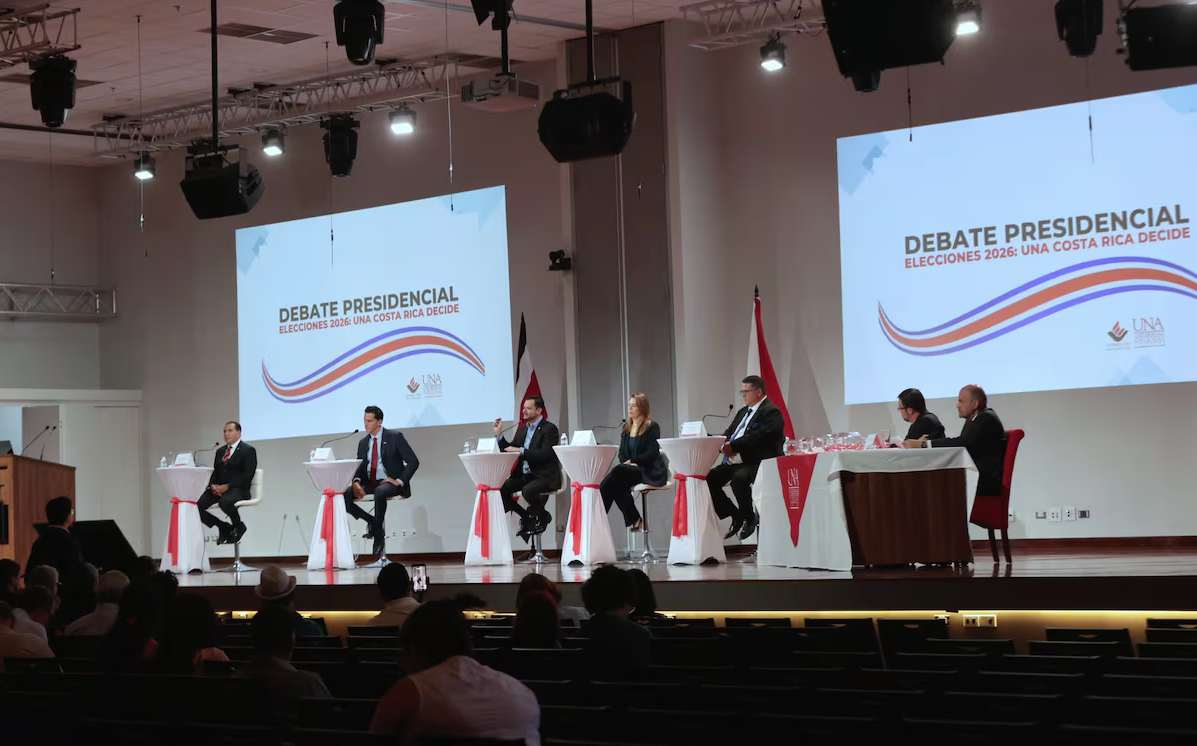
The upcoming contest to be held on February 1 exemplifies this new complexity. A crowded field of twenty presidential aspirants does not translate into a close race. Polls give a wide lead to the ruling party’s candidate, Laura Fernández of the Partido Pueblo Soberano, who tops voting intentions. Far behind appear Álvaro Ramos of the Partido Liberación Nacional, Ariel Robles of Frente Amplio, Claudia Dobles of the Coalición Alianza Ciudadana, and Fabricio Alvarado of Nueva República, while other candidacies languish with statistically irrelevant support.
The explanation for this dominance in voter preferences is multifaceted. It stems from a permanent and sophisticated government communication strategy, executed intensively on social media, which has succeeded in transferring an unprecedented level of presidential popularity to the official candidate. A decisive advantage further reinforces this momentum: access to resources that enable an omnipresent campaign, in contrast to an opposition largely weakened by severe funding shortages.
That opposition also suffers from paralyzing fragmentation. The proliferation of twenty candidacies is not synonymous with democratic richness, but rather evidence of deep dispersion that atomizes discourse, disorients citizens, and paradoxically simplifies the race by concentrating real attention on very few actors. The chronic inability to build bridges and forge consolidated programmatic alliances reinforces this landscape, operating as an objective factor that favors the candidate who arrives with the unified backing of the state machinery.
What is at stake in these elections goes far beyond the mere appointment of individuals to public office. The outcome could reconfigure the country’s political and institutional landscape for decades to come, opening the door to substantial state reforms, changes to the political system, and even the possibility of a constituent process, all determined by the balance of forces emerging from the ballot box.
In this context, the battle for the Legislative Assembly takes on critical importance. Although traditionally difficult to predict, everything points to a significant redistribution of seats: the ruling party emerges with concrete chances of substantially expanding its caucus, and the left shows signs of growth, while the traditional center and right face a contracting outlook. Securing a legislative majority—whether alone or through coalitions—would grant the next government transformative power capable of altering the existing institutional balance.
These dynamics have led analysts to draw cautious, never equivalent, comparisons with previous junctures in countries such as Venezuela, Nicaragua, or El Salvador. Attention focuses on shared patterns: legitimacy derived from a popular majority, erosion of established parties, a disarticulated opposition, and a potential progressive concentration of power in the executive—processes that in other contexts also began with broad electoral mandates and within formal legal frameworks.
However, assigning a definitive outcome to these trends would be premature. Recent Costa Rican electoral history serves as a constant reminder of the limits of prediction. Polls and readings of social media outline contours, not destinies, and a considerable segment of the electorate reserves its decision for election day itself, thereby preserving an essential margin of surprise.
Costa Rica approaches a defining moment in which the forces of fragmentation and uncertainty will test the strength of its democratic tradition. The electoral process will not only decide who occupies positions of power, but will also measure the very health of its political system.
The true victory, in this context, will not belong solely to the candidate who attains a majority, but to the nation’s collective capacity to navigate this period of transition while preserving the pillars of institutional balance, civil dialogue, and respect for norms that for more than seventy years have guaranteed stability and social peace. The challenge ultimately lies in renewing the democratic contract without fracturing its foundations.
Autor

Political scientist, former Advisor to the Legislative Assembly of Costa Rica, former UNDP official, academic and researcher at the School of Political Science of the University of Costa Rica. Director of the opinion publication La Revista CR.