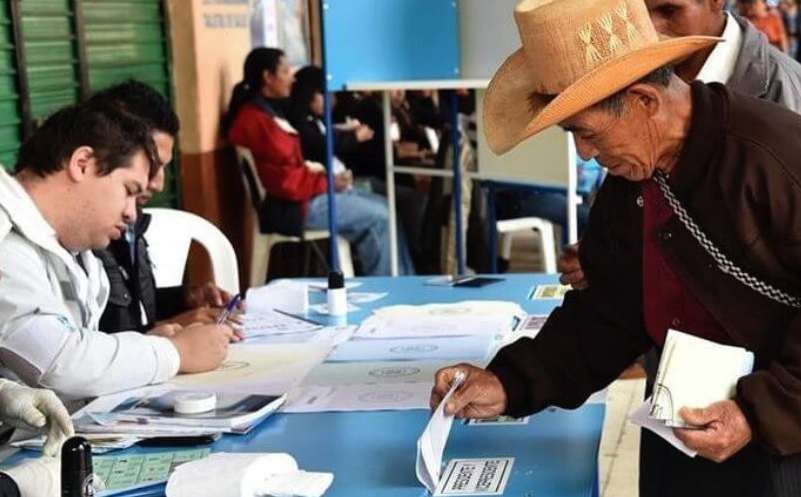
This year will be crucial for Guatemala. The country’s highest authorities will select the individuals who will occupy what are known as “second-degree offices.” The positions at stake are numerous, ranging from magistrates of the Supreme Electoral Tribunal (TSE) to the head of the Public Prosecutor’s Office. These processes are marked by the institutional shortcomings of the selection mechanism and by the fact that they take place in a pre-electoral year. Added to this is the current tension between political factions that favor the continuity of an existing system and the reformist drive of emerging groups.
Second-degree offices in Guatemala
In the Guatemalan political system, second-degree offices are understood as those that, although not elected by popular vote, are fundamental to the fulfillment of state functions. Likewise, they play a key role in safeguarding democracy, promoting justice, and applying the principle of checks and balances among institutions. Given their relevance, groups from different spheres of power have historically influenced the selection processes. 2026 will be no exception.

The offices in dispute are the magistracies of the TSE, the magistracies of the Constitutional Court (CC), the position of Attorney General and Head of the Public Prosecutor’s Office, and the post of Comptroller General of Accounts. The TSE magistrates selected in 2026 will bear the responsibility for overseeing the general elections of the following year.
Additionally, in 2026 the process to elect the rector of the country’s only public university—the University of San Carlos of Guatemala (USAC)—will take place. Although this appointment is not decided by the president or Congress, it is also highly relevant. The reason is that USAC is the only university in the world with the authority to propose legislative initiatives. Moreover, it holds various avenues of influence within public administration and Guatemalan politics.
The nomination commissions mechanism
It is important to note that most second-degree elections are based on the mechanism of nomination commissions. These commissions are temporary bodies made up of individuals from different sectors, with the purpose of preselecting and assembling a slate of candidates. They serve as a filter so that the competent authority receives a list of the best profiles and selects the most suitable one.
In the case of the nomination commission for TSE magistrates, it presents a slate of 20 candidates to Congress, which, with 107 votes (a two-thirds majority), selects five full magistrates. In the case of the Attorney General, the deciding authority is the president, who chooses from a slate of six candidates presented by the respective nomination commission. For the Comptroller General of Accounts, the commission proposes a slate of six candidates, from which Congress elects one by absolute majority.
However, although the commissions originally represented the involvement of other actors in decision-making, they have become a means for the institutionalization of parallel groups’ interests and an excuse to co-opt key institutions. This has been occurring with the Bar Association (Colegio de Abogados y Notarios, CANG), whose Assembly elects a principal representative to the TSE nomination commission and directly elects one magistrate to the CC.
An academy without legitimacy to participate
A similar situation is observed in the academic sector. For example, in the selection of the five full magistrates of the CC, one is elected directly by USAC. Unfortunately, the current rector of that institution has been accused of illegitimacy and of promoting fraud in his favor during the 2022 rectoral elections. As if that were not enough, the current rector presides over the nomination commission for TSE magistrates, as established by the Electoral and Political Parties Law.
Private universities are not far behind. Both deans of law schools and rectors of private universities play an important role in the nomination commissions. Evidence of this is that the nomination commission for the Attorney General of the Republic is made up of all the deans of faculties of Legal Sciences in the country. A similar situation occurs with the commission for the Comptroller General: it is composed of the deans of faculties of public accounting and auditing.
Unfortunately, the ideal of involving academia in order to choose the best candidates has been circumvented through the creation of new universities. In recent years, there has been an increase in the number of private universities. This has made it easier for certain political actors to influence the nomination commission processes, which in turn has eroded the credibility of higher education in the country.
Tensions and electoral scenarios
To all these factors and institutional weaknesses is added the sociopolitical context. It is evident that there is tension between factions seeking to perpetuate a system aligned with their interests and groups with a reformist vocation for power. The former are associated with what in Guatemala is called “the pact of the corrupt,” while the latter are linked to anticorruption movements orbiting around the ruling party, Movimiento Semilla.
Amid all this, there is a clear intention on the part of political actors to prevent the reformist faction—whether through the Movimiento Semilla party or another organization—from competing in the upcoming elections. This heightens the importance of the aforementioned processes, as those selected for second-degree offices will have the final say in many decisions concerning the 2027 elections.
Be that as it may, the rejection by the political opposition of President Bernardo Arévalo and his allies will surely become more intense. As a result, greater polarization, obstruction of the government agenda, and ongoing political crises are anticipated, which, with regard to public affairs, translates into an unsustainable scenario of ungovernability.
The active participation and oversight of civil society organizations, the international community, and the citizenry at large will be vital in these selection processes. Guatemala must be at the center of regional attention not only because high-ranking authorities are being chosen, but because, from a forward-looking perspective, democracy, the rule of law, and justice in the country are at stake.
Autor

Political scientist from the University of San Carlos of Guatemala. Researcher on youth issues at the Association for Research and Social Studies (ASIES) and coordinator of advocacy projects for the Youth for Transparency Foundation in Guatemala.