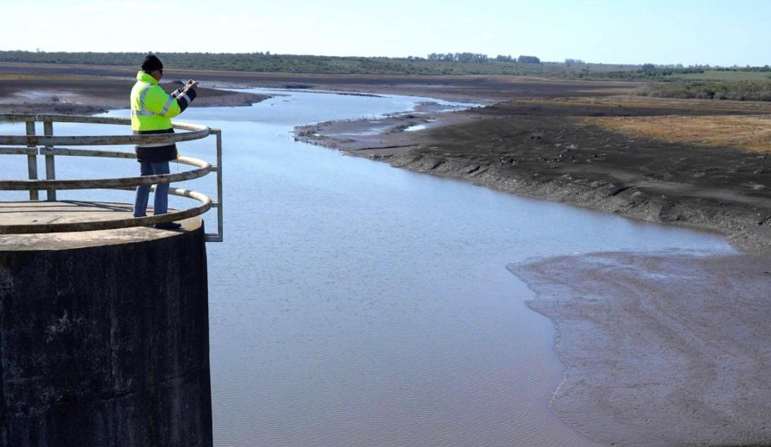
In recent years, at least two South American metropolises have experienced water shortages due to issues of adequate quality or quantity. In 2020, the Metropolitan Region of Rio de Janeiro faced a water emergency caused by contamination with geosmin, a non-toxic organic compound produced by algae, which made the water’s odor “unpleasant,” according to residents, and exposed a structural crisis in water supply and sanitation. And in 2023, the Metropolitan Area of Montevideo went through a crisis that put approximately 1.5 million people at risk, due to drought, increased water salinity, doubts about potability, and a widespread sense of vulnerability.
At first glance, the crises seem different: one due to excess sodium chloride, the other due to bad odor. But there is a common pattern: disputes over the water management model, pressure from the private sector (interested in entering the distribution market), management crises stemming from a predominantly centralized model with little participation and strong power asymmetries in governance, and official narratives that sought to mask responsibilities. These were some of the reflections that emerged from the roundtable “What comes first: water crises, hydraulic solutions, or the involvement of private companies? Reflections on Montevideo and Rio de Janeiro,” which brought together experts María Selva Ortiz, Álvaro Briano, and Ana Lúcia Britto, within the framework of the project “Hydrosocial dimensions of the water crisis in the Metropolitan Region of Montevideo,” alongside PRIDES (Faculty of Social Sciences) and the Unit of Science and Development (Faculty of Sciences) of the University of the Republic.

Explaining the causes as a natural process
Official discourse and certain media outlets placed responsibility on drought, climate variability, and environmental phenomena such as algal blooms or geosmin. In Montevideo, the increase in water salinity—redefined as “drinkable” (a new category used to replace that of potable water)—and water restrictions were explained as a consequence of the low flow of the Santa Lucía River (which empties into the Río de la Plata estuary) and the prolonged drought. However, this diagnosis omits the decisions that led to delays in investments, lack of maintenance of hydraulic networks, difficulties and delays in implementing the planned management measures for the basin, limited social participation, among other factors.
Similarly, in Rio de Janeiro, the chronic contamination of the Guandu River basin—source of water for more than 9 million people—the historical underinvestment in water and sanitation, and a management marked by negligence preceded the geosmin episode. Added to this was an understanding of the problem as strictly technical, the depoliticization and low level of social participation in management, marked by “intentionally” deficient decisions. This included the failure to interrupt raw water intake when conditions were not suitable for treatment, with the consequent distribution of water with altered organoleptic characteristics (odor and taste) throughout the metropolis. The public narrative did not seek to minimize alarm (on the contrary, it helped amplify it), with the crisis functioning as one of the factors that sustained and legitimized an already ongoing privatization agenda, initiated after the enactment of Law No. 14,026/2020.
In short, in both cases the crises were partially explained as natural or technical phenomena, even though they had deeply political and institutional roots.
Hydrosocial scarcity and opportunities for privatization
If we seek to understand these crises through the concept of hydrosocial scarcity, formulated by expert Ana Lúcia Britto, we can see them not as environmental or natural consequences, but as the product of institutional decisions, development models, inequalities, and power relations. In an ideal context, water would be guaranteed as a human right and managed in a participatory manner; however, when the state fails to make necessary investments, prioritizes economic interests, or underestimates social participation, the result is the scarcity that affected millions of people.
In the Uruguayan case, the vulnerability of supply today depends on long-term investment decisions, the management model chosen for the Santa Lucía basin (which prioritizes the agricultural productive sector), and the maintenance of the distribution network. In Rio de Janeiro, scarcity arises from a web of territorial inequalities, concentration of supply, institutional fragility, and a centralized technical model, along with historically low investment in infrastructure and shortcomings in water and sanitation coverage. These factors were compounded by the economic and fiscal crisis of the state of Rio de Janeiro, which favored the privatization of the sector.
It is often argued that water crises can become windows of opportunity to reconfigure water governance. The case of Rio shows how contamination was used to delegitimize the public water and sanitation company (CEDAE), which, together with other factors, led to the concession of services to private operators in 2021.
In Montevideo, the 2023 crisis reignited the debate over large hydraulic works, such as the Neptuno Project, proposed by a consortium of private companies and approved during the previous government, defended as structural solutions under the banner of “water security.” Unlike the case of Rio de Janeiro, the privatization agenda in Uruguay was partially contained, largely due to social mobilization and political change, which is currently renegotiating other hydraulic projects with the private consortium.
Final considerations
Water crises reveal what our societies prioritize: who decides, who benefits, who is left out, and what kind of relationship we imagine with a resource that is fundamental for life.
Twenty-first-century metropolitan water crises are not defined solely by the water that is lacking or by the poor quality of the water that reaches households. They are defined by the way in which states, companies, and societies mobilize—or fail to mobilize—political capacities to confront them. The cases of Montevideo and Rio de Janeiro show that what is at stake is not only water management; it is also the model for managing watershed territories, sanitation infrastructure, and the urban environment. In both cases, the technical and the political cannot be separated: the water crisis is not merely an environmental (or natural) problem or a technical failure, but a sign of major shortcomings in a management model.
Political cycles change, but the hydraulic paradigm remains. Whether through inherited contracts, regulatory flexibilization, or new works presented as indispensable for water security, crises end up consolidating the same model that privileges infrastructure projects and private participation over democratizing alternatives for managing a common good. In the face of this situation, we must ask ourselves: can crises also lead to strengthening water management as a common good and a human right? Or will they always end up being a pathway to solutions that involve private sectors with an interest in water supply services?
Autor

Professor and researcher of the Research Program in Sustainable Development of the Faculty of Social Sciences of the University of the Republic (Uruguay). PhD in Environmental Sciences from the University of São Paulo (Brazil).

Professor of the Science and Development Unit of the Faculty of Sciences of Udelar. Associate Researcher at the SARAS Institute. PhD in Natural Resources Management and Environment from the University of Manitoba (Canada).

PhD in Urban and Regional Planning. Professor at the Federal University of Rio de Janeiro.