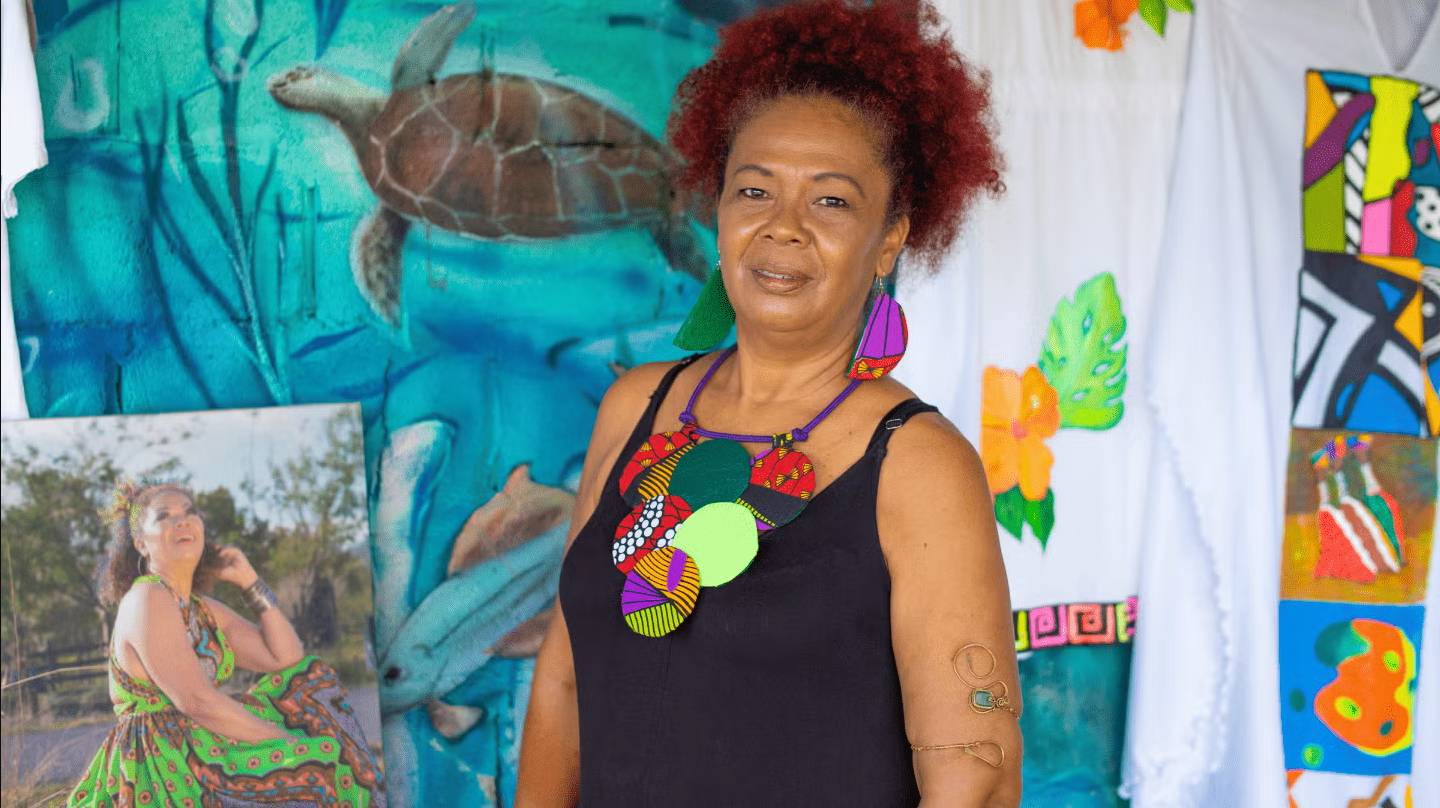
Jakelyn Chiu is a community leader from the municipality of Bocas del Toro, Panama. She gave birth for the first time at the age of 17 and later became a single mother of three children. An Afro-descendant woman living in Almirante, one of the main cities in the province of Bocas del Toro, she is also an artist committed to her community. In addition to her creative work, she supports women in defending their sexual and reproductive rights.
“We don’t have specialized care for women. We have a gynecologist who sometimes shows up, but here, at least in the district, we don’t have a permanent gynecologist. Women have to go to another province to receive care,” she explains.
Her testimony reflects the harsh reality faced by many women in communities across Latin America and the Caribbean. Sexual and reproductive health services and centers for reporting violence are virtually inaccessible. Barriers to access are compounded by factors such as gender, ethnicity and race, income, age, and place of residence.
This particularly affects Afro-descendant adolescent girls. In the region, where an adolescent gives birth every 20 seconds, Afro-descendant girls are 50% more likely to become mothers than their non-Afro-descendant peers.
In this context, “Leaving No One Behind” is part of the vision of the United Nations Population Fund (UNFPA) and is also the name of a project it is implementing, with the support of the Government of the Grand Duchy of Luxembourg and the Government of Ireland, in municipalities along the Central American Caribbean Coast, including Bocas del Toro.
Jakelyn is there where services do not reach
The lack of health infrastructure forces many women to travel long distances to receive basic care. Jakelyn recalls an occasion when, while experiencing bleeding during pregnancy, she had to travel by public transportation from Almirante to the city of David to receive medical attention—a journey of more than four hours that put her health at risk.
This lack of access to health services increases the risk of maternal deaths. In Latin America and the Caribbean, 20 women die every day from causes related to pregnancy, childbirth, or the postpartum period. For Indigenous and Afro-descendant women, the risk is up to three times higher.
Reporting cases of violence is another major challenge. Jakelyn explains that the nearest reporting center is in Changuinola, one hour from Almirante. However, for women living in rural areas, on islands, or in mountainous regions, the journey can take up to three hours and cost as much as $25—an obstacle that many are unable to overcome.
Jakelyn works to provide support services to these women, facilitating their access to justice and the care they need, thereby contributing to women’s empowerment and the reduction of sexual violence. However, this support is not always well received. Jakelyn explains: “Many men see me as a danger to them because I guide many women and tell them about their rights and where they can go for help, and they see me as a threat.”
Despite these challenges, Jakelyn also works with UNFPA to empower adolescent girls and prevent unintended pregnancies in her community.
The urgency of educating adolescent girls
The lack of comprehensive sexuality education (CSE) represents a major challenge for Bocas del Toro. Rashell Briggitte, a young woman from Almirante, explains that Bocas del Toro has a high rate of sexually transmitted infections. In schools, sex education is limited to basic biology classes.
Rashell Skeeling, shaped by the experience of her friend who became pregnant at 16, advocates for the importance of informing young people about sexuality to prevent unintended pregnancies. © UNFPA Panama
“There are many cases of unintended teenage pregnancies, and this is something that should be addressed. There should be a subject in schools where this topic can be explored in greater depth, because it is very necessary,” she says.
The “Leaving No One Behind” project promotes CSE so that adolescents and young people can make informed decisions about their sexual and reproductive health. In 2024, approximately 1,000 young people participated in initiatives supported by the UNFPA-led project and gained access to accurate information on identity, human rights, sexuality, bodily autonomy, and healthy relationships. This approach is grounded in human rights, gender equality, and youth empowerment.
The project also helps reduce gaps by training health-care providers in comprehensive sexual and reproductive health care, with a focus on rights, gender, and interculturality. In 2024, 278 health professionals were trained across the five countries covered by the project.
Access to contraceptive methods is also addressed, a key aspect of preventing unintended pregnancies. To date, services in the municipalities selected for the project have been supported through the distribution of more than 25,300 contraceptives, as well as anatomical models and medical supplies to strengthen health-care providers’ skills and offer more comprehensive care to adolescents.
Youth empowerment is the way forward
Ashley Santizo and Astrid Benet are two young women who have participated in activities brought by the project to Colón, another province of Panama. Like Rashell, they advocate for more spaces to receive comprehensive sexuality education and community support to make their life plans a reality.
Astrid Benet and Ashley Santizo, two young women from Colón, embody the strength of a new generation of women: informed, empowered, and determined to transform their own lives and those of their communities. © UNFPA Panama
“Regarding sexual and reproductive rights, I learned that one of the most important things is having information readily available so that we can practice sexuality safely and responsibly,” Astrid tells us.
Meanwhile, Ashley adds that “learning about gender equality meant opportunities for me. The opportunity to bring new knowledge and experiences to my community.”
The stories of Jakelyn, Rachell, Ashley, and Astrid demonstrate that when access is provided to health services, comprehensive sexuality education, and safe spaces, Afro-descendant women and young people not only exercise their rights but also drive profound transformations in their communities.
Closing gaps in sexual and reproductive health can no longer be optional. It requires a firm commitment from policymakers to ensure that every person—regardless of ethnicity and race, income, age, and location—has the opportunity to live with dignity, autonomy, and well-being. By strengthening their participation and leadership, their perspectives and specific needs can be considered in policies and programs, thereby helping to close inequality gaps, reduce maternal mortality and adolescent pregnancy in their communities, and ensure that no one is left behind.
Autor
El Fondo de Población de las Naciones Unidas es la agencia de la ONU para la salud sexual y reproductiva.