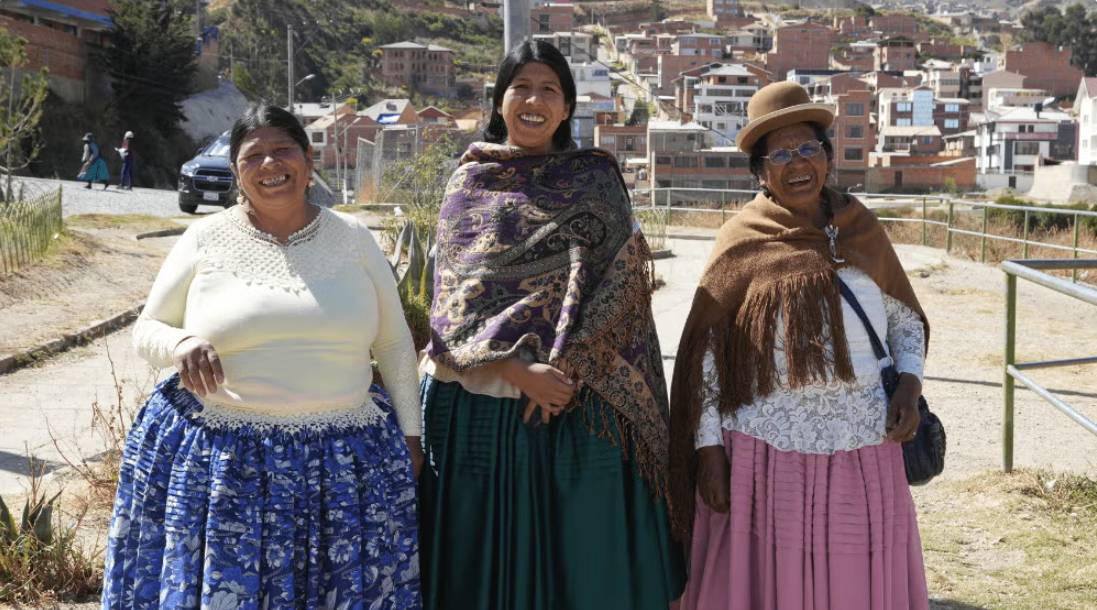
Three decades ago, teenage pregnancy was a normalized phenomenon in Bolivia. Roxana Vargas, who lives in La Paz, became pregnant with Jesika, her first daughter, at the age of 19. “That was when I had to get married. I knew nothing about contraceptive methods or family planning, but when I became pregnant, my parents told me I had to get married. And so I had to.”
Roqui, as she is known by her family and friends, did not finish her studies. She worked as a nanny and a cook and, finally, after many sacrifices, managed to become a successful entrepreneur selling the outfits traditionally worn by women in polleras in Bolivia, more commonly known as “cholas.”
Roqui overcame a life-threatening ordeal and is now the owner of two colorful stores where women who wear polleras come to shop. ©UNFPA Bolivia/Jorge Canido
In 2023, Bolivia recorded 32,660 teenage pregnancies among adolescents aged 15 to 19 who attended prenatal check-ups at health facilities (Single Health Information System, SUIS, Ministry of Health and Sports, 2024). Despite the progress made, reducing the number of girls and adolescents who face pregnancy at the expense of their lives remains a challenge.
Because she had no knowledge of family planning, Roqui soon became pregnant with her second daughter. This time, she almost lost her life. “I had a C-section. After I was discharged, I had to return to the hospital because I was in severe pain. I went into the operating room again because they had left a gauze pad inside me. I survived by a miracle.”
Alejandra Aliaga de Vargas is Roqui’s mother. Since childhood, she devoted herself to farming and weaving. Now 73 years old, she acknowledges that motherhood brought many changes and challenges.
Her first pregnancy was attended by a traditional birth attendant. “When I became pregnant, I went back to my village to give birth. A traditional birth attendant cared for me there, and everything went well. She gave me hot herbal teas and, by checking my pulse, told me how much time was left before I gave birth. My wawa (baby) was born healthy.” However, her second pregnancy was complicated. “From the sixth month of my pregnancy, I was already unwell. Pus was coming out of my ear and my hands were contracting. At the end of the seventh month, I had a C-section at a hospital. I almost died,” she recalls.
Alejandra was unable to access education and therefore supports her granddaughter Jesika’s efforts to build a life project that will help her feel fulfilled. ©UNFPA Bolivia/Jorge Canido
Maternal mortality is a clear manifestation of inequalities in Bolivia, as 68% of maternal deaths involve Indigenous women and 14% involve adolescents aged 14 to 19 (Ministry of Health and Sports, 2016). To prevent more women like Alejandra from suffering complications during pregnancy, with the resulting risk to their lives and those of their children, it is essential to guarantee comprehensive, quality health services.
For Alejandra, not having access to education because of her parents’ decision was a barrier that kept her from better opportunities. “I never went to school. My mother didn’t want to send me.” That is why she encourages her granddaughter Jesika to study and achieve her professional goals.
“One thing my grandmother has taught me is that no matter how old you are, you can keep studying, because the more knowledge you have, the more income you can earn,” says Jesika Ajata, Alejandra’s granddaughter and Roqui’s daughter.
According to the Milena study (2021), conducted in Bolivia by the Ministry of Health and Sports and UNFPA, with support from Swedish cooperation, teenage pregnancy negatively affects the income of women who became mothers before the age of 20, as they tend to attain lower levels of education, have lower levels of labor market participation and earn lower wages compared with women who postpone motherhood until young adulthood.
In this context, Jesika, 30, says that “a woman needs to have her own income, have an education and be economically independent; that enables empowerment.” In her own case, she has focused first on making her professional life project a reality. “My partner and I plan together, and we have talked about having children, but not now because it’s not the right time,” she says.
Jesika has postgraduate studies and fully exercises her right to family planning, with the support of her partner. She feels that she is in a position to make her life project a reality. ©UNFPA Bolivia/Jorge Canido
She is the leader of an innovative venture called Warmi empollerada, whose goal is to empower women through their identity and cultural roots. The warmis empolleradas promote the value of wearing the pollera and form a network of tourism ambassadors in Bolivia.
The story of these three generations of women reflects the positive changes the country has achieved in recent decades. At the same time, it reveals the challenges Bolivian women face when making informed decisions. Through their bodies and lived experiences, we see how sexual and reproductive health can mark the line between life and death.
For Pablo Salazar Canelos, UNFPA Representative in Bolivia, “the life of every mother can be saved if she fully exercises her sexual and reproductive rights; if she has access to quality obstetric care under an intercultural approach; if she can fully exercise her bodily autonomy to make decisions about her health and access to contraception and family planning in an appropriate manner; if she receives information in a timely manner; and, above all, if each person recognizes the importance of exercising human rights.”
Autor
El Fondo de Población de las Naciones Unidas es la agencia de la ONU para la salud sexual y reproductiva.