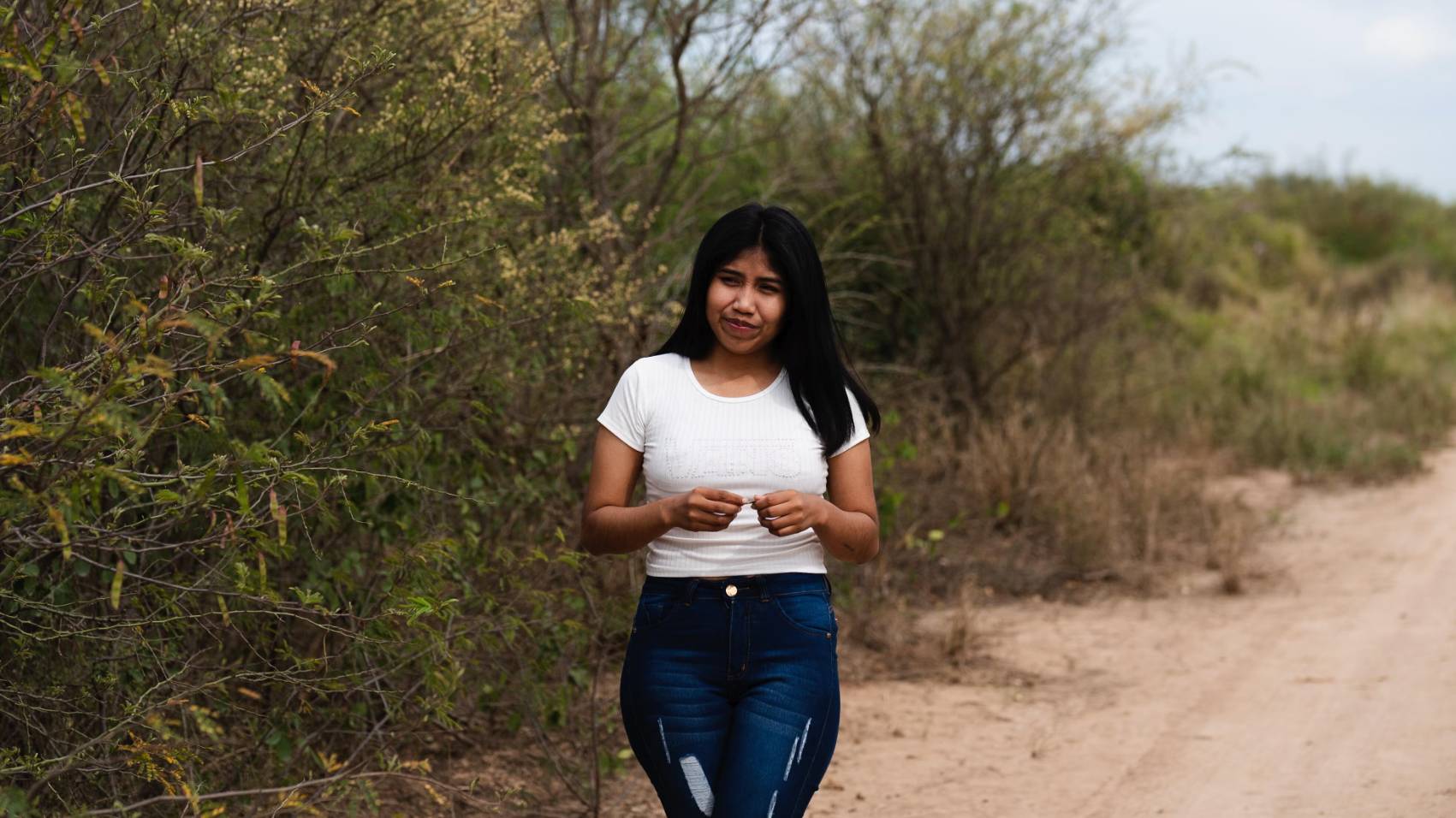
Along the dirt roads connecting Filadelfia and Campo Loro lives Nora Galarza Picanerai Chiqueñoi. In this Ayoreo community, language is more than a form of communication: it is identity, culture, history, and survival.
“Here, we speak Ayoreo one hundred percent of the time,” says Nora, a 21-year-old young teacher who teaches third- and fourth-grade girls and boys. “Very few of us know Spanish. Just me, my brother and my cousin,” she emphasizes.
Her story begins with language. At the age of four, Nora was sent to a boarding school far from her community. She spent five years there. “The hardest thing was the language, understanding how people spoke,” she recalls. “I found it difficult to socialize with my family when I returned, because I hardly spoke Ayoreo anymore.”
Although this separation was a sacrifice for her and her family, it was also crucial in allowing Nora to grow and develop in a safe environment. This is particularly relevant given that, among girls aged 12 and under, Paraguay has the highest specific fertility rate in the Southern Cone, which is directly linked to sexual abuse of girls*.
Educating so we can say who we are
Today, with calmness and determination, Nora teaches in the same community where she grew up. In a simple classroom, with a blackboard as her only teaching tool, she supports a dozen curious girls and boys who learn new words every day. “I just write everything on the blackboard,” she says. “I use my cell phone to search Google for the things I need to teach.”
Her main motivation is to help girls grow up feeling secure and develop their own aspirations. In contrast, according to data from the National Institute of Statistics (INE), in 2022, 6,130 girls and adolescents between the ages of 12 and 17 gave birth, while a total of 10,371 girls and adolescents were married, in a union, widowed, separated or divorced, thereby having their rights to live a life free from violence and to exercise bodily autonomy violated.
Nora reflects and tells us that she wants to help them express themselves in Spanish “because if they ever have to go to the hospital, they won’t be able to explain to the nurse where it hurts, because she won’t understand them in Ayoreo. That’s why I want to teach them.” Each class thus becomes an act of connection between two worlds: the world of the roots that sustain Ayoreo identity and the world of the opportunities offered by learning.
An environment that demands resilience
Campo Loro is home to more than 400 people who live surrounded by the Chaco forest. Temperatures reach 45 degrees Celsius, and climate change is now a direct threat to Indigenous communities, jeopardizing the future of adolescents and young people. Added to this is the fact that the distance to basic services remains a challenge: in the event of a medical emergency, they must travel to Villa Choferes, which is more than 60 kilometers away.
The community has electricity and some water pumps, but access remains limited. “Water is the most essential thing,” says Nora. “Many people suffer because they don’t have access to this resource.”
By enrolling her in that educational center, her mother and father made a crucial decision that would later become a benefit for Nora and the entire community. ©UNFPA Paraguay / Laura Iparraguirre
Despite the difficulties, she speaks with hope. She wants to continue studying information technology and improve her classes with more technological resources. “I really like that,” she says with a shy smile. Her family was her greatest source of support in her studies, and today the community trusts her to guide new generations. Every word she teaches has a profound purpose: to ensure the exercise of rights, so that her people can express themselves, ask for help, learn and make decisions. Her work represents a quiet yet steadfast form of young leadership rooted in everyday commitment.
Bridges that transform
Stories such as Nora’s reveal the power of education as a tool for exercising fundamental rights, including sexual and reproductive rights. In Indigenous communities, this means ensuring that girls and adolescents grow up safe, away from early unions and unintended pregnancies.
In this Ayoreo community, where language is identity, culture, history and survival, building intercultural bridges is essential to ensuring rights and choices for everyone. ©UNFPA Paraguay / Laura Iparraguirre
The Ministry of Public Health and UNFPA work alongside Indigenous communities in the Paraguayan Chaco to strengthen these ties: ensuring access to sexual and reproductive health services and developing educational materials that respect local languages and worldviews.
One successful experience has been strengthening the provision of family planning services, accompanied by talks and conversations in their own languages and adapted to their cultural context, so that adolescent girls and women can learn about and choose a modern contraceptive method. “Since last year, in our community, adolescents who have already had a child have been able to access the subdermal implant as a method to prevent another pregnancy at an early age,” explains Alejandra Uneai (30), from the Ayoreo people, who participated in the process of developing and validating family planning materials in her language.
Autor
El Fondo de Población de las Naciones Unidas es la agencia de la ONU para la salud sexual y reproductiva.