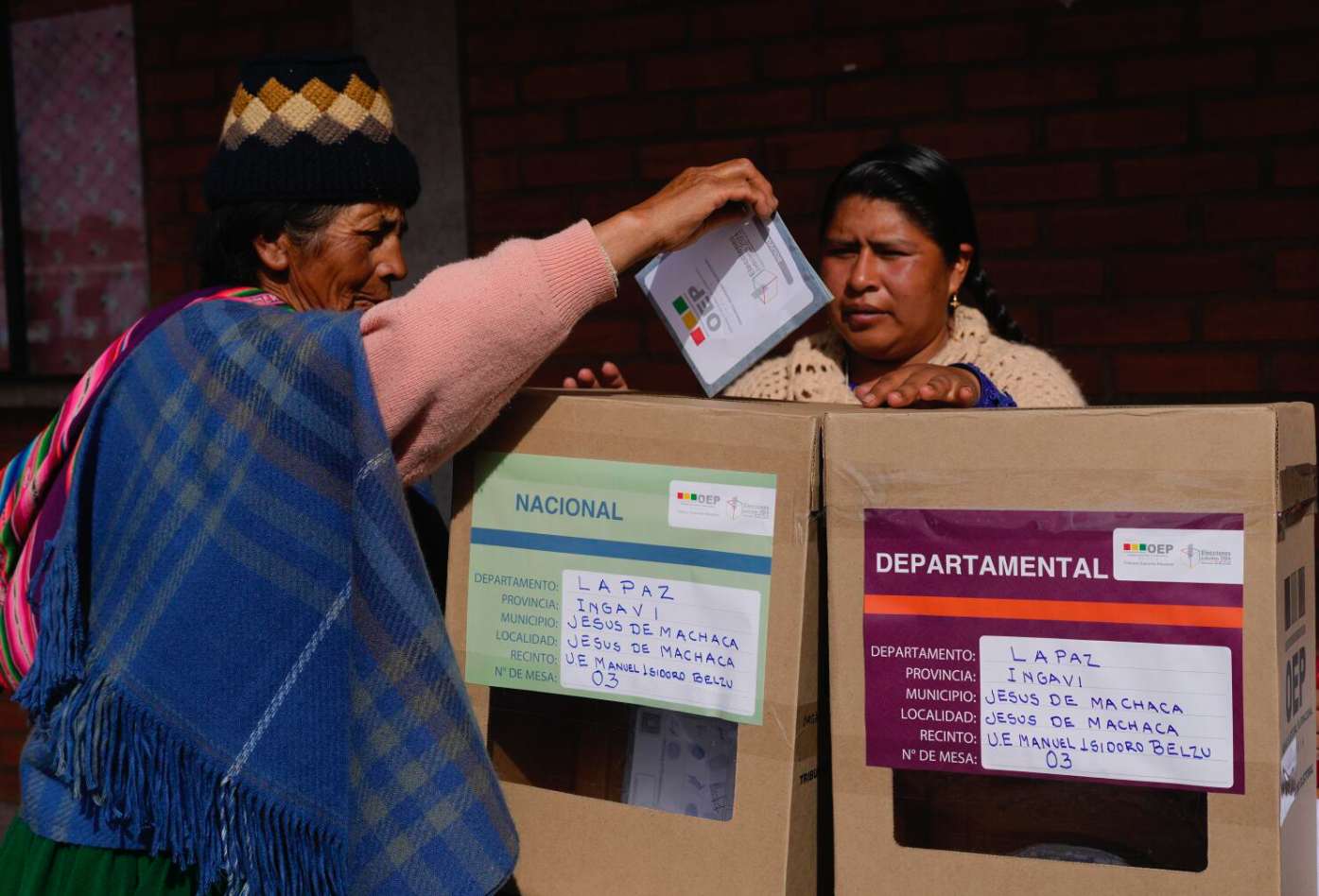
Next March 22, Bolivian citizens will elect nine governors, 277 departmental assembly members, 335 mayors, and 2,049 municipal councilors. This megademocratic process closes the stage of political reconfiguration that began with the presidential elections of August 2025, which brought Rodrigo Paz’s PDC to the presidency of the state, and has been characterized by the end of MAS (Movement Toward Socialism) hegemony and the fragmentation of political representation.
The MAS has completely disappeared from the electoral contest, as it has not fielded candidates in any departmental capital city. Nor will the party Evo es Pueblo participate under its own banner or with its own candidates. Some MAS militants are indeed running as candidates, but outside the party’s structure. This scenario is the result of the MAS’s internal decomposition, whose fratricidal struggle between the arcista and evista factions led to mutual blockage that metastasized at the subnational level.

In its place, the parties Libre and Patria have emerged, presenting candidate lists in nearly all municipalities in each department. Libre corresponds to Tuto Quiroga’s party, who unsuccessfully sought to come to power in 2025, while Patria brings together various movements around the figure of President Rodrigo Paz. It remains to be seen whether these parties will manage to attract the MAS electorate, currently confused and disarticulated. It does not seem likely.
If it was once assumed that the MAS and the left could regroup for the subnational elections, none of that is happening. The debacle of the decolonial left and the emergence of the right will continue.
All the same, the loss of MAS hegemony does not imply a strengthening of the party system or of political mediation mechanisms. Both Libre and the ruling Patria lack a solid party structure, to the point that many of their candidates are figures external to their own apparatus.
To this must be added political fragmentation. On average, the nine departmental capital municipalities have fifteen parties competing. With eighteen candidacies, La Paz has the highest number of contenders, while the fewest is the city of Cobija, with eleven. In a context in which a hegemonic party like the MAS no longer exists, what can be foreseen is that the subnational elections in March will be marked by a high fragmentation of the vote and a notable atomization of political representation.
Nor is there any discourse capable of even minimally ordering the political field. The parties now in contention continue trying to electorally capitalize on the MAS–anti-MAS cleavage, though with very little political effect, given that the MAS has ended up being not only a minority party but a marginal one. The mutual accusations of being “masistas” carry no political effect, because Morales, as of now, is a rag doll fearful of being the next Maduro.
Candidates’ discourses end up being varied and curious; very much in line with the technocratic trend, they seek to distance themselves from ideological coordinates—which they consider outdated—and attempt to present themselves as apolitical and technical. Thus, candidates who in the past worked for the MAS government seek to show that their experience in that administration was valuable from a technocratic standpoint and, they claim, will be able to place it at the service of the population if elected.
Ultimately, Bolivia is heading toward an election day centered on individuals rather than parties. The de-hegemonization of the MAS has not given way to a deeper democratic renewal, but rather to a further atomization of the vote. Confusion, discouragement, and social media advertising that abhors the debate of ideas reign. Insults and diatribes prevail, but no proposal capable of making the electorate dream of better days appears.The great danger is that, after March 22, the country could wake up with local authorities lacking solid governing majorities, trapped in ungovernable municipal councils. As the MAS fades away in its own metastasis, the new actors seem to forget that governance without a political project is of little use—much like caudillos without a party.
Autor

Political scientist. Professor and researcher at San Francisco Xavier University (Sucre, Bolivia). PhD in Social Sciences with mention in Political Studies from FLACSO-Ecuador.