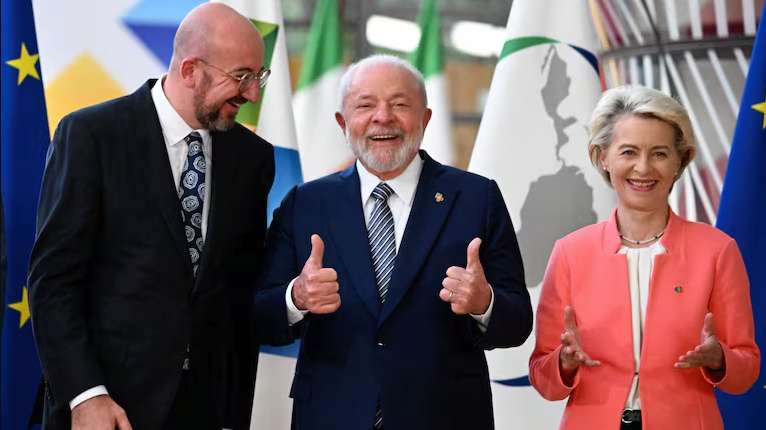
On January 9, 2026, the Council of the European Union (EU) approved the long-awaited trade agreement with Mercosur. This decision contrasts with what happened just a month earlier, when the President of the European Commission, Ursula von der Leyen, had to cancel her planned trip to Brazil to sign the instrument, as she had failed to secure the Council’s green light. Now, the signing will take place in Paraguay on January 17. How did we get here, and what lies ahead?
What happened: Overcoming internal resistance
The basis of the so-called Interim Trade Agreement (ITA), the commercial pillar of the deal, dates back to the “agreement in principle” announced in June 2019 by the leaders of both blocs. That announcement quickly led to the formation of a powerful opposition coalition in Europe, which ultimately brought the approval and ratification process to a standstill. This coalition coalesced around two main components: a traditional one, made up of European agricultural producers, and an emerging one, composed of civil society organizations focused on environmental protection.

In a short time, the world changed and, for reasons predominantly associated with the new global geopolitical context, the Commission resumed its efforts to finalize this agreement. To do so, it needed to neutralize the aforementioned opposition coalition, which, taken together, had the capacity to block it—either through national governments in the Council or through their political representatives in the European Parliament.
The Commission’s strategy was to deactivate the environmental component of the coalition. To that end, beginning in 2023 it embarked on a renegotiation with Mercosur, particularly with Brazil, aimed at increasing the binding environmental commitments included in the agreement. In exchange, it was willing to forgo some of the market access gains achieved in the 2019 arrangement. On the basis of this trade-off, both blocs announced a new agreement in December 2024.
While environmentally based opposition declined markedly after this announcement, agriculturally based opposition persisted. And, as expected, it found a channel for representation in countries with strong agricultural communities. Thus, the governments of France, Poland, and Ireland expressed their opposition to the agreement and sought to build a blocking minority to prevent its approval in the Council.
Because this required at least four countries representing at least 35% of the EU population, the opposing countries needed new allies. Along the way, they found an unexpected partner, given its historical support for the agreement: Giorgia Meloni’s Italy. From December 2024 onward, the Italian government sent ambiguous signals, alternating between rejection and conditional support. But when the time came for approval in December 2025, the Italian government did not cast its vote, and as a result the signing could not be finalized.
However, Italy’s position turned out to be transactional. After the failure in early December, the Commission negotiated with the Italian government a series of side payments in exchange for its favorable vote, the most significant of which was an advance on agricultural subsidies provided for under the Common Agricultural Policy. In parallel, the European institutions approved a specific mechanism to activate the bilateral safeguards set out in the text of the agreement, which provides for the automatic launch of investigations for a range of sensitive agricultural products if domestic prices or exports from Mercosur fall or rise by 8%, respectively. It should be noted that these safeguards complement the fact that the opening offered by the EU for these sensitive goods is partial, via quotas, which in itself already limits the scope of liberalization in this sector. And although this set of concessions was not sufficient to appease agricultural opposition—leading France, Poland, Ireland, Austria, and Hungary to vote against it (with Belgium abstaining)—the agreement was ultimately approved by a qualified majority in the Council.
What comes next: The challenge of ratification
Following approval, the ratification stage of the ITA shifts political action to the European Parliament and to the national parliaments of the Mercosur countries. In the former, the emergence of a new battle between supporters and opponents is highly likely.
The two largest political groups in the European Parliament—the Popular Party (center-right) and the Social Democrats (center-left), which together underpin the governing coalition in the EU—have already announced their support. However, driven by opposition from agricultural producers, it is to be expected that a significant share of Members of the European Parliament from countries such as France, Poland, and Ireland, among others, will vote in line with their country’s opposing position rather than that of their political group. Thus, while the baseline scenario is one in which there is a majority in favor of ratification, it will certainly be a narrow one, meaning that marginal shifts in position could end up tipping the balance one way or the other.
In parallel, there will be efforts by some Members of the European Parliament to refer the agreement to the Court of Justice of the EU, with the formal objective of determining the instrument’s compatibility with European law. Indirectly, these efforts aim to delay the ratification process and buy time to build an opposing majority. There is no certainty that initiatives of this kind will succeed, but in any case they will be an additional factor to monitor in the coming months.
In the Mercosur countries, by contrast, a less contentious parliamentary process is expected in principle. Those who could theoretically be negatively affected in distributive terms—namely, different segments of the manufacturing industry—have supported the agreement (in Brazil) or at least have not actively opposed it (in Argentina). Moreover, in 2019 the Mercosur countries agreed on provisional bilateral entry into force as each member of the bloc, together with the EU, ratifies the agreement. In addition to effectively loosening the adoption of preferential agreements with third parties, this measure is intended to encourage ratification in each national parliament. As each Mercosur member ratifies, the cost of remaining outside preferential access to the European market increases.
In short, ratification is the next and final step before the agreement enters into force. As since 2019, the focus will remain predominantly on what may happen in the EU.
Autor

Professor and researcher in the International Studies Program at the University of the Republic (Udelar), and member of the National System of Researchers of Uruguay. He holds a PhD in Political Science from Udelar and a Master's degree in International Political Economy from the London School of Economics.