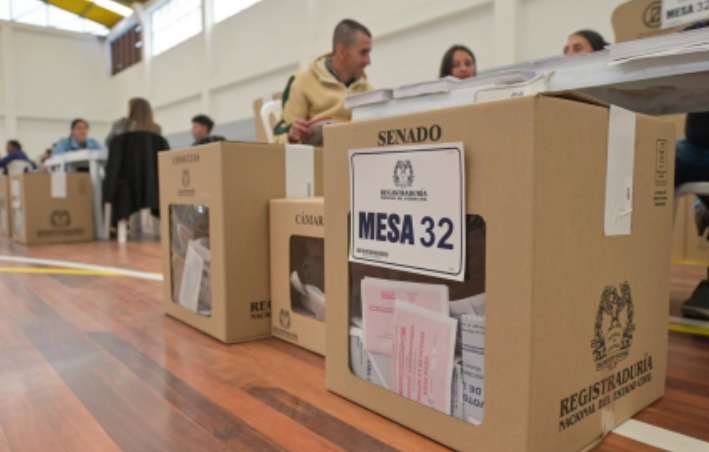
The legislative elections and the interparty consultations delivered a clear political message: Colombia is entering a new stage of fragmentation and open competition with traditional political structures. Rather than an outright victory for a specific force, the results reveal a political system divided into several blocs with the capacity to exert influence, where no single force manages to prevail completely. This scenario anticipates a complex Congress and a presidential process in which alliances will be decisive.
An increase in political fragmentation
First, the main political message of these elections is the confirmation of a fragmented Congress. According to the preliminary count by the National Registry, the ruling Historic Pact would be the most voted force in the Senate with more than 4.4 million votes, followed by former president Uribe’s Democratic Center with close to 3 million, and then by parties such as the Liberal Party, the Conservative Party, and the Green Party.

However, none of these groups reaches a single majority in Congress. This distribution confirms that the Colombian political system continues to move away from the bipartisan framework and now requires alliances with traditional parties to achieve governability. Therefore, the next government will have to build broad coalitions in order to govern and move its reforms forward, and to avoid the paralysis that was often experienced during this four-year term.
Second, compared to the previous Congress, the political map largely maintains the same overall structure. Progressive forces retain significant weight, especially with Historic Pact as one of the most voted blocs, increasing by five seats so far. This shows that the political project that brought Gustavo Petro to power still maintains a significant electoral base and reaffirms the president’s favorability.
At the same time, the right, represented by the Democratic Center, manages to remain one of the main forces in the system, particularly in regions such as Antioquia, where it obtained majority vote totals. Meanwhile, the traditional parties—Liberals, Conservatives, and La U—continue to have enough presence to become pivotal actors in the governability of Congress.
Great expectations surround the stance that the Green Alliance Party will take, which will obtain 10 or 11 seats, since it does not have a clearly defined ideological tendency and includes candidates who respond either to consolidated political structures in the regions or who have aligned themselves around specific issues. Therefore, the election has consolidated a political system of three blocs: left, right, and an expanded center that primarily responds to regional political structures.
Looking ahead to the presidential election
The interparty consultations, on the other hand, reflect the broader landscape ahead of the presidential elections. In the right-wing consultation, Senator Paloma Valencia prevailed; in the “center” consultation, former mayor Claudia López won; and in the “left” consultation, Roy Barreras emerged victorious. However, both López and Barreras fell short of their targets and will therefore have to define their positions ahead of the first round.
The consultations also highlight the weight of media-driven and opinion-based campaigns. A clear example was the phenomenon surrounding right-wing candidate Juan Daniel Oviedo, who managed to position himself as a competitive figure within the political landscape, with a vote total that surprised observers and demonstrated the mobilizing capacity of candidacies that rely heavily on social media and on discourses of political renewal. This type of result reveals that the urban and opinion-oriented electorate continues to play a decisive role in the reconfiguration of leadership, something that had already occurred when he ran for mayor of Bogotá. His participation in the elections in May will depend on the agreements he manages to reach with Paloma Valencia, leader of the Democratic Center, whom he has already offered to accompany as vice president.
Abstention above 50%
Another relevant aspect of the electoral day was the low participation. The elections recorded high levels of abstention, above 50%, which once again puts on the table one of the structural problems of Colombian democracy: the distance between citizens and the importance of voting. This is especially evident in Senate elections, which even in remote areas are still perceived as distant contests. This phenomenon not only weakens the legitimacy of institutions, but also reinforces the weight of territorial political machines that manage to mobilize voters in contexts of low participation in exchange for economic transactions.
From a strategic perspective, these results anticipate a Congress in which the balance of power will depend on coalitions. This implies that the next president will need to negotiate with traditional parties and independent sectors in order to build legislative majorities. In that sense, the Congress emerging from these elections is shaping up to be a space of permanent negotiation, where political agreements will be key either to the approval of structural reforms or to paralysis for any political sector.
Finally, the balance of these elections shows that Colombia continues to go through a process of political transition tending toward polarization at the extremes. Centrist positions were punished. The arrival of new forces in recent years has not eliminated the traditional parties, but it has produced a more competitive and volatile system. Moreover, Colombia remains a country politically segmented by regions, where territorial dynamics—local leaderships, political structures and regional agendas—can weigh as much as or even more than ideological debates.
In short, the 2026 legislative elections and interparty consultations did not produce an absolute winner, but rather an open political scenario that must close ranks ahead of the first round. However, the two consultations have marked a trend.
Autor

Assistant Professor at Externado University of Colombia. Master's degree in Government and Public Management in Latin America from Pompeu Fabra University, Barcelona. Member of the Network of Women Political Scientists.