Faced with an unmanageable electoral offer and an institutional system in crisis, gamification played an educational role that the formal and media systems have failed to fulfill, motivating youth voting.
The Peruvian political landscape in 2026 has become a laboratory of innovation in the region. Extreme party fragmentation and a saturated digital ecosystem have driven political and social actors to seek new channels of mediation.
In this context, the Peru City experience on Roblox and financial technology such as Yape have served both as entertainment and as key tools for shaping preferences among emerging audiences. By the end of 2025, Peru had 28.4 million active digital users, representing 82% of the population. Young people—new voters in 2026—are the most active. 12.6% of the population is between 5 and 12 years old, 8.3% between 13 and 17, and 11.5% between 18 and 24. More than 30% use Roblox regularly.

Roblox is a global platform within the metaverse ecosystem, designed for user socialization and engagement through interactive experiences. In the third quarter of 2025, it had 151.5 million daily active users worldwide, who spend nearly three hours a day on the platform.
Recently, Roblox has become an important channel for Peruvian brands and companies seeking to reach audiences they cannot access through other means. In politics, electoral simulations and interactions in virtual worlds have encouraged young people to participate in real debates. Globally, on metaverse platforms such as Fortnite and Minecraft, public opinion and political engagement are growing.
Peru City as a virtual public square
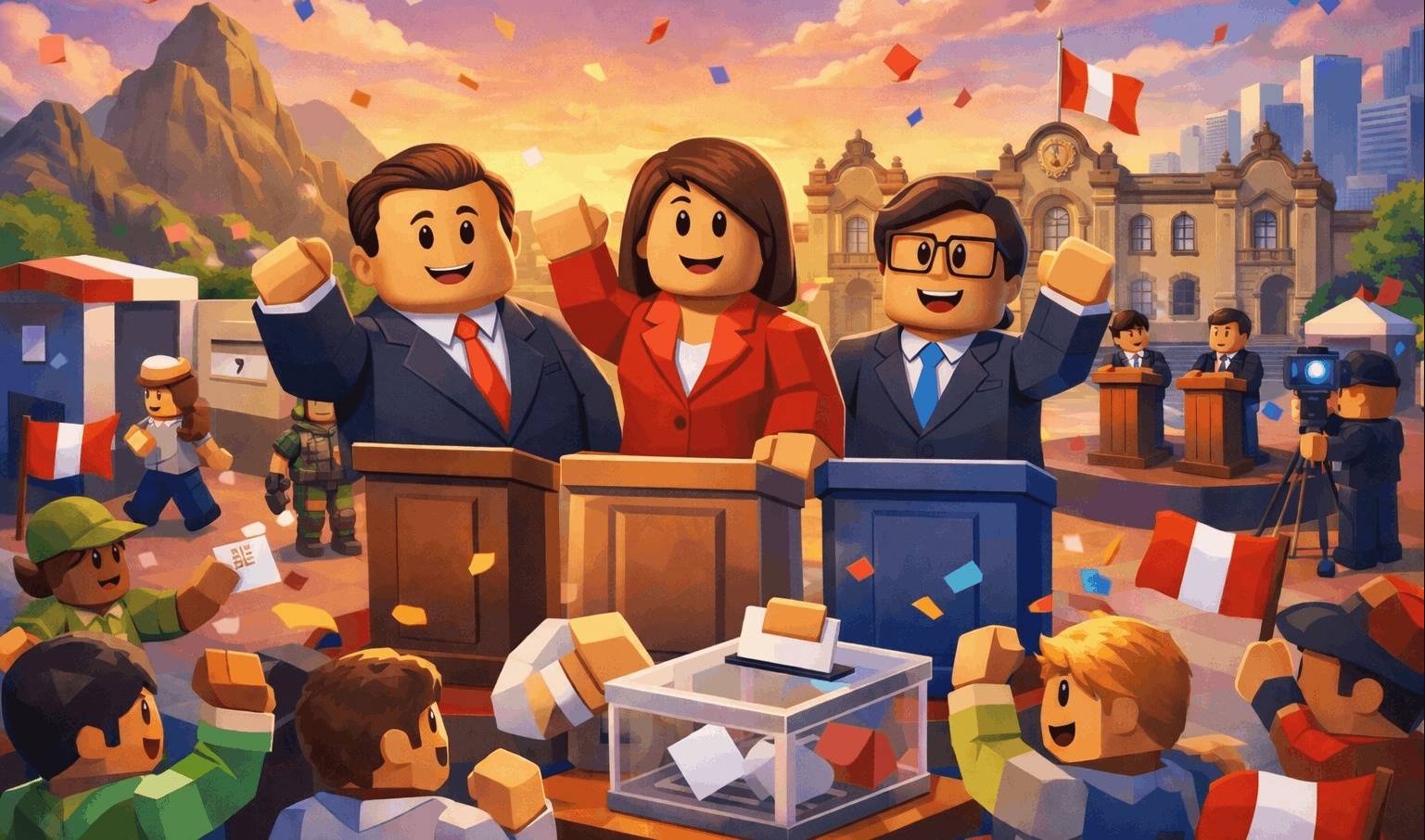
In Peru, during the 2026 presidential elections, political attention centered on Peru City. It is an architectural recreation and simulated governance space within Roblox.
Users interact with institutions, carry out fictional procedures, and participate in the game’s economic life, replicating tensions and dynamics of Peruvian society. In a country with high distrust toward political institutions, these virtual spaces offer a safe “playing field” where citizens can explore their political role without the constraints of traditional discourse.
The dominance of TikTok, Instagram, and YouTube has been key to its success. Roblox content has transcended the platform and gone viral through these channels. This interconnection has created a feedback loop in which playful experiences become political content consumed by millions outside the metaverse.
The emergence of Yape in the pursuit of informed voting
The implementation of the mobile payment app Yape in Peru City has been a disruptive political and corporate communication strategy during the 2026 campaign. Unlike traditional advertising, Yape promoted informed voting through fictional candidates and proposals such as green spaces and virtual museums.
Its ingenuity lies in the fact that winning proposals were implemented after the digital vote, demonstrating the impact of collective decisions. This didactic approach has taught the relationship between voting and reality—often lost in abstract electoral promises.
Meanwhile, community tutorials have shown users how to top up balances, functioning as a mechanism of digital and financial literacy alongside political education. This civic model has also sought to connect young people with official sources, such as the National Jury of Elections, and to serve as a gateway to the formal electoral ecosystem.
Electoral simulation: Pedagogy in the face of technical complexity
The general elections of April 12, 2026, were highly complex. The ballot included the election of a president, two vice presidents, 60 senators, 130 deputies, and 5 Andean parliamentarians. Faced with this challenge, the electoral simulation in Peru City gained significant relevance.
The simulation allowed young voters to understand how they could invalidate their vote. Among its benefits, it promoted:
- Active participation: Unlike passive consumption of television or radio, Roblox requires constant decision-making, reinforcing information retention and preventing procrastination.
- A safe environment for experimentation: The simulation allowed users to make mistakes in voting without legal consequences, encouraging learning through trial and error.
- Development of civic competencies: Yape’s strategy fostered critical thinking by requiring users to choose between government plans with limited resources.
However, there is a risk that gamification may oversimplify the structural problems of the state. It can create the false perception that public management can be resolved with the same speed or simplicity as building in a virtual world. This calls for stronger commitments to digital literacy campaigns.
Beyond Yape’s activation, the final stretch of the campaign saw an unusual effort to bridge the physical and digital worlds. While Rafael López Aliaga held his closing rally in the Gamarra commercial hub and Roberto Sánchez in Plaza 2 de Mayo—arriving on horseback as a symbolic gesture of rural connection—replicas of these events in Peru City allowed thousands of young people to participate virtually. Presidential candidate Jorge Nieto even opted for a campaign closing exclusively on Roblox, seeking to consolidate his image as a representative of innovation and technology.
These actions, though they may seem marginal, are key to mobilizing Generation Z. Their participation is lower than that of older groups, but it can determine who advances to the runoff on June 7. They also serve as reference points for Generation Alpha, which will be able to participate electorally by 2029.
With TikTok and Instagram, it has become clear that political communication can no longer be one-directional. On platforms like Roblox, content is the experience itself, involving the user and reinforcing this principle. Emerging voters demand authenticity, interactivity, and transparency—and they respond to these initiatives.
Playfulness as a safeguard of democracy
The Peru City experience on Roblox and the integration of strategies like Yape have become mechanisms of democratic resilience. Faced with an unmanageable electoral offer and an institutional system in crisis, gamification assumes an educational role that the formal school system and traditional media have not been able to fulfill with the same effectiveness.
By transforming young people from passive spectators into actors who evaluate government plans and practice voting on a complex ballot, the risk of total political disengagement is reduced. However, the sustainability of this model will depend on its ability not to trivialize politics and to maintain a strong connection with institutional reality and accountability.
*Text originally published in Political Dialogue
Autor

Ph.D in Communication and a Master's degree in Social Communication. He has conducted several research projects on new narratives and technologies in journalism, advertising, marketing, and corporate communication.