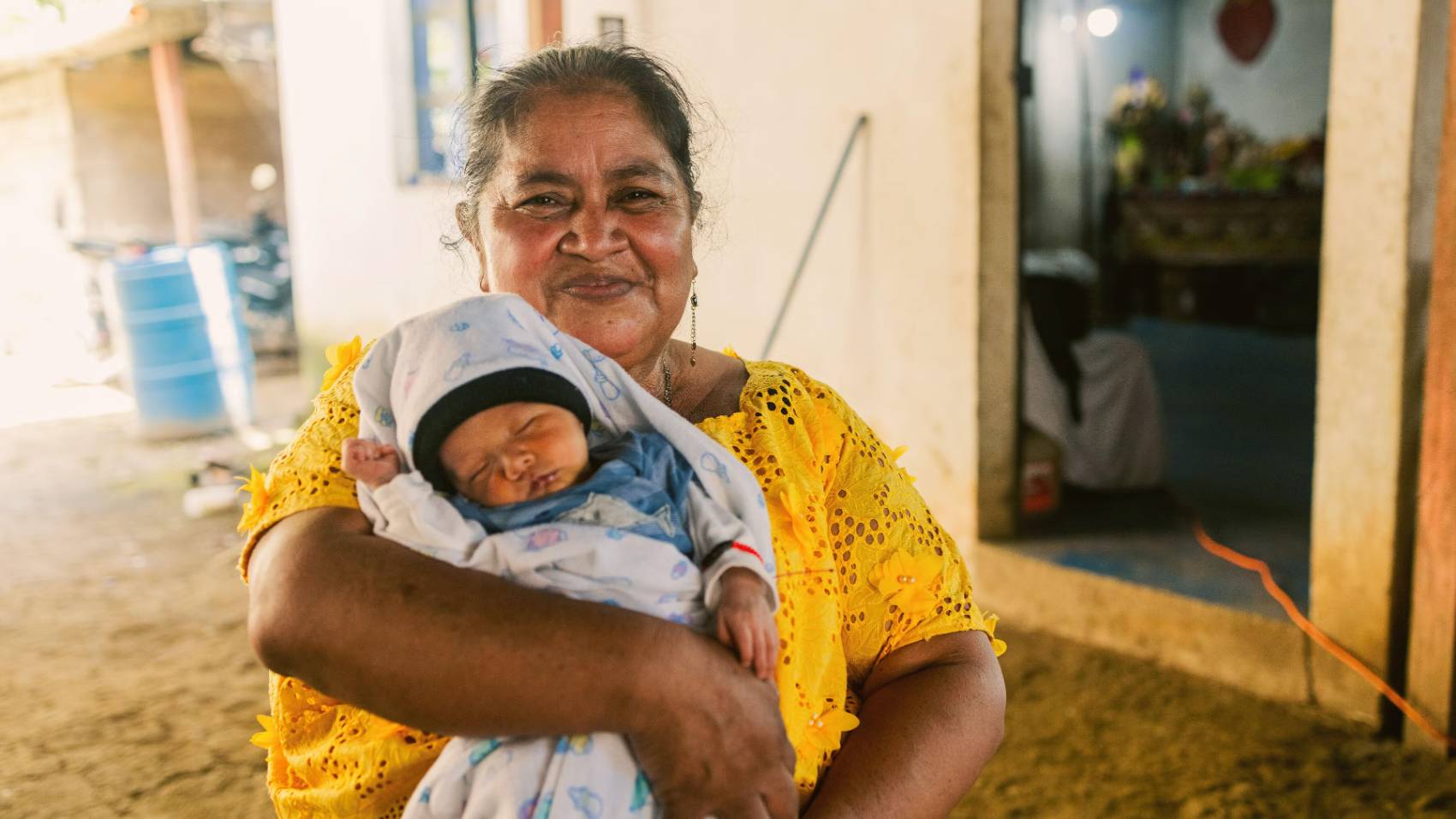
The first time Ana María Maas brought a baby into the world, she was 16 years old, and no one had taught her how to do it. Today, at 62, she cares for pregnant women with complete confidence, accompanies them to their prenatal checkups, and knows how to prevent postpartum hemorrhage.
It all began one day when it was impossible to call an ambulance and a woman needed help giving birth. This happened in the community of Samanzana, in Cobán, Alta Verapaz, in central Guatemala.
In that department, approximately 4 out of every 10 births take place at home or at the community level, mainly in rural and Indigenous areas where accessing health services is particularly difficult.
“I didn’t have any equipment and I didn’t know how to do it. Not even a cloth, because it had to be done quickly.”
After that first delivery, people began seeking her out. Although she was very young, she attended the births of many people; however, she did not know anyone who could provide her with training.
That changed between 1985 and 1990. “A nurse approached me and told me that, since I attended so many births, I could receive training to become a better midwife and have some scissors, some forceps.”
Ana María remained interested. She received training from the Red Cross and from the Comprehensive Health Care System (SIAS) of the Ministry of Public Health and Social Assistance (MSPAS). Since then, she has continued learning and improving her practice. She can proudly say that there has never been a maternal or infant death.
In communities such as Ana María’s, one of the greatest risks for women is postpartum hemorrhage, which has historically been among the leading causes of maternal death in the country. The time it takes to transport a woman to a hospital can mean the difference between life and death. Hemorrhage can occur without warning, even in pregnancies with no apparent complications.
Ana María remembers the difficulties, but the situation has been changing over the past four years. A community-based strategy led by the Ministry of Health’s National Reproductive Health Program was introduced to make a difference in six departments across the country, including Alta Verapaz. Since then, a medication called misoprostol has been used to prevent these hemorrhages during home births.
Ana María says that during this time she has noticed an improvement in her patients’ well-being.
“Five minutes after the baby is born, I bring them a glass of hot water and give them the misoprostol. They say it makes them dizzy and gives them a stomachache. I stay there with them, it goes away, and then they ask for food.”
Recommended by the World Health Organization, misoprostol works by stimulating the uterus to contract after birth, thereby reducing the risk of excessive bleeding. It does not require refrigeration or injection.
The focus is prevention. In high-risk pregnancies and emergencies, patients must be treated at a hospital.
UNFPA’s support for the community-based misoprostol strategy “seeks to ensure that its implementation is backed by the best available technical and scientific evidence, as well as clear protocols and appropriate training, so that every midwife has safe and effective tools,” emphasizes Daniel Frade, UNFPA Technical Specialist in Reproductive Health in Guatemala.
Ana María has received training on the use of misoprostol, the identification of warning signs, the appropriate timing for administering the medication, and coordination with health services in the event of complications.
Gilma Ayala, who oversees the misoprostol strategy at the Alta Verapaz DRIS, leads a training session on its use in community births.
Gilma Ayala, who is responsible for the misoprostol strategy at the Directorate of Health Services (DDRISS) of Alta Verapaz, says: “We have currently managed to cover approximately 55% of community births with the use of misoprostol. The results confirm that this is a key intervention for reducing risk at the community level, and we are working to progressively expand it from 8 to all 19 districts in the department.”
Since its introduction in the department, postpartum hemorrhage has declined as a cause of maternal death.
Over the course of a year, Ana María attends approximately 15 women. She prepares natural infusions or heats medicinal plant leaves with a burning stone and places them on the women’s bodies to relieve their discomfort until they recover.
“My children tell me: ‘Mom, stop working, please.’ But I can’t… because I love my work.” Her hands want to keep welcoming boys and girls into the world in the communities of Cobán. She has been part of the transformation of her community and of a better life for the women she cares for: with less pain, less fear, fewer emergencies, and greater protection.
Autor
El Fondo de Población de las Naciones Unidas es la agencia de la ONU para la salud sexual y reproductiva.