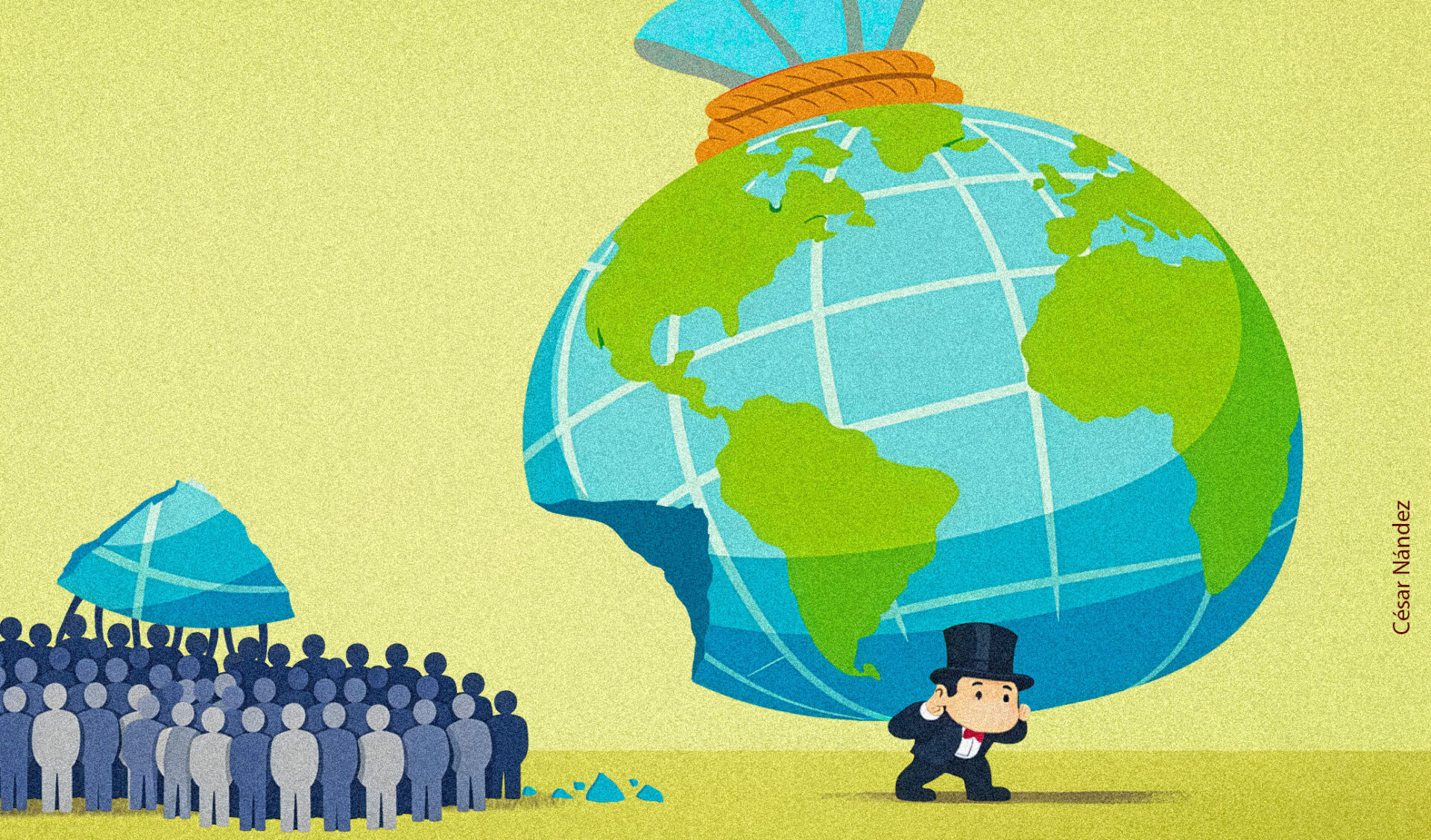
Never before has there been income and wealth inequality like that of today. Nor has there been such extreme concentration of ownership, nor has the billionaire elite enjoyed so much political power. This is how U.S. Senator Bernie Sanders describes the current situation in his foreword to the report Inequality Inc., recently published by Oxfam. The data on the concentration of wealth and income are overwhelming, and most troubling of all is that this trend is intensifying. Meanwhile, the labor situation of large segments of society is deteriorating, with more intense labor regimes, longer working hours, obstacles to unionization, and wages lagging behind rising profits.
The power of corporate lobbying
We are faced with economic systems that largely seek to benefit small elites of millionaires. In this context, the web of relations between large corporations and governments plays a fundamental role, as do the pressures exerted to shape public policies that secure or defend labor regulations minimizing companies’ obligations toward workers.

The Oxfam report recently presented at the World Economic Forum states that: “There are links between corporate lobbying and political restrictions on unionization and opposition to restrictions on forced labor, resistance to minimum wage increases, rollbacks in child labor regulation,” as well as reforms that undermine labor rights.
The consequences of this web are evident: a marked concentration in the world of large corporations and the advance of monopolies across a wide range of activities. This is occurring with particular intensity even in economic activities that three or four decades ago were barely emerging. For example, three-quarters of global spending on online advertising now goes to Meta, Alphabet, and Amazon, while more than 90% of internet searches are conducted through Google.
This concentration is also advancing in other industries. Twenty-five years ago, ten companies controlled 40% of the global seed market, whereas by 2020 only two companies controlled that same share. In the pharmaceutical sector, there are ten global giants as a result of mergers and acquisitions carried out over the previous two decades. In beer production and marketing as well, two or three global companies concentrate production, among them Anheuser-Busch InBev, with more than five hundred brands such as Budweiser, Beck’s, Corona, and Stella Artois.
In the agricultural sector, there is also a notable increase in the concentration and centralization of production, alongside the global commercialization of agricultural and food products. Added to this list are significant changes in ownership among major automotive firms, where a small group of globally established companies determines the course of the industry, including the transition toward electric vehicles. The result is large corporations with the ability to influence prices, preferential access to financing, and the capacity to decide their investments based on tax reductions, labor costs, government support, and various trade rules. Once again, the web links economics and politics.
The concentration of the financial world
The financial world and companies operating in banking, insurance, investment funds, and other financial firms constitute another sector with notable levels of economic concentration. Indeed, this has facilitated processes of concentration and reorganization that reinforce the power of monopolies across the economy as a whole.
For years, investment funds that manage private resources have stood out in the market, aiming to achieve the greatest profit in the shortest possible time. On this basis, they increase their own fortunes, set rules for many companies, participate in merger processes, and reorganize firms to secure immediate gains.
Taken together, the “big three”—BlackRock, State Street, and Vanguard—traded financial assets worth approximately $20 trillion in 2022, representing nearly one-fifth of all financial assets invested worldwide. According to the Oxfam report, research by the Boston Consulting Group suggests that this type of market concentration reduces incentives for companies to compete and, in turn, deepens monopolistic power.
Minimal tax contributions
The power of large corporations is also reflected in governments’ fiscal behavior. For years, there has been a reduction in the relative share of corporate taxes applied in many countries. This is a sustained trend based on the argument that such measures are necessary to spur investment and thereby promote growth and public well-being.
To date, as widely documented in reports by major multilateral financial and economic agencies such as the IMF, the World Bank, the WTO, and the OECD, these measures have not generated sustained growth either in advanced economies or in many developing ones, nor have they succeeded in reducing income and wealth inequality.
In this context, Latin America is facing one of the decades of lowest GDP growth in a long time. Moreover, many corporations are not satisfied with lower tax rates and engage in creative accounting practices to avoid, and in some cases evade, taxes, significantly reducing their payments.
By contrast, recent decades have seen a significant increase in the profits of many large firms which, through share buyback measures and dividend distribution terms for shareholders, ultimately benefit a small group of millionaires. For example, between July 2022 and June 2023, for every one hundred dollars in profits generated by 96 large companies, 82 dollars were returned to shareholders in the form of share buybacks or dividends, according to the Oxfam report.
The advance of the power of monopolies and major financiers is constant and is not due merely to the workings of markets. The web of relationships with governments is part of the problem, as is the very action of corporate lobbying. Changing this reality is essential to prevent social fracture and to confront problems as serious as climate change. Current levels of inequality are not allowing for better economic performance in many countries and are fostering a marked process of social breakdown.
In the face of this complex reality, it is worth recalling the words of former President Roosevelt in a message to the United States Congress: “Liberty in a democracy is not safe if the people tolerate the growth of private power to a point where it becomes stronger than their democratic state itself.”
Autor

Professor and senior researcher in the Department of Economics at the Metropolitan Autonomous University (UAM), Iztapalapa Unit. PhD in Latin American Studies (Political Science) from UNAM, Mexico.