Whether viewed as a resource or a common good, water lies at the heart of social and environmental tensions. An increasing number of rivers around the world are being dammed, mined, channelled, polluted, and overexploited. Mining and hydroelectric projects are multiplying, benefiting from green and clean energy narratives that set them apart from their gas and oil counterparts. Although essential to the energy transition, these projects are reshaping territories where competing visions of development and humanity’s relationship with nature intersect and clash.
Colombia’s hydroelectric expansion
In Colombia, hydropower accounts for 70% of the country’s electricity generation. Since the 1980s, support from the national government, international institutions, and the private sector has consolidated its dominant position in the energy mix. More recently, the National Energy Plan 2006–2025 reinforced an export-oriented vision by treating electricity primarily as a commodity. In 2024, Colombia exported electricity worth $320 million.

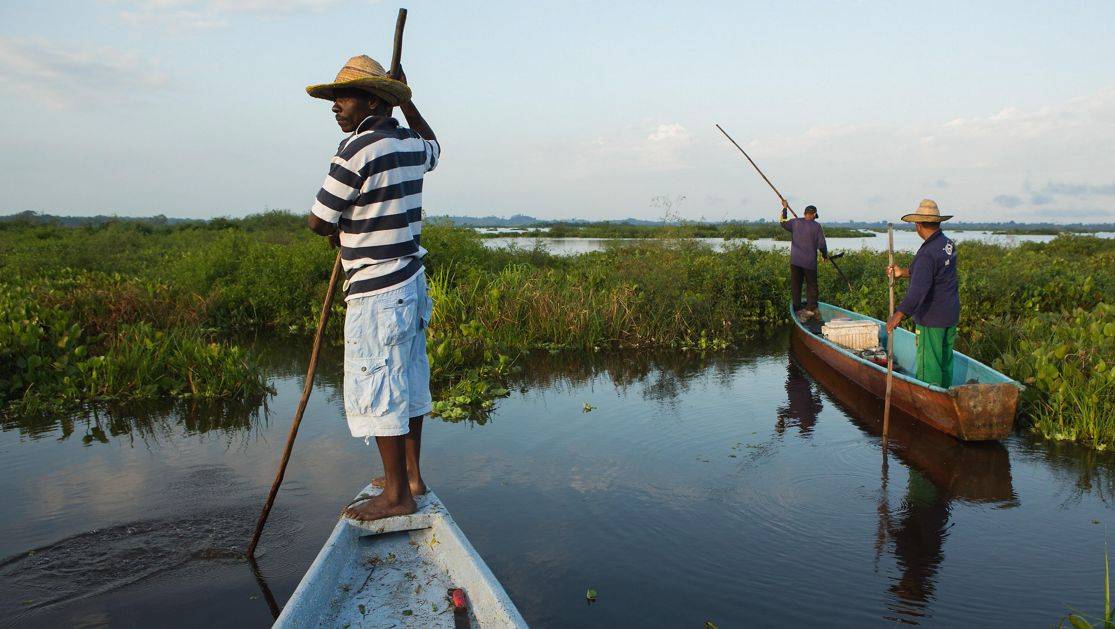
This expansion is concentrated in the heart of the department of Caldas. Rich in water resources, its rivers rise in the Central Cordillera and flow eastward into the majestic Magdalena River. But their course has not been without obstacles. Since the construction of the Hidromiel I dam in 2002, the largest in the department, four other hydroelectric and river-diversion projects have emerged. More than 40 projects are planned in eastern Caldas. Despite strong local opposition and an electrification rate already close to 100% across the department, multinational companies continue to promote these projects through a development narrative, emphasizing above all their role in generating electricity and creating jobs.
Losing access to and control over water
It is precisely this sudden influx of projects that has led to rivers being dammed, water being captured and diverted, and, in some cases, communities being deprived of it altogether. Water extracted and diverted through tunnels reduces the natural flow of rivers and streams. More importantly, these excavations in the mountains cause surface water to seep underground. As a result, rural communities have watched streams running through their farms dry up. “This stream used to provide water to 18 families,” exclaims David, a farmer from the municipality of Pensilvania, during a visit to the remnants of the streams that once shaped these valleys. The University of Caldas counted 80 farming families affected by El Edén, a small hydroelectric plant that has been operating since 2017. These families depend on water for both domestic and productive activities.
Hydropower development is therefore fundamentally reshaping established hydrosocial networks. When water becomes scarce near homes and farmland, some farmers are forced to turn to alternative sources, increasing water stress elsewhere. “If [companies] destroy our territory, it is another form of forced displacement,” says one farmer, comparing hydroelectric projects to the “forced displacement suffered at the hands of illegal armed groups.”
Beyond the material losses associated with access to and use of water, these projects also threaten the very ways people inhabit and relate to their territory. Sebastián, another farmer affected by El Edén, describes this dependence in more personal terms: “The only thing I know is how to cultivate the land; the only thing I know is how to enjoy the landscape […]. All of this affects me emotionally and economically. They are killing me, you see? They are killing everything I am as a farmer. My life, my identity.” His words reveal not only an economic dependence on water, but also an attachment to a landscape that is progressively losing what keeps it alive.
For rivers that flow, alive, free and joyful
Farming communities describe the situation as a genuine war over water: a struggle for access to a resource and control over its use, on which the survival of rural life depends. The farmers’ collective MACO is leading a legal and social battle against the development of these hydroelectric projects. The organization, which brings together 2,000 farmers, emphasizes that water is the material foundation of a territory that is inhabited, cultivated, and passed down through generations. It sustains the cultivation of cocoa and coffee, pillars of the local economy and of a way of life that has shaped these farming communities’ identity over generations.
Through brief interventions at COP16 on biodiversity and demonstrations in the streets of Manizales, the regional capital, the collective turns its knowledge of the territory into a tool for political action. Farmers’ mobilization thus provides the foundation for an alternative vision of development, one rooted in the continuity of agricultural practices and communities’ ability to decide the future of their territories. Their account highlights the dispossession experienced by local communities in the face of infrastructure presented as progress. Above all, their struggle exposes a fundamental tension at the heart of the energy transition: the production of energy labelled “clean” and the social and ecological costs it entails.
Green development?
Colombia is not an isolated case. Across Latin America, hydroelectric, mining, and energy projects are pushing the frontiers of extractivism into new territories, often areas inhabited by farming, Indigenous, and Afro-descendant communities. The issue goes beyond access to water. It also concerns the uses to which water is put and the populations that bear the consequences.
Water extractivism is now embedded in a powerful green narrative. Diverting and capturing water to turn it into an economic resource is thereby justified, at the expense of local uses and ecological balances. As territories are reshaped, entire ways of life are marginalized or erased while a particular development model is imposed. Moving beyond the assumption that large-scale projects offer the only path to development is essential if we are to address deep-seated environmental injustices.
In eastern Caldas, the conflict over water therefore goes far beyond the question of hydropower. It raises a fundamental question about the clash between a development model imposed from outside and the ways of life that have historically sustained the territory. A transition cannot be sustainable if it reproduces the inequalities of the extractivist model it claims to overcome.
Autor

Research assistant at the New Water Culture Foundation (Fundación Nueva Cultura del Agua), Spain. He has collaborated with researchers, NGOs, and farmers on socio-environmental conflicts related to water.