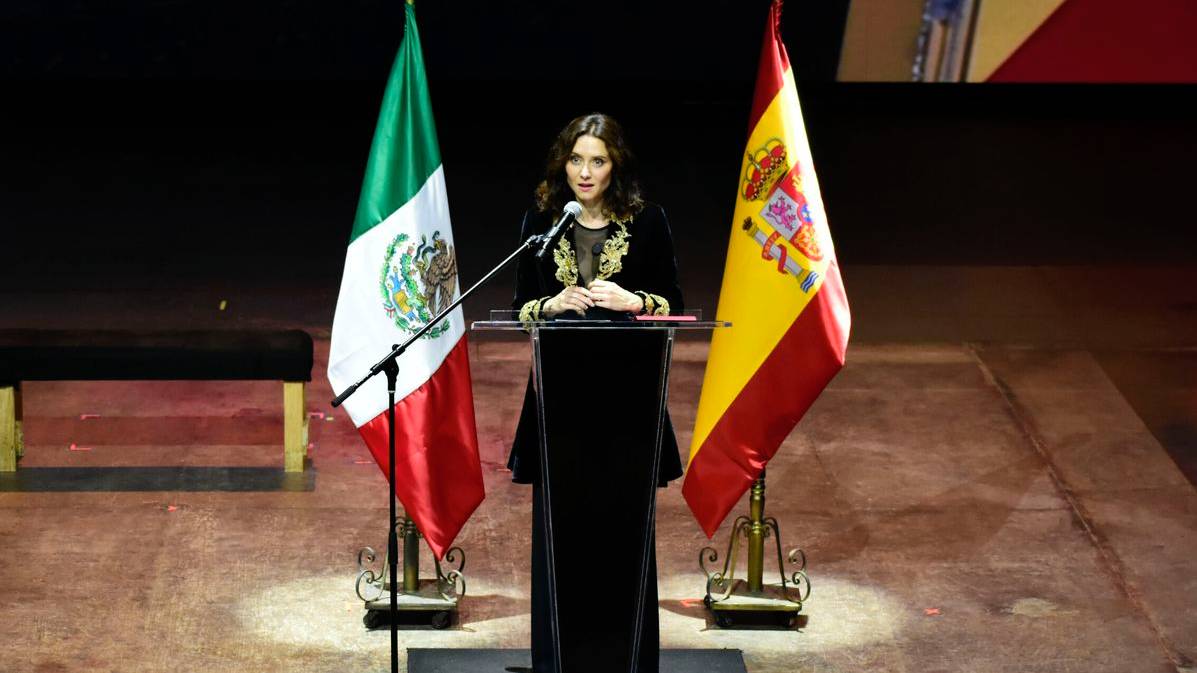
For several days, Spanish and Mexican media were dominated by the visit of the President of the Community of Madrid, Isabel Díaz Ayuso, representative of the most conservative wing of Spain’s Popular Party (PP), to Mexico and the ensuing spectacle of actions and reactions involving the local government. The debates it sparked seemed to place the reader-viewer before the need to line up behind either Mexican President Claudia Sheinbaum or Ayuso, almost as if it were a neighborhood football club match.
That visceral polarization risks obscuring the structural dimension underlying the diplomatic incident: the consolidation of a transnational ultraconservative network. And, particularly relevant for the Latin American reader, a contradiction that this movement would rather keep concealed: “Hispanidad” as a banner and borders as practice.
An infrastructure, not an incident
The visit did not emerge out of nowhere. Ayuso belongs to a specific ecosystem. Since 2020, a formal architecture of transnational ultraconservative coordination has been taking shape on both sides of the Atlantic. The Madrid Forum, founded by the Spanish far-right party Vox, defines itself as a permanent “international organization,” explicitly designed as a conservative counterweight to the São Paulo Forum and the Puebla Group. The tension is real: three weeks before Ayuso’s trip, Sheinbaum, Lula, Petro, and Sánchez, among others, gathered in Barcelona for the IV Summit “In Defense of Democracy.” Two transnational networks, two agendas, one global ideological battle. Ayuso’s trip to Mexico is just another node in that circuit.
The three keys to the visit
First, Ayuso did not meet with President Sheinbaum, nor with Congress, nor with the Head of Government of Mexico City. She met with the mayor of Cuauhtémoc, the governor of Aguascalientes, and leaders of the National Action Party (PAN), with no high-level meeting on the agenda.
The language is equally revealing, to the point of reviving the archaic spelling “Méjico” in her communications. Ayuso praised Hernán Cortés, celebrated the conquest as a civilizing mission, and described the relationship between Spain and Hispanic America as “five centuries of love.” These are not diplomatic blunders, but the deliberate vocabulary of a transnational political identity that constructs its enemy—the communist narco-state—while also contesting the past: mestizaje as a “message of hope and joy,” and its critics as “idiots” and enemies.
When the trip was interrupted, the third element was predictable: the narrative of persecution. Ayuso accused Sheinbaum’s government of “boycotting” her visit, orchestrating a “totalitarian drift,” and later, of failing to receive protection from the Spanish government. Categorically denied by the Xcaret Group, the martyrdom narrative collapsed empirically, but it had already fulfilled its function: days of international coverage, a villain, and a heroine who “stood up to the left.”
The playbook and its operators
This playbook is neither exclusive to Ayuso nor a Spanish invention. Milei executed it with inverse precision: he traveled to Madrid, declined to meet with Sánchez, surrounded himself with Vox and PP leaders, used the same political grammar—“socialism,” “decadence,” “destruction of freedom”—and reaped the expected coverage and scandal. The mirror image is almost perfect.
Among the conservative centers of gravity, Trump stands out as the foremost exponent: his rhetoric about the Western Hemisphere revives the “Monroe” doctrine, and his Mar-a-Lago estate functions as a consecration stage for the circuit. Ayuso was honored there for her work on behalf of Hispanidad, sharing the stage with Milei and María Corina Machado.
The Venezuelan opposition leader, who executes the playbook flawlessly, embodies the Venezuela that the movement needs as a rhetorical weapon: “Madrid cannot become Caracas.” But Venezuela is also the human reality of more than seven million displaced people living in countries where this movement promotes restrictive and exclusionary policies.
An overlooked contradiction
The same political ecosystem that sends figures to Latin America to celebrate “Hispanidad” is today waging a battle against Latin Americans in Spain. Faced with the extraordinary regularization of around half a million immigrants promoted by Sánchez’s government, the PP forcefully rejected the measure. Vox described it as “consecrating the invasion.” Nearly 70% of the potential beneficiaries are Latin Americans—precisely the peoples whom the rhetoric of the “Iberosphere” embraces as brothers in civilization.
The timing is eloquent. While Ayuso was receiving medals in Aguascalientes, her own party in Madrid was opposing the regularization of hundreds of thousands of Latin Americans. The narrative arrived in Trumpian terms: “invasion,” “Spain first,” and mass deportations —the vocabulary of the American node applied in Madrid against the very people the circuit embraces during its Latin American tours. “Hispanidad,” it seems, has a precise geography. It functions as a slogan on Latin American stages, but evaporates in Spanish parliaments.
The evidence suggests that the classification of the “good Hispanic immigrant,” popularized by Ayuso, was never protection. It was a tactic: a racial hierarchy designed to target African and Muslim immigration. When that tactic collides with the concrete reality of regularization, the movement chooses the “Spain first” element over “Hispanidad.” The clearest gesture came from Vox, which shut down the website “Latinos por Abascal” in January 2026 under anti-immigration pressure from its own base.
Latin American migrants are indispensable as a discursive argument: they embody the danger of “communism.” Whether Colombians emigrated under Duque or Petro, or Argentines under Kirchnerism or Milei, is irrelevant when defining the enemy. But as individuals, they remain subject to the same logics of exclusion that the movement constructs. The question that must therefore be asked is very concrete: in which column does Mexico stand—among the brothers of civilization, or among the “invaders”?
What Latin America should be watching
The importance of the Ayuso case in Mexico does not lie in diplomatic protocol or in the spectacle surrounding its two protagonists. It lies in the network and its methods. A transnational conservative network with a framework of alliances, vocabulary, and common enemies operating across “Hispanic America” or the “Western Hemisphere.” It knows how to generate scandals that function as propaganda, frame freedom as a banner and communism as a threat, and use Latin America as a stage for legitimation or Latin Americans as invading migrants depending on what is most convenient.
The reader-viewer who wants to move beyond football-style polarization will have to learn to read the clues concealed by the scandal: who is in the room, the vocabulary being deployed, and the martyrdom narrative that will inevitably follow. And to ask what that same leader says about their own people, at home, when Latin American cameras are pointed elsewhere.
Autor

Sociologist from the National University of Cuyo and PhD in International Relations from Florida International University. Advisor at Pan-American Strategic Advisors. Postdoctoral researcher at the Steven J. Green School of International and Public Affairs at Florida International University.