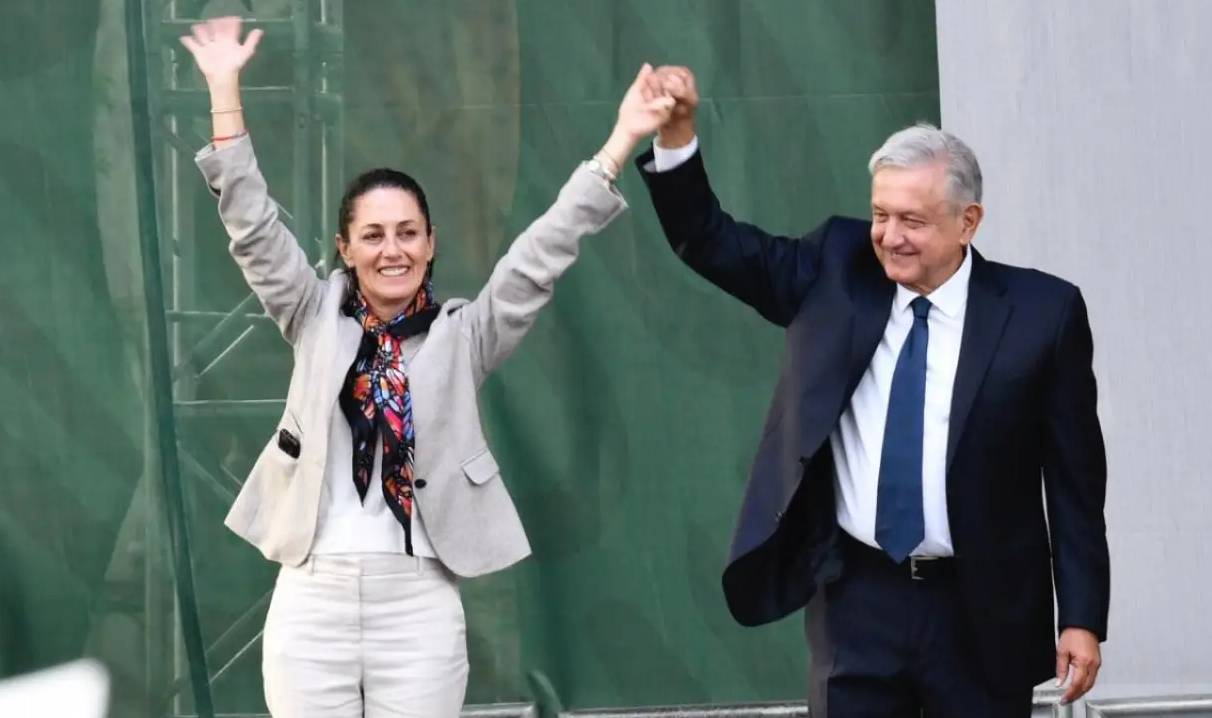
The 2026 Democracy Report by the V-Dem Institute, a global academic analysis coordinated by the University of Gothenburg that measures and classifies the quality of democracy worldwide, notes that Mexico’s political system has shifted from a liberal democracy to an “electoral autocracy.” This regressive classification comes at a bad time for the government of President Claudia Sheinbaum, who faces U.S. pressure and the multiple elections to be held on June 6, 2027, in Mexico.
There is no doubt that the President of the United States, Donald Trump, will take note of this report and add it to his narrative that Mexico is a “narco-state,” and that President Sheinbaum does not acknowledge this because she is afraid to confront organized crime cartels.

The report also comes at a bad time because, although the ruling party now claims the president’s approval rating exceeds 70%, unity within the legislative branch between Morena and its allies—the Green Ecologist Party of Mexico (PVEM) and the Labor Party (PT)—has cracks: a presidential commission composed solely of Morena members and officials drafted a constitutional and regulatory reform initiative that sought, with little tact, to further empower Morena at the expense of its political allies’ interests.
The so-called Plan A for constitutional electoral reform contemplated a series of changes that ran counter to public financing for political parties and promoted a new model of political representation that was endorsed neither by the traditional opposition nor by Morena’s allied parties in Congress.
This rejection triggered an unnecessary offensive against those who broke unity—or rather, who rejected the submissive role assigned to them by the ruling party. The rupture was partially repaired through modifications to the original proposal, the so-called Plan B, which managed to bring the Green Party into alignment but not the Labor Party, which is ideologically further to the left than the ruling bloc.
Without the votes of six Labor Party senators, it was impossible to reach the qualified majority required to amend the constitutional pact in reforms of this kind, which demand a two-thirds majority in both chambers. Given this reality, the recall referendum provided for in the Constitution—an instrument promoted during President López Obrador’s term, whereby the president submits to citizens’ judgment to determine whether they should remain in office or be removed—will not be held concurrently with the 2027 constitutional elections but, as planned, in 2028, without campaigns or legal involvement from political parties.
That referendum will test Sheinbaum’s high approval ratings in perception polls. If the president translates that approval into victory, the referendum will allow her to distance herself from López Obrador and decide without interference in the 2030 presidential elections. But if she is rejected by more than 40% of participants, she will have to leave office and be replaced by someone appointed by Congress. This would be a definitive blow to President Sheinbaum and to the so-called second phase of the Fourth Transformation (4T).
In that case, even if the replacement were another Morena member, it would reveal that she does not have the support she claims, nor a party or political movement sufficiently rooted in the Mexican “people.” On the contrary, it would expose an unsustainable media strategy aimed at installing the idea that this party is the only one capable of governing.
Thus, presenting an exclusionary initiative without opposition consensus—or worse, without considering the interests of its allies—was a miscalculation destined to be rejected in the Senate vote; or perhaps, why not, a move by former president López Obrador to keep Sheinbaum aligned with his interests.
Now the president faces a triple challenge: restoring trust among the parties that make up the Sigamos Haciendo Historia coalition, preserving that coalition for the 2027 elections, and winning the recall referendum decisively.
However, in these bitter days for President Sheinbaum, politics continues to unfold within allied parties, which have shown that Morena, without their votes, is not what it claims to be internationally. They now know—given the arrogance displayed in the constitutional proposal—that they have specific political weight beyond blackmail and ideological or political arrangements.
Evidence of this power can be seen in early political disputes in some states, where local leadership is setting the course. This requires a significant political operation ahead of candidacies for the Chamber of Deputies and for 17 of the 32 states that will renew their governments in June 2027.
The forecast is that Morena and its allies will not necessarily form coalitions everywhere. While they may remain allied in most electoral districts, in others they could run independently, with their own candidates or in coalition with the Green Party and the Labor Party. Nor should it be ruled out that, in some districts, alliances may be formed with the traditional opposition—PAN, PRI, or Movimiento Ciudadano—something that should concern strategists at the National Palace and within Morena for having opened this Pandora’s box.
Regardless of the outcome in 2027, it is evident that these will not be elections like those of 2024, and, predictably, if the trend of ruptures and realignments continues, there will be a new distribution of power in the Chamber of Deputies and across the states.
However, the results that may emerge in 2027 will not be sufficient to contradict the Swedish report on the quality of democracy, which defines Mexico as an “electoral autocracy.” This reality cannot be reversed because it would require not only a new majority in the Chamber of Deputies but also in the Senate—and that will not be at stake in 2027, but in 2030. Any reversal would require a qualified majority in both chambers and majorities in 18 local congresses.
Finally, one point worth highlighting is that the broad coalition formed in 2018 and reaffirmed in 2024 in support of Obradorism no longer has the momentum it had during López Obrador’s presidency. Sustaining it requires extensive clientelism, political renewal, and new agreements—not only with allies but also with the traditional opposition, which is necessary in the face of pressure from U.S. President Donald Trump, who repeatedly targets the political flank where Morena actors are allegedly linked to organized crime cartels. This is especially relevant now, as negotiations over the continuation of the USMCA are underway.
Autor

Professor at the Universidad Autónoma de Sinaloa. D. in Political Science and Sociology from Universidad Complutense de Madrid. Member of the National System of Researchers of Mexico.