The Secretary of Security, Omar García Harfuch, has spent weeks traveling across the country alongside President Claudia Sheinbaum, stating that homicide rates have declined in Mexico and that this is the result of his political strategy. The government reports a 44% decrease in the daily average of intentional homicides between September 2024 and February 2026, dropping from 87 to 49 cases per day. But the reality is that Mexico is facing one of the most violent moments in its history.
The government needs to show results to the United States, while the local political system remains bewildered, not really understanding what is happening. The truth is that criminal governance is more widespread than ever, as reflected in the increase in the number of disappeared persons, very high levels of reported homicides, and widespread criminal impunity across the territory. This has generated growing distrust in the information presented by the government.

The security strategy
The government has focused on consolidating, expanding, and extending a National Guard now fully integrated into the Ministry of National Defense. Along these lines, it has announced the strengthening of an intelligence apparatus that operates in coordination with the Armed Forces. In addition, it has implemented targeted operations against criminals, politicians, and police officers who operate in the service of criminal organizations.
At the end of 2024, the government launched “Operation Swarm,” aimed at detaining authorities in different federal entities. Since then, drug laboratories have been destroyed, operations against telephone extortion centers have been carried out, and a large network of hydrocarbon smuggling—also linked to tax crimes and operated by employees of the Ministry of the Navy—has been dismantled.
Additionally, the government extradited from Paraguay Hernán Bermúdez Requena, former Secretary of Public Security in Tabasco and leader of the criminal organization “La Barredora,” a close collaborator of the Morena leader in the Senate, Adán Augusto López Hernández. As its greatest trophy, the Sheinbaum administration eliminated “El Mencho,” the top leader of the Jalisco New Generation Cartel, which triggered road blockades, arson attacks, and localized violence in different parts of the country.
Following the decapitation of the organization, a struggle has erupted among the former factions of the Sinaloa Cartel aligned with Mayo Zambada, the “Chapitos,” or other leaders such as José Caro Quintero. These clashes are occurring mainly in Sinaloa and Sonora, but also across the national territory, especially in areas where groups are competing for territorial control.
Violence remains very intense in states such as Michoacán, where the mayor of Uruapan, Carlos Manzo—who had created a political movement for peace—was assassinated in the city center. It also continues to be severe in rural areas of Morelos and Guerrero and in many other parts of the country. In fact, major industrial, commercial, and tourist corridors operate alongside high levels of violence.
The case of Chiapas is paradigmatic of the consequences of concessions to the United States. In 2019, Mexico fortified its southern border under pressure from the U.S. government to stop migrant flows. With the closure of border crossings, organized crime found a highly profitable business: controlling and charging for the movement of people. This led, from 2021 onward, to a surge in arrivals of Venezuelans, Haitians, Asians, and Africans. As a result, disputes among criminal organizations over different areas of the state intensified.
The rise in disappearances
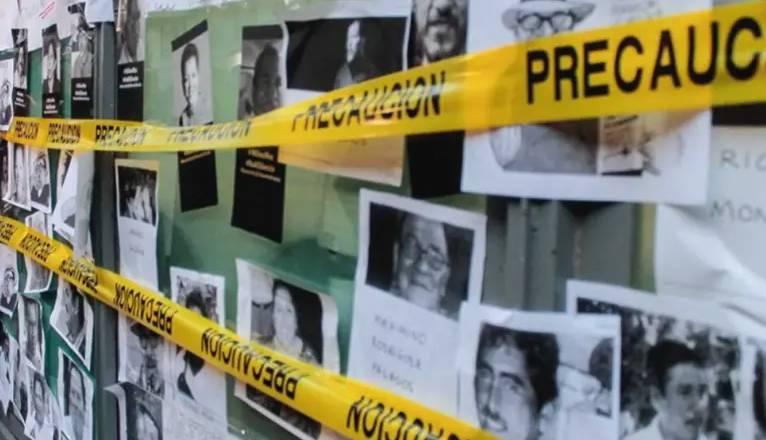
Although the number of murders has apparently declined, the number of disappeared persons in Mexico has increased from 4,126 in 2015 to 12,663 in 2025, totaling more than 92,000 disappearances between 2015 and 2025. This has raised alarm at the United Nations, which is increasingly insisting on the need to halt this phenomenon.
The problem of violence in Mexico is very deep and manifests in different forms across the entire national territory.
The administration of Omar García Harfuch has had to simultaneously confront a major administrative and institutional transformation. It has strengthened the Armed Forces, attempted to control the intelligence system, and created a rapid-response force that answers directly to its command. So far, actions have been more targeted and surgical—as demanded by the Trump model—and less deep-rooted across the territory, leaving municipal and state police forces without sufficient capacity.
In light of this reality, the government’s communication strategy seeks to maintain optimism and emphasize “good news”; however, the country’s reality is very different. In much of Mexican territory, people live in fear, subjected to extortion, the “protection fees” demanded by criminals, and the spillover effects of violence driven by territorial control and the absence of the state.
Autor

National Researcher Level II affiliated with El Colegio de la Frontera Sur. PhD in Political Science and Sociology from the National University of Distance Education, Madrid.