In Brazil and Argentina, few institutions generated symbolic integration comparable to that of the national football team during the twentieth century. In societies marked by regional inequalities, institutional fragility, and challenges of territorial integration, the World Cup offered an exceptional experience of collective belonging.
That experience had political effects, since football, television, and the state operated within the same national structures of mediation. While collective symbols circulated through a handful of major media outlets, governments could associate sporting success with political legitimacy.

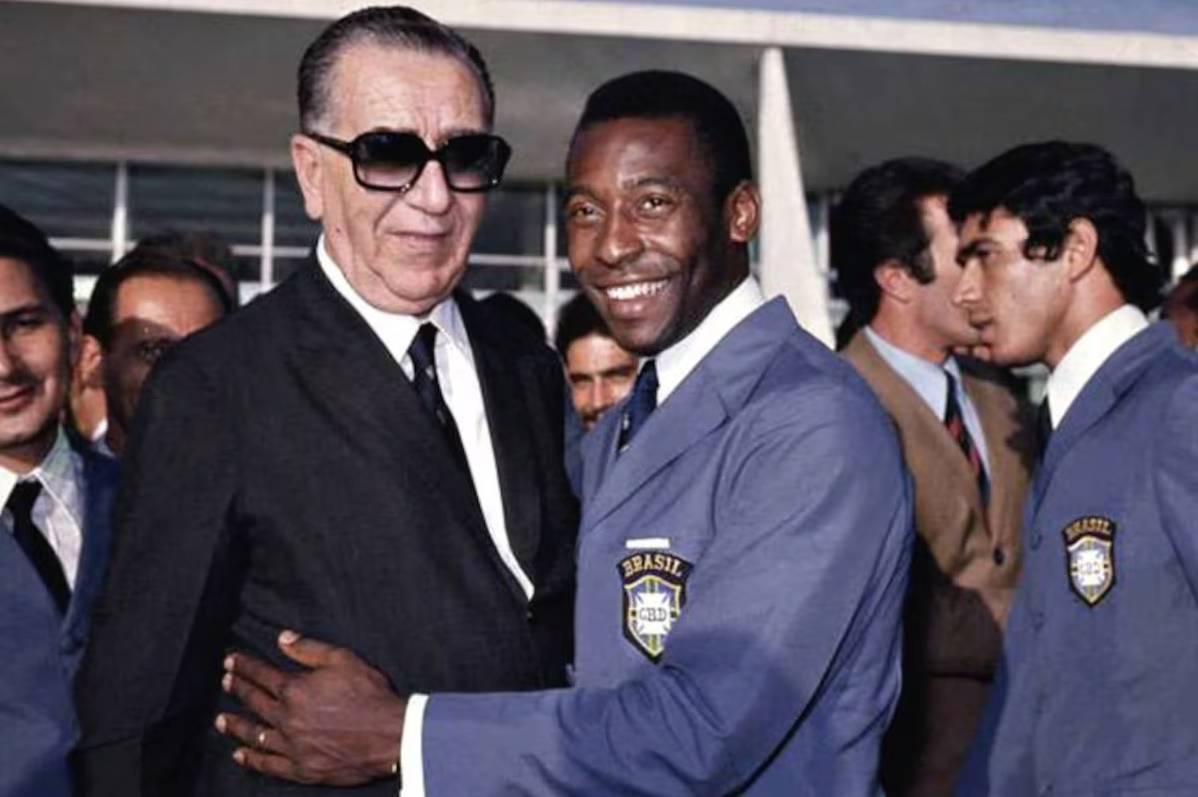
Brazil in 1970 was a clear example. The expansion of public television allowed the military dictatorship to synchronize the emotion generated by Pelé with an optimistic image of the country. The third World Cup title became associated with economic growth, modernization, and territorial integration. The national team came to embody a representation of Brazil itself.
This operation was possible because a relatively centralized public sphere still existed. Television organized much of the national conversation and made it possible to stabilize shared meanings about the political community. Social and regional divisions persisted, but they remained subordinate to a common narrative of national belonging.
Argentina in 1986 operated under a similar logic. The defeat in the Falklands/Malvinas War had triggered a military crisis and undermined state authority. The match against England became a symbolic continuation of the 1982 war because Maradona embodied a national-popular representation based on sovereignty, opposition to the central powers, and popular identification. His political centrality stemmed from his ability to reorganize the relationship between the people, the state, and national identity.
The 1990s transformed the conditions that had made this connection between football and state legitimacy possible. The fragmentation of the public sphere altered the way national symbols circulated and acquired political meaning. Television no longer monopolized the public conversation. Digital platforms, global markets, and the expansion of transnational entertainment dispersed the mechanisms of collective identification. The simultaneous experience of the World Cup remained, but establishing a shared interpretation of its political significance became far more difficult.
The conflict between Javier Milei and the Argentine Football Association (AFA) reflects this transformation. The dispute is no longer primarily about symbolically appropriating the national team, but about controlling one of the principal structures that produces cultural legitimacy in Argentine society. Football’s symbolic capital remains enormous, but it is now distributed among federations, platforms, sponsors, European clubs, and competing political actors.
Messi belongs entirely to this new landscape. His sporting legitimacy was built outside Argentina, and his triumph in Qatar 2022 restored a rare moment of collective simultaneity in the public life of a polarized country. The celebration of the World Cup victory, however, circulated within mediation structures far more fragmented than those of Maradona’s era, limiting the state’s ability to incorporate that symbolic capital.
Brazil perhaps offers the clearest example of this shift. For decades, the national team’s jersey was one of the most immediate symbols of a shared national identity. Since 2018, however, the traditional yellow shirt has become strongly associated with Bolsonaro’s political movement and has lost part of its integrative capacity.
The effect was visible during the last two World Cups, when many supporters began wearing the blue jersey as a way of avoiding that political association. This illustrates the extent to which football still generates collective belonging, but can no longer symbolically organize the nation in the way it did for much of the twentieth century.
Pelé and Maradona emerged in a context in which football, television, and the state still operated within relatively unified national structures. Messi and Neymar belong to a different world—one in which football retains its power to mobilize emotions but no longer enables states to politically stabilize its meaning.
Autor

Profesora de la Faculty Central de Recife y Doctora y Máster en Ciencia Política por la Universidade Federal de Pernambuco (UFPE), Brasil. Member of the Red de Politólogas.