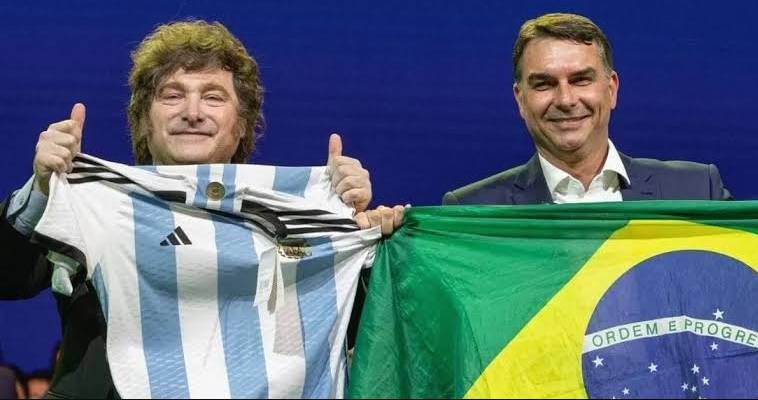
Javier Milei’s visit to São Paulo on July 25 to support Flávio Bolsonaro’s presidential candidacy helped trigger a new diplomatic crisis between Brazil and Argentina. But the episode represents something broader: the growing coordination of Latin American right-wing forces and the struggle over the region’s political direction.
During the convention of the Liberal Party (PL), Milei directly attacked President Lula, whom he called a “thief” and a “socialist,” and also lashed out at Supreme Court Justice Alexandre de Moraes. At the same time, he presented Flávio Bolsonaro as the alternative capable of “stopping” socialism. The intervention showed the extent to which the disputes involving the new Latin American right are crossing national borders.

The episode is part of a political cycle that is reshaping the regional balance. Recently, the right has advanced in Argentina, Bolivia, Chile, Ecuador, and Paraguay, and in 2026 it added the victories of Keiko Fujimori in Peru and Abelardo de la Espriella in Colombia. Brazil is now preparing for one of the year’s most important elections, to be held in October. This shift shows that the right has gained ground across much of South America, although its governments and political projects are rooted in different traditions and agendas.
This is not, however, simply a repetition of the “conservative wave” of previous decades. The right itself is changing. Traditional parties are incorporating discourses centered on security, reducing the role of the state, and cultural confrontation, while more radical movements are seeking to become governing forces. The boundary between the traditional right, the conservative right, and the far right is becoming increasingly difficult to establish.
Insecurity and deteriorating economic conditions play a central role in this process. Promises of a “tough-on-crime” approach are combined with a discourse that blames traditional political elites for the crisis. The experience of Nayib Bukele in El Salvador and Donald Trump’s return to the White House provide reference points for these new right-wing forces, which find in security, cultural confrontation, and opposition to the left tools for electoral mobilization.
Brazil is now one of the main arenas of this dispute. The latest polls continue to place Lula in the lead, but show a close contest with Flávio Bolsonaro. The BTG/Nexus poll released on August 17 puts Lula at 41% and Flávio at 36% in the first round. In a potential runoff, Lula receives 47% and Flávio 44%. The Quaest poll also pointed to a close race, with Lula at 43% and Flávio at 40% in the runoff.
But the contest is not limited to the two leading candidates. Ronaldo Caiado, Romeu Zema, and Renan Santos are also seeking to occupy the conservative space, although they still register lower percentages in the polls. Their presence reveals a struggle within the right itself to determine who will be capable of representing this electorate and, eventually, surpassing the political leadership built by Jair Bolsonaro.
The U.S. dimension is fundamental to understanding this scenario. Donald Trump’s administration is no longer a distant ideological reference but an actor with a concrete capacity to intervene in Latin American political conflicts. Commercial pressure on Brazil, criticism of Brazilian institutions, and political support for Bolsonaro-aligned sectors linked to former President Jair Bolsonaro, who was convicted of attempting a coup, once again place Washington at the center of disputes over the region’s political direction.
Here, a central contradiction emerges. While the new Latin American right uses the language of national sovereignty, many of its forces simultaneously seek a privileged relationship with Washington and accept external instruments of pressure against opposing governments. Sovereignty appears to be becoming a selective principle: it is invoked when confronting the left, but relativized when the pressure comes from the United States and benefits their own political camp.
Brazil is a particularly clear case. Flávio Bolsonaro has sought to strengthen his ties with Trump and present his candidacy as part of a broader international political alliance. Bolsonaro-aligned sectors have also welcomed the measures adopted by Washington against Brazil. The tension between the nationalism championed by Bolsonarismo and its willingness to accept pressure from a foreign power constitutes one of the main contradictions of this political project.
For Lula, this situation opens up electoral space. Faced with pressure from Washington and Milei’s attacks, the Brazilian president has reinforced a discourse centered on defending sovereignty and national autonomy. While Flávio combines a nationalist discourse with a close alignment with Trump, Lula seeks to portray external pressure as a threat to Brazilian interests and counter it with a policy of greater international autonomy.
The confrontation also carries costs for both countries. Brazil and Argentina have an economic and strategic relationship that goes beyond the ideological preferences of their governments. Trade, investment, production chains, energy, and Mercosur depend on a relatively stable relationship. Milei’s strategy of confrontation may strengthen his position within the regional right, but it damages a relationship that is fundamental to the Argentine economy and to South American integration.
This connection between domestic and foreign policy is one of the defining features of the new regional right. Electoral disputes are no longer fought exclusively within national borders: political leaders exchange support, rhetoric, and strategies, while external actors such as the United States are playing an increasingly visible role in shaping political alliances.
For this reason, Brazil’s election will be more than a presidential contest. It will be a test of the new Latin American right’s ability to transform its electoral growth into regional hegemony and, at the same time, of who will succeed in leading Brazil’s conservative camp. Following the victories of the right in Peru and Colombia, Brazil becomes one of the main battlegrounds between two different projects for the region’s political future.
The result will show whether this transformation can become consolidated or whether Lula can still represent a limit to the new regional political configuration. In October, Brazil will not simply elect a president: the political balance of Latin America will also be at stake, as will the kind of relationship the region establishes with the United States.
Autor

Bachelor of Science and Humanities and undergraduate in International Relations and Economics from the Federal University of ABC (UFABC) and researcher at the Observatory of Foreign Policy and International Insertion of Brazil (OPEB).