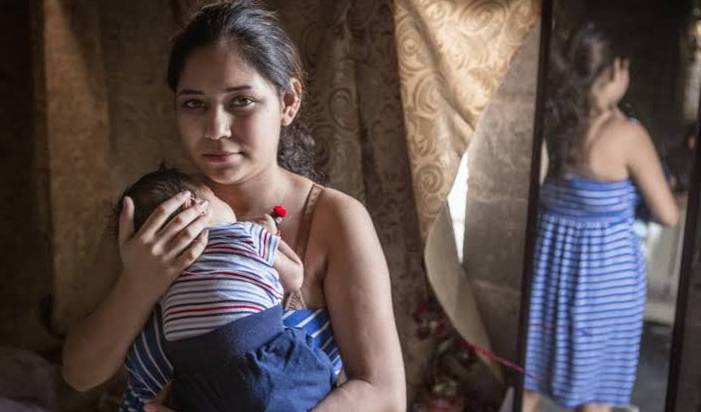
In Portobelo, a town on Panama’s Caribbean coast, adults often warn teenage girls: “Be careful, or you’ll end up with your Sunday seven!” This popular expression, common in several Central American countries, is used to refer to an unexpected pregnancy. Yet the warning is almost never accompanied by an explanation. “They still treat it as a taboo,” says Jiseel Muñoz Chavarría, a young community leader from the province of Colón. “They never explain to them how to prevent unintended pregnancies.”
What happens in Portobelo reflects a contradiction found throughout Latin America and the Caribbean. Many teenage girls are told to avoid pregnancy, but most of the time neither they nor adolescent boys receive the information, contraceptives, and sexual and reproductive health services they need to do so. It is worth noting that two out of every three teenage pregnancies are unintended and, in many cases, result in child marriages or forced unions. Nevertheless, the region has made significant progress in recent years, although that progress has been uneven and insufficient.

Risk is not distributed equally
Over the past few decades, Latin America and the Caribbean has managed to reduce adolescent fertility. Among girls aged 15 to 19, the rate fell from around 73 births per thousand in 2010 to 50 in 2025. This represents a decline of nearly 30%; however, countries are not progressing at the same pace, and national averages can conceal even greater inequalities within individual countries.
Girls born into low-income households, living in rural areas, or belonging to Indigenous or Afro-descendant communities often face greater risks of becoming pregnant before the age of 19. The vulnerable circumstances they experience limit their ability to access contraceptives, comprehensive sexuality education, and quality health services.
This is particularly evident in rural and coastal areas of Central America and the Caribbean. These areas are home to Afro-descendant, Creole, Garifuna, Miskito, and Indigenous communities that have endured long processes of exclusion. Adolescents from these populations face greater obstacles to receiving comprehensive sexuality education and accessing quality, confidential health services adapted to their needs. A basic example is simply being able to reach a health center, which often is far from their communities.
The lack of staff and supplies, prejudice, racism, and the existence of services that do not always take into account the languages or cultural practices of these communities also play a role. Added to these barriers is the taboo that still surrounds sexuality within many families and schools.
Averages can leave many behind
The decline in the regional rate shows that public policies have produced results. The expansion of sexual and reproductive health services for adolescents, access to modern contraceptive methods, and the gradual incorporation of comprehensive sexuality education have all contributed to this progress.
To move beyond national averages and address the needs of vulnerable populations, the response must also take their circumstances into account. Free, confidential, accessible health services free from racism and discrimination would make a difference. The same applies to comprehensive sexuality education both inside and outside schools, with age-appropriate content and a territorial and intercultural approach. At the same time, effective mechanisms for reporting sexual violence and accessing justice are needed.
Child, early, and forced marriages and unions, in turn, require a specific response. Thirty-five percent of teenage pregnancies occur in the context of such a union, while 45.4% of adolescent girls living in these unions become pregnant.
Preventing teenage pregnancy is therefore not limited to providing contraceptives. It also requires families, schools, health services, and communities to create the conditions necessary to prevent it.
When our girls and adolescents are able to make decisions about their bodies and freely and knowledgeably plan their reproductive lives, when the prevention of all forms of gender-based violence, including sexual violence, becomes a reality, and when they have the opportunities and tools to develop their life plans, they will be in a better position to choose the path they want to follow in life. They have the right to do so.
Autor

Regional Advisor on Sexual and Reproductive Health for the United Nations Population Fund (UNFPA) in Latin America and the Caribbean.