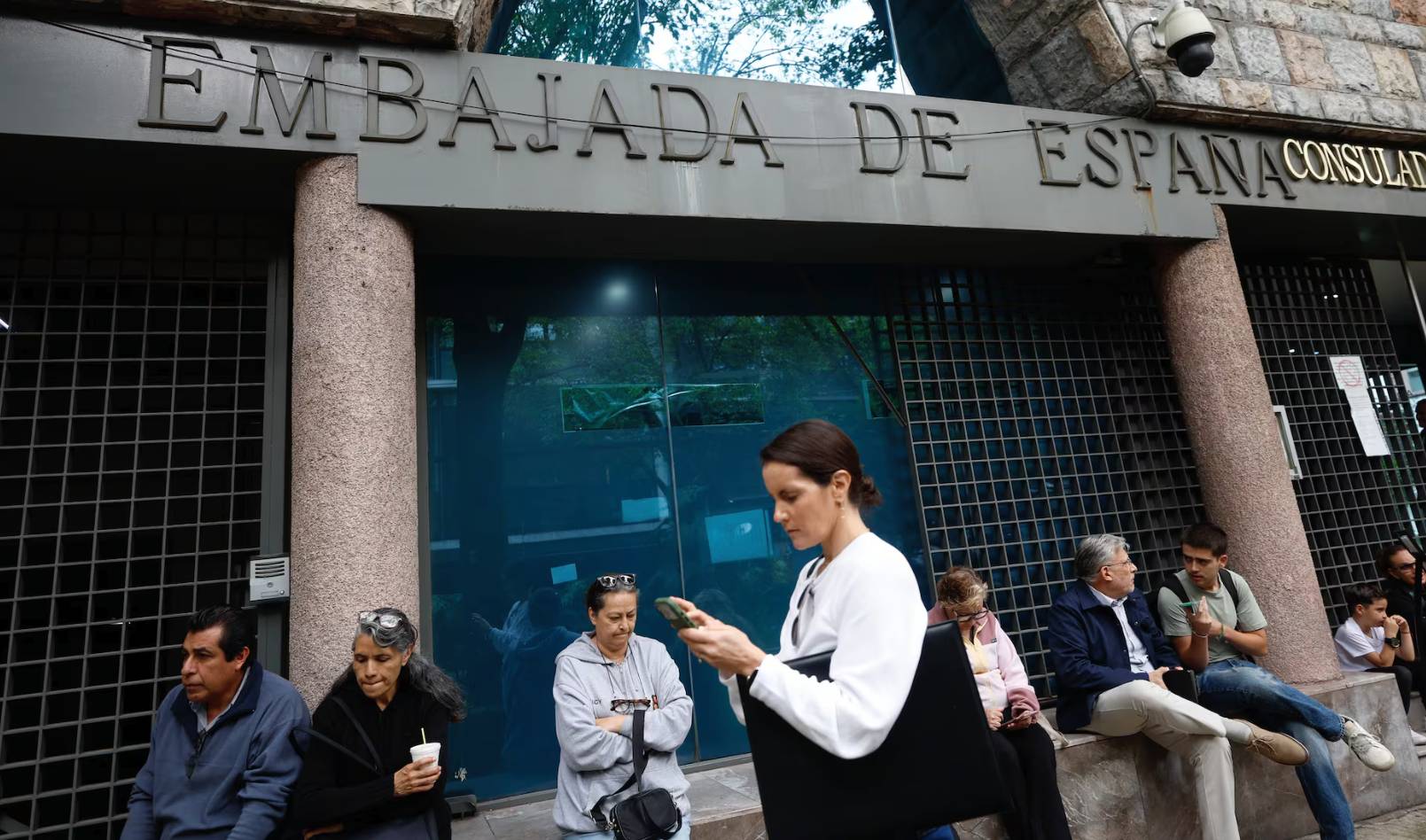
On November 29, Spain will elect its Congress of Deputies and Senate, and part of that election will be decided far from Madrid. Of the 38.7 million voters eligible to cast a ballot, 2,769,645 live abroad, representing 7.15% of the total. The country with the largest number of Spanish voters is neither France nor Germany: it is Argentina, with 520,023, or almost one in five of all overseas voters. Cuba, Mexico, Venezuela, Brazil, and Uruguay complete a map in which Latin America carries more electoral weight than any other region in the world.
The 2022 Democratic Memory Law opened the door to Spanish citizenship for descendants of those who left Spain during the Civil War and Franco’s dictatorship. A directive issued by the Ministry of Justice that same year went even further, presuming that everyone who emigrated between July 1936 and December 1955 had gone into exile. The Spanish consulate in Buenos Aires alone received 645,052 applications, compared with 337,980 Spaniards registered in that consular district before the law was passed.

In September, at the request of the far-right party Vox and the Iustitia Europa association, the Supreme Court provisionally suspended the voting rights of those who had obtained citizenship under that presumption. In October, it rejected the government’s appeal and upheld the suspension for the November 29 election. The measure affects 163,020 registered voters, unless consulates certify that they meet the requirements established by the law. The government argues that, given historically low participation rates among overseas voters, only around 14,000 of them would actually have cast a ballot. The dispute is more symbolic than numerical. And that is precisely what makes it political.
The paradox is that Latin Americans holding Spanish passports are precisely the voters least likely to cast a ballot. In the 2023 general election, more than half of overseas voters lived in Latin America, yet voters residing in Europe accounted for 62% of ballots cast abroad. Disconnection from the country and logistical obstacles both play a role. That year, Cuba had only one consulate, in Havana, even though fewer than 30% of Spaniards on the island live in the capital.
Spain knows all too well the cost of such barriers. From 2011 to 2022, it required emigrants to apply in advance to vote, and overseas turnout fell from 31.7% in 2008 to 4.9% in 2011. I was part of that electoral register myself during my years as an expatriate, when the system of requesting a ballot was still in force, and I can attest to how difficult it was to participate from abroad.
There is another problem: votes are not counted where voters live. Spain has no overseas electoral constituency. Each voter is assigned to their last municipality of residence or, if they have never lived in Spain, to the municipality with which they or their ancestors have the strongest ties. A grandchild of Galician emigrants living in Rosario, for example, votes for representatives from Ourense, a province where almost 31% of registered voters live abroad. They elect representatives ten thousand kilometers away, to whom they will have little opportunity to hold to account.
Across the Atlantic, the trend is the opposite: states do not restrict their diasporas; they court them. Almost every Latin American country allows citizens to vote from abroad, and several grant them their own representation. Colombia has reserved a congressional seat for citizens living overseas since 2002. Ecuador allocates six of the 137 seats in its National Assembly to overseas voters, while the Dominican Republic reserves seven of the 190 seats in its Chamber of Deputies for them. Peru established a constituency for citizens abroad in 2021, and Mexico has guaranteed migrant representation in its Chamber of Deputies since that year through an affirmative action measure mandated by the electoral court and implemented by the National Electoral Institute (INE).
The most recent example is El Salvador, which in May 2026 created an overseas constituency with six of the 60 seats in its Legislative Assembly. This is revealing: Nayib Bukele has cultivated the diaspora, particularly Salvadorans living in the United States, as a political base, and the new constituency formalizes that relationship.
There is no reason to idealize this model. Overseas electorates carry more weight in political discourse than at the ballot box. In the Dominican Republic, one of the countries with the longest tradition of overseas voting, abstention among diaspora voters exceeded 82% in 2024. Representation is also uneven: Colombia has just one representative for approximately five million citizens abroad, compared with one for every 400,000 in Ecuador. And remote voting requires rigorous safeguards. Diasporas matter more for what they represent—remittances, influence, and legitimacy—than for the number of votes they cast.
Spain is not the only European country debating what to do with the descendants of its emigrants. Italy, whose citizenship-by-descent policy fueled enormous demand in Argentina, Brazil, and Uruguay for decades, tightened its rules on citizenship by blood in 2025. The two main countries of origin of European emigration to the Río de la Plata have taken opposite paths: one opened the door in the name of historical memory; the other narrowed it in the name of control.
Geopolitics lies behind these developments. Economic instability and tighter US immigration policies have turned a European passport into a form of insurance for many Latin American families. For Spain, this demand also represents soft power: a transatlantic community of citizens with emotional, economic, and now political ties to the country.
In Spain, the proposal to establish an overseas constituency is already on the table. The General Council of Spanish Citizens Abroad has proposed seven seats in the Congress of Deputies and five in the Senate, while the left-wing Sumar party took up the idea this summer. But the Constitution establishes the province as the electoral constituency, meaning that any change would require constitutional reform. There are also serious objections, starting with those who argue that residence should remain the basis for voting rights.
The Supreme Court’s decision raises a question that goes beyond the upcoming November 29 election: is citizenship granted in the name of historical redress full and unconditional, or does it remain subject to suspicion? While Latin American countries are turning their diasporas into electoral districts, Spain risks turning its own into a battleground for partisan disputes. Across the Ibero-American space, the boundaries of the electorate no longer coincide with those of the territory. The vote already crosses the Atlantic; representation, however, has yet to follow.
Autor

International political consultant. He has advised on electoral campaigns and for governments in Spain and Latin America. He has also collaborated on institutional communications with organizations such as ECLAC (CEPAL), the UNDP (PNUD), the OAS (OEA), and the IDB (BID).