Mobilization in the streets and on social media made the difference. But the election was marked by a chaotic election day, polarization, and a rightward shift in the country.
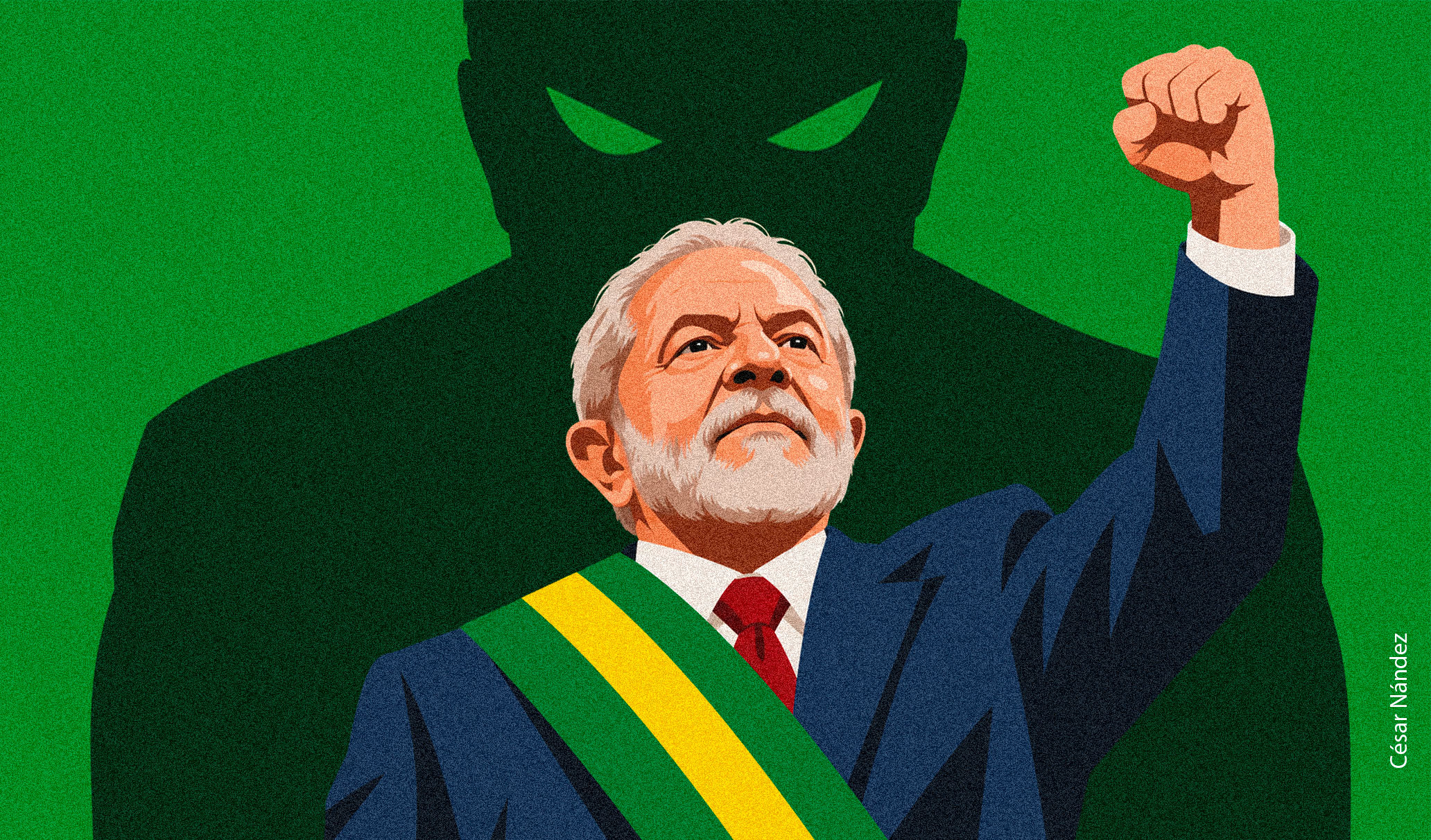
Brazilian President Luiz Inácio Lula da Silva achieved something no president had ever accomplished before. In the first round of the presidential election, on October 4, he unexpectedly trailed Flávio Bolsonaro, with 45.16% against 47.03%. Three weeks later, the Workers’ Party (PT) candidate prevailed with 51.79%, defeating Liberal Party (PL) candidate Flávio Bolsonaro, who received 48.21%.
The figures illustrate the scale of the turnaround. Between the two rounds, Lula gained approximately 10.38 million additional votes, while Bolsonaro added only around 3.72 million. Lula’s increase even exceeded the total number of votes received in the first round by all the eliminated candidates combined. In other words, he not only managed to attract voters who had supported other candidates, but also mobilized some of those who had not voted.

Around three million more voters took part in the second round than in the first. The increase in votes was not limited to the PT’s traditional strongholds in the Northeast. Lula also gained ground in cities and municipalities across the South and Southeast. The number of municipalities in which he won rose from 2,663 in the first round to 2,870 in the second. Even in key states such as Rio de Janeiro and São Paulo, he managed to significantly narrow the gap. In São Paulo, Bolsonaro had won the first round with a 14.7% lead; in the second, the difference between the two narrowed to 6.2%. The turnaround in Minas Gerais was particularly significant: Bolsonaro had won the state in the first round, but Lula overtook him in the second.
Three reasons for Lula’s victory
1. The shock of the first round
The first-round result sent shockwaves through Brazilian politics. Nobody had expected a gap of nearly 2%.
This was compounded by the PL’s clear successes in the legislative and gubernatorial elections held simultaneously. In the first round, the party won five governorships and 19 of the 54 Senate seats being contested. In 2027, it will become the largest force in the upper house, with 28 senators.
The PL’s unexpectedly strong performance and the prospect of a Flávio Bolsonaro victory led most eliminated right-wing candidates to rally behind him. Within the Bolsonaro movement, the impression took hold that victory was within reach. Those close to the candidate began talking early about possible ministerial appointments and the composition of a future government.
Lula and the PT, by contrast, were forced to acknowledge their mistakes and redirect their campaign within a matter of days. Under pressure from a younger generation on the left, they openly acknowledged that they had made insufficient strategic use of social media. At the same time, greater attention was paid to regional weaknesses, and reaching those who had not voted became central to the strategy.
These contrasting reactions proved decisive. While the Bolsonaro movement was already preparing for a victory it considered certain, Lula was strategically repositioning his campaign for the second round.
2. Mobilization in the streets and on social media
After the first round, the initially weak campaign transformed into a broad movement of social mobilization. Citizens, students, artists and cultural workers, young politicians, and digital activists increasingly took responsibility for the campaign.
A new generation of left-wing politicians and activists, in particular, highlighted the shortcomings of Lula’s digital communications. From that point on, his social media presence became more personal, more direct, and better adapted to the logic of digital platforms. Spontaneous videos, livestreams, easily shareable messages, and more content featuring Lula were used to target a younger audience and narrow the digital gap with Flávio Bolsonaro. According to Quaest’s Digital Popularity Index (IPD), a 9.3-point disadvantage turned into a 6.2-point lead in just eleven days.
One key figure was Congressman André Janones. The WhatsApp channel he created, “Exército do Lula” (Lula’s Army), surpassed ten million members in three weeks. Videos, audio messages, and instructions on how to spread campaign content were shared through the channel. The idea was to turn passive supporters into active multipliers.
The day after the first round, students from the Universidade Federal Fluminense, in Niterói, took to the streets to support Lula and defend democracy, public education, and science. In the following days, student mobilization spread to universities and secondary schools across different parts of the country.
The first major nationwide peak in mobilization came with the March for Democracy on October 11, which featured events in more than 70 cities. On the morning before the second round, according to estimates by the Rio de Janeiro city government, around 1.1 million people gathered in Copacabana. In the afternoon, Lula supporters filled at least 14 blocks of Avenida Paulista in São Paulo for his campaign’s closing rally.
3. Democracy as the central theme, social progress as a decisive supporting argument
The centerpiece of Lula’s campaign after the first round was the defense of democracy and the rule of law. The campaign portrayed the Bolsonaro movement as a threat to democratic institutions, seeking to frame the election as something beyond the traditional left-right confrontation. At his final major campaign rally on Avenida Paulista, Lula conspicuously held up the Brazilian Constitution and the national flag. In doing so, he sought particularly to reach moderate, liberal, and conservative voters who, despite their criticism of the PT, wanted to avoid a further escalation of institutional conflicts.
Shortly before the second round, the Senate also voted 75 to 1 in favor of gradually abolishing the 6×1 work schedule. The maximum working week would be reduced from 44 to 40 hours, with two paid days off per week envisaged. The broad support for the measure, which included some opposition lawmakers, shows that the reform cannot be considered solely a presidential achievement. Nevertheless, it gave Lula a concrete argument: that his government could deliver social change even under difficult parliamentary conditions.
These developments were complemented by an increase in the minimum Bolsa Família benefit and the advancement of October payments to before the second round. The government justified the measure on the basis of the expected effects of the El Niño phenomenon. Regardless of the official justification, the timing, in the middle of the campaign, was politically advantageous for Lula.
The combination of defending democracy and delivering tangible social improvements helped Lula reach beyond his traditional base, mobilizing non-voters and part of the moderate political spectrum.
Lula in power, Bolsonaro movement on the rise
Lula’s reelection represents political continuity, but it is not a cause for unqualified celebration for the Brazilian left. The narrow result, the PL’s successes in the legislative elections, the Senate, and the gubernatorial races, and the nearly 60 million votes cast for Flávio Bolsonaro instead show that the country’s rightward shift has become entrenched. Despite its defeat, the Bolsonaro movement remains the defining force of the Brazilian right and retains a broad social base, an effective digital infrastructure, and considerable parliamentary influence.
The PL can obstruct government initiatives and exert decisive influence over appointments and institutional debates. Lula will therefore continue to depend on agreements with centrist and moderate right-wing parties. The search for consensus is one of his political strengths. However, the new balance of power will present him with even greater challenges than before.
Relations between the branches of government as a warning sign
A central test of the next presidential term will be the relationship between the Executive, Legislative, and Judicial branches. In recent years, political conflicts have increasingly been settled before the Federal Supreme Court (STF) and the Electoral Court.
Election day itself demonstrated how difficult this balance can be. For the second round, public transportation was supposed to be free and operate at least at the frequency of a regular working day. However, several states reported reduced bus fleets, long waiting times, and failures to provide free transportation. In response, STF Justice Cristiano Zanin extended voting hours by two hours at polling stations that remained open. Both campaigns requested the extension, although for different reasons. Lula pointed to transportation problems, while the Bolsonaro movement cited, among other things, heavy rainfall.
After learning of his defeat, Flávio Bolsonaro declared that he would not recognize the result and would seek to have it annulled. He accused the STF of changing the rules in the middle of the electoral process. The president of the Superior Electoral Court (TSE), Kassio Nunes Marques, rejected the accusation, stating that the extension had not affected the integrity of the election or the vote count.
This confrontation offers a preview of what lies ahead in the next legislative term. Lula will have to negotiate with a conservative Congress while defending the independence of democratic institutions. It is likely that sectors of the PL will combine parliamentary opposition with broader criticism of the government, the judiciary, and electoral authorities.
Foreign policy: continuity and strategic autonomy
The reelection of Luiz Inácio Lula da Silva has regional implications that extend beyond Brazil. In a Latin America increasingly governed by right-wing and far-right forces, Lula remains one of the few prominent center-left presidents and the main political counterweight to the region’s rightward shift. His victory also halts the expansion of a conservative right-wing bloc backed by the government of Donald Trump in the United States. A victory for Flávio Bolsonaro would probably have given Washington another close ally and brought Brazilian foreign policy into closer alignment with that of the United States.
For the region, Lula’s reelection means that Brazil will continue to champion multilateralism, regional autonomy, and cooperation with different centers of power. Lula is expected to maintain Brazil’s strategic autonomy and avoid clearly aligning the country with either the United States or China.
This article was originally published in Diálogo Político.
Autor

Deputy Director of the Konrad Adenauer Foundation's Brazil office. Master of Science in Public Administration: International and European Governance from Leiden University, Germany.

Director of KAS Brazil. Exdirector of the workshop in Venezuela. Spanish Filology Study with Latin American Studies and Portuguese-Brazilian Studies in Berlin, as well as International Relations and African Studies in Madrid.