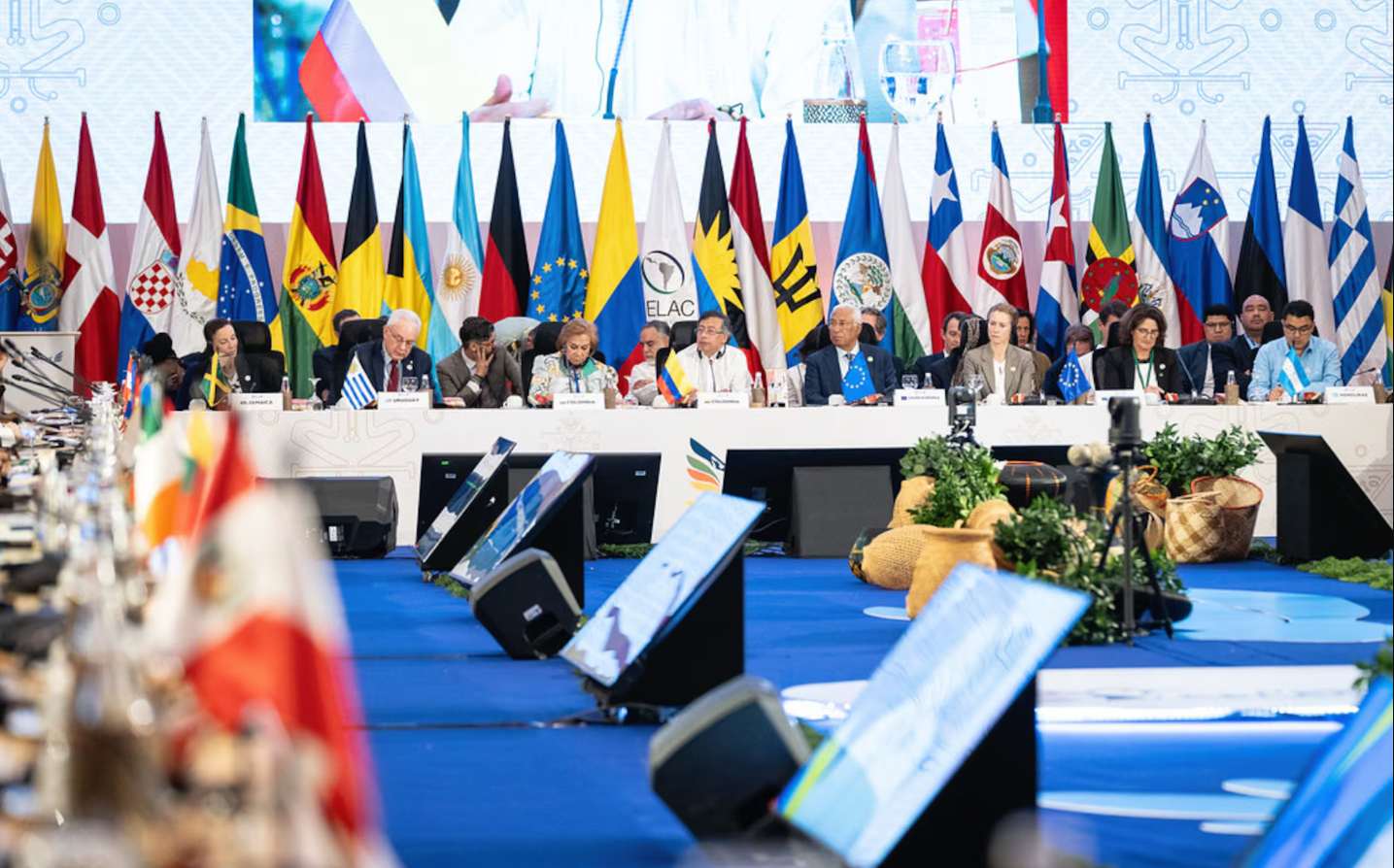
In early November, the IV Summit between the Community of Latin American and Caribbean States (CELAC) and the European Union (EU) was held in Santa Marta, Colombia. Considering the eight-year gap between high-level meetings—2015 to 2023—the fact that this summit took place just two years after the last one in Brussels, and within the agreed timeframe, may be seen as an achievement. However, the summit set a precedent: in more than 26 years of dialogue, it was the first time that the President of the European Commission—Ursula von der Leyen—did not attend. Not only that, but Emmanuel Macron, Friedrich Merz, and Giorgia Meloni were also absent. It was an extremely negative symbolic gesture. Reports attribute this absence to the influence of the U.S. government, in line with Donald Trump’s “bullying” foreign policy.
Von der Leyen’s lack of participation—at a time when her leadership is weakened—underscores Europe’s powerlessness in an adverse global landscape where a former ally has become a revisionist power. On the Latin American side, the absences were also notable: the only significant appearances were those of Luiz Inácio Lula da Silva and, of course, the host, Gustavo Petro.

By comparison, the IV CELAC–China Summit, held a few months earlier, saw broader participation both quantitatively and qualitatively, with several Latin American presidents and Chinese President Xi Jinping in attendance. This contrast may suggest that the relationship with China is now perceived as more strategic and politically meaningful than the traditional alliance with Europe.
The Joint Final Declaration of the EU–CELAC Summit was issued on the first day. A plausible interpretation is that, diplomatically, it had already been assumed that the parties’ positions would not allow for further progress, and so they decided to formalize the achievable consensus right away.
The declaration reveals an unprecedented fact: several countries detached themselves from the text, either wholly or partially. In 2023, the sixty participating countries endorsed the final declaration, with only one exception—Nicaragua, which rejected the section concerning the conflict in Ukraine. By contrast, the Santa Marta document recorded a significantly higher number of detachments across various issues.
However, the paragraph from which many countries distanced themselves was paragraph 10, referring to the characterization of CELAC as a “zone of peace.” This objection can be interpreted as an indirect way of delegitimizing the concerns of many LAC governments regarding the military incursions carried out by the Trump administration in the Caribbean. Another clause that several countries refused to sign was the one calling for an end to the embargo against Cuba. Finally, another point of convergence among this group of countries was their opposition to the section concerning the conflict in Gaza.
Without attempting to resolve the dilemma of the glass half full or half empty, the 2025 summit raises troubling questions. Looking inward: does the notable number of detachments by Latin American countries reflect a mature acceptance of regional diversity, or does it confirm that CELAC is no longer—if it ever was—the collective voice of LAC? What remains, then, of its motto “united in diversity”? Perhaps it is time to invert the terms: diversity, yes; effective unity, practically none.
This finding admits two readings: it may be understood as an uncomfortable but necessary truth for rebuilding consensus from scratch, or as a diagnosis so negative that it prevents imagining even a minimal foundation for collective action. At this point, the inevitable question arises: is CELAC a resilient framework, or one that survives merely by inertia? What remains of post-liberal or post-hegemonic regionalism? Could we be facing the most fragile and vulnerable phase of Latin American regionalism in decades?
Lula da Silva acknowledged the region’s polarization and profound fragmentation, but proposed no concrete initiatives to overcome them. The question becomes unavoidable: is there any real strategy to turn this acknowledgement into action, or are we merely confronting an inventory of problems with no solutions in sight? Where is the leadership? Brazil, mired in its own internal fractures, has been unable to galvanize support to relaunch South American integration, and apparently also unable to articulate a broader regional leadership.
Looking outward, the questions become even more uncomfortable: what real room does CELAC have left to act as a regional interlocutor with third countries or blocs? How much of the supposed Euro-Latin American space was truly represented at this EU–CELAC summit? Are we witnessing the exhaustion of the format itself? Is there space to build consensus and cooperation in other arenas? And how might countries with strategic interests in the region—particularly China—interpret this level of fragmentation as an opportunity to deepen their influence and shape regional cooperation dynamics to their advantage?
The strategic relevance of the Euro-Latin American space—both in managing external pressures and navigating shifts in the global balance of power—should grow, not despite this turn, but precisely because of it. There is still room to see whether the EU–CELAC relationship—no matter how debated or imperfect—can serve as a key space for strategic action and cooperation, and as a valuable tool to balance and counteract external forces.
Autor

Professor and researcher at the Faculty of Political Science and International Relations of the National University of Rosario (Argentina). Director of the Study Group on the European Union at the UNR.