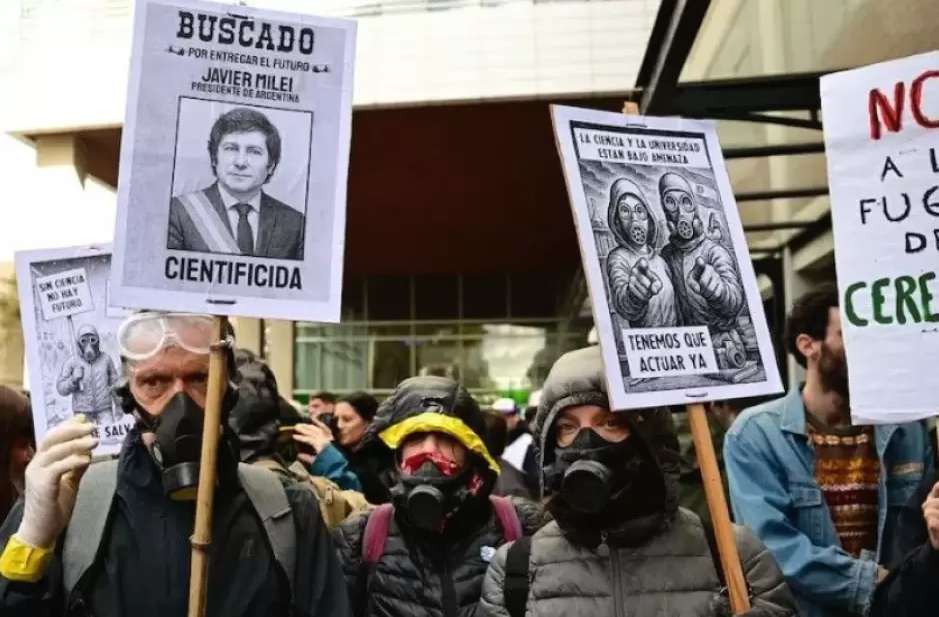
“Argentine science is an eternal déjà vu,” someone wrote on social media, and it reminded me of a book I read back in the 1990s when I was a student: Disparen contra la ciencia. De Sarmiento a Menem, nacimiento y destrucción del proyecto científico argentino by Nuñez and Orione. Rereading it almost thirty years later, the repetition becomes undeniable. Inside, I had kept a clipping from Clarín where Mario Albornoz, a key figure in science policy, and Gregorio Klimovsky, a renowned epistemologist, warned about the imminent brain drain. A prediction more than fulfilled: hemorrhaging talent, institutional defunding, and the devaluation of knowledge have become persistent features of Argentina’s recent scientific history.
In the 1990s, Domingo Cavallo’s phrase “let them go wash the dishes” summed up the official contempt for science. That was his response, as Minister of Economy, to a CONICET researcher demanding better salaries. Today that logic has returned, intensified: Milei’s “chainsaw” threatens to wipe out anything that smells like critical thinking. “Shoot at science” is no longer a metaphor but a slogan repeated—out of conviction or indifference—by those who view science as a luxury rather than a right.

But this deterioration doesn’t come out of nowhere. As Argentine physicist Diego Hurtado shows in La ciencia argentina, un proyecto inconcluso (1930–2000), the country’s scientific history has been shaped by political crises, economic swings, and democratic breakdowns that derailed any attempt to build a stable project. Although Argentina has scientific tradition and talent, it also carries a long list of missed opportunities.
A recurring pattern
However, this problem is not exclusive to Argentina. Globally, science is going through a legitimacy crisis that deepened after the COVID pandemic. Climate denialism under George W. Bush—which included the U.S. withdrawal from the Kyoto Protocol—Bolsonaro’s health denialism—who described COVID as just a “little flu”—and Trump’s recent call for pregnant women to avoid paracetamol due to an alleged link with autism are just a few examples.
During the pandemic, this logic became brutally clear: conspiracy theories, miracle cures, attacks on public health, and anti-vaccine campaigns did not only emerge from the margins. In many cases, they were amplified or even promoted by governments themselves. This climate of suspicion revealed something deeper: the discrediting of expert knowledge and the growing difficulty of incorporating scientific evidence into social and political decision-making. This form of symbolic violence against research has gone global and today affects, to varying degrees, both well-established scientific institutions and more fragile systems.
In Latin America, recent attacks on scientific institutions, research bodies, and university programs are also not isolated episodes but part of a global trend that turns science and public universities into ideological adversaries. The motives vary, but the mechanism repeats itself: defunding state agencies, delegitimizing researchers and universities, building alliances with lobbies and think tanks that fuel misinformation, and colonizing public debate with narratives of suspicion: “science lies,” “experts are wrong,” “evidence is just an opinion.”
As sociologist Castelfranchi warns, these actors understood something traditional politics was slow to notice: shaping common sense about science is a tool of power. That is why they invest in digital campaigns, produce emotional content, and deliberately erode trust in empirical evidence. In contexts of fear, instability, or uncertainty, anti-science discourses find fertile ground.
What science, for what society?
At this point, it’s worth noting that in Argentina and globally, debates on science policy often remain superficial—budget yes or no, researchers yes or no—when the problem is deeper. As physicist and novelist Charles Percy Snow warned in his famous 1959 lecture The Two Cultures, we continue to think of knowledge in watertight compartments, as if the sciences and humanities inhabited separate worlds. Thus, hard sciences are celebrated for their productivity, while social or exploratory sciences are dismissed as “useless,” a fracture that persists and limits our ability to understand an increasingly complex reality.
Yet some events challenge this dichotomy. CONICET’s science livestream during the Schmidt Ocean Institute expedition showed this clearly: a 21-day oceanographic campaign broadcast live on YouTube and Twitch gathered nearly 18 million views between July and August this year. Millions followed the discovery of 40 new marine species and unexpected biodiversity at a depth of 3,900 meters. What many would have labeled a “luxury” became a scientific and communication milestone that brought research closer to the public and strengthened trust in knowledge. When science is told differently, it moves people. And when it moves people, it matters.
That is why in a global context saturated with anti-science messages, simply defending “science” is not enough. The uncomfortable—and urgent—question is another: for what and for whom is knowledge produced? It’s not enough to show indicators and demand funding. We need a different horizon: dignified science, understood as science oriented toward the common good, aware of its social responsibility, in dialogue with local knowledge, listening to communities, and addressing real problems such as food sovereignty, energy inequality, climate change, or public health.
The career of physician and molecular biologist Andrés Carrasco illustrates this vividly. His research on the effects of glyphosate on amphibian embryos earned him rejection and discredit from economic and political sectors, but his ethical stance against corporate pressure inspired the creation of the Day of Dignified Science (June 16), established in 2014 by the National University of Rosario’s Faculty of Medical Sciences. His case shows that science should not be measured only in papers, but also in principles and social commitment. As mathematician Oscar Varsavsky warned in Science, Politics and Scientism (1969), we must rethink a scientific production model in which many researchers, adapted to the “scientific market,” detach themselves from the social and political meaning of their work.
Without stable policies, sustained funding, and decent working conditions, there is no future for science in the region. But that is not enough either. As CONICET’s livestream demonstrated, the scientific world must add something else to its demands: the willingness to tell its story in public and on time. When science fails to communicate its findings, dilemmas, and social relevance, others will fill that space with narratives of suspicion, fear, and conspiracy.
Shooting at science not only weakens institutions; it erodes our shared horizon. Saying “Do not shoot at science” today must go beyond corporate defense: it means restoring its dignity, overcoming false divides, integrating different forms of knowledge, and returning to science its most urgent purpose—helping us orient ourselves in a world that desperately needs to imagine futures beyond catastrophe or interplanetary escapism.
*Machine translation, proofread by Ricardo Aceves.
Autor

Bióloga, Dra. en Farmacología (UBA) y Master en Comunicación Científica, Médica y Ambiental (UPF). Docente e investigadora en Comunicación de la Ciencia, la Salud y el Ambiente de la Facultad de Ciencias de la Comunicación FCC de la Universidad Nacional de Córdoba (FCC-UNC).