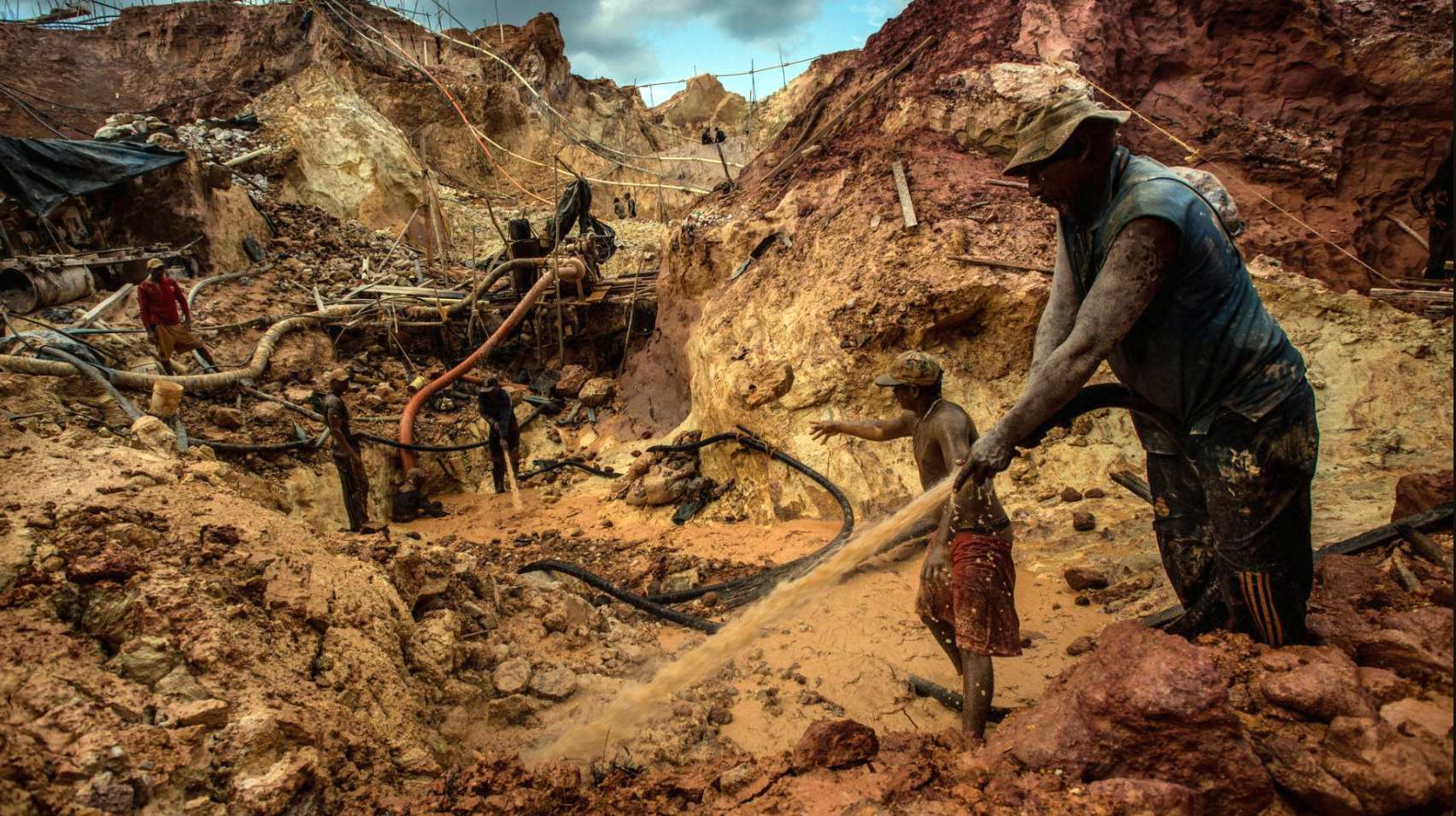
Since the 1990s, mining in Latin America has ceased to be just another economic activity. It has become a mechanism for territorial, ecological, and political reorganization. Under the discourse of development and modernization, the expansion of the extractive frontier altered the very foundations upon which life and sovereignty in the region are sustained.
The first impact fell on nature. Large-scale mining—predominantly open-pit—does not merely transform ecosystems: it renders them expendable. Polluted rivers, fragmented forests, and perforated mountains are the visible expression of a deeper process: the conversion of living territories into spaces of intensive extraction. But the damage is not limited to the environmental plane. Alongside ecological devastation advances the dispossession of communities whose relationship with nature is not utilitarian or mercantile, but a constitutive part of their way of life.

The second axis of this open wound is the productive specialization imposed on Latin American countries. Although mining has a colonial matrix, its recent consolidation responds to dynamics specific to contemporary financialized capitalism: cycles of rising prices, technological changes, transformations in productive and energy organization, and financial dominance. In other words, to the very metabolism of capital. Latin America did not choose this place in the world economy; it was integrated as a strategic supplier of minerals to sustain the global accumulation of central and emerging economies.
This process was neither accidental nor the result of isolated decisions. It is part of the structural functioning of dependent capitalism. Since the 1990s, nature was “flexibilized” to become not only a source of productive profits, but also of financial gains. Under the baton of large extractive corporations, so-called mining modernization concealed a profound opening: the loss of sovereignty over resources and the subordination of national interests to the mandate of private capital—national, but above all, transnational.
While mining companies displayed visible profits, a second circuit of appropriation operated in the shadows. Shareholders, investment funds, and global banks extracted value without touching the territory. Natural wealth ceased to be merely a physical resource: it became a financial promise, traded on stock exchanges and futures markets, far from the communities affected by extraction. Thus, mining generated not only productive surpluses but also financial rents transferred to the centers of global economic power.
Today, this dynamic is reactivated under new forms. The hegemonic dispute between the United States and China once again places Latin America at the center of the global chessboard. The so-called “energy transition” and the new technological cycle characterized by digitalization turn strategic minerals into key pieces for industry, national security, and technological leadership. The outcome is not new: historical mechanisms of dispossession are recycled, now legitimized by a green and technological language, while gaps of economic and ecological inequality deepen.
Faced with this scenario, the management of natural resources becomes a decisive issue. It cannot be thought of solely in national terms, but rather regionally. Latin America possesses a real margin of maneuver: without its minerals, much of the life cycle of contemporary technologies is simply not viable. However, that margin will not activate automatically. It requires coordinated political action, common regulation, and clear limits on the financial power that today dominates extractive markets.
A regional strategy would make it possible to capture extraordinary rents, halt the dissipation of wealth in global circuits, and channel surpluses toward transforming productive matrices. The region’s mineral diversity is a strategic advantage: each country can contribute a link in the value chain and build collective strength vis-à-vis extractive capital. Without coordination, that wealth becomes vulnerability; with it, it can be transformed into negotiating capacity.
But no alternative will be viable if those on the front lines of the conflict are ignored. Communities, the living expression of a plural and diverse society, face the irreversible consequences of intensive mining, both industrial and artisanal. Recognizing their ways of life and their relationship with nature is not a symbolic gesture, but a basic condition for imagining ways out of the extractive confrontation. Without a State that defends territories as part of a sovereign policy, transnational capital acts with the freedom—and the violence—guaranteed by impunity.
What is at stake is not merely an economic model. It is the capacity to decide the future of the region. Persisting in the primary export pattern implies deepening dependence and accelerating ecological devastation. Beyond minerals, Latin America faces a historic dilemma: to continue being a supplier of raw materials or to build its own path that prioritizes life, autonomy, and the needs of its peoples.
Because, ultimately, this is not only about extracting resources. It is about deciding who decides the destiny of territories and of those who inhabit them.
Autor

Economist, with a master's degree in Latin American Studies from the National Autonomous University of Mexico (UNAM) and another in Sociology from the Latin American Faculty of Social Sciences (FLACSO). He is a doctoral candidate in Latin American Studies at UNAM and a researcher at the Research Center for Geopolitics, Regional Integration, and the World System at the Federal University of Rio de Janeiro (UFRJ).