In Simulacra and Simulation (1981), Jean Baudrillard presents the “hyperreal” as a social condition that emerges when signs cease to refer to their real-world counterparts and become simulacra of what was once “real.” The most emblematic illustration of this concept is undoubtedly his inversion of Borges’s story about a map so perfect that it loses all usefulness as a representation of the territory. Baudrillard argues that in “hyperreality,” it is the territory that eventually loses its usefulness and, over time, disappears, having been preceded by the map. In the end, no one remembers the territory for what it was, but rather for what the map simulates.
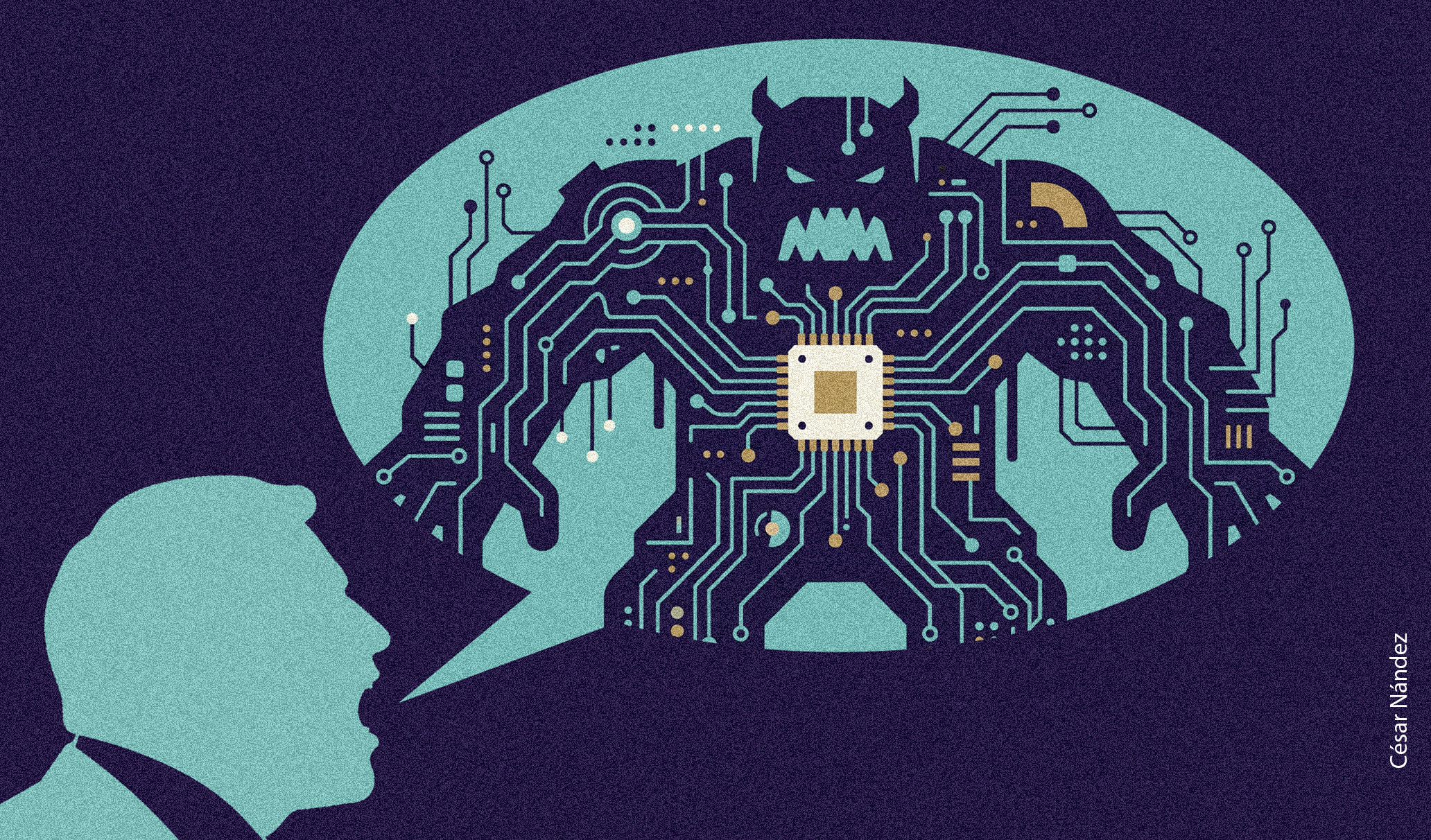
I have invoked the French sociologist’s ideas for a particular reason: I believe we need to rescue the discourse surrounding the “risks of artificial intelligence” from the hyperreal and bring it back to the territory.

On Saturday, September 12, Dario Amodei, CEO of Anthropic, published an essay arguing that AI progress was accelerating dramatically, driven above all by AI’s growing ability to build its own next generation. He cited the incident involving OpenAI and Hugging Face, in which a swarm of AI agents autonomously carried out cyberattacks, as an example of a pivotal event underpinning his argument.
Following this, figures directly involved in the development of generative AI, including Elon Musk and Sam Altman, voiced their support for Amodei’s position. They agreed on the need to slow the advance of the technological frontier, and Altman even pledged to admit independent evaluators with access comparable to that of his own employees.
The markets, in turn, reacted to these reactions—if the redundancy may be forgiven. On Monday, September 14, semiconductor stocks plunged: Nvidia fell 3.4%, and the Philadelphia Semiconductor Index dropped 5.9%. That same day, Trump tried to downplay the warning. By September 23, however, Amodei was addressing the UN Security Council, warning that the risks posed by the most advanced AI models constituted “the most important global security problem the world faces today.”
What I would like to highlight in this sequence of events is the chain of reactions. Each link was forged in response to another: Musk and Altman reacted to Amodei’s essay; the markets reacted to the billionaires’ statements; Trump reacted to all of them. And it is not that data are lacking. Independent investigations into the incident exist, as do risk reports running to hundreds of pages. But between those documented incidents and the warning that set the chain in motion—that within six to twelve months, a similar swarm could take control of the internet—lies a leap that no one has publicly measured. In Amodei’s own words, it is a concern.
Is there any data-based forecast to support that leap? Is there verifiable information beyond what CEOs believe? Curiously, the first measure Amodei proposes—external evaluators with permanent access and the freedom to publish their findings—points precisely in that direction. The problem is that the chain of reactions did not wait for their results.
For now, the latest link in the chain was forged at the White House on September 29. After a luncheon with leading industry figures, Trump signed what amounted to a “Joint Commitment on Frontier Responsibilities” alongside Dario Amodei (Anthropic), Elon Musk (xAI), Jensen Huang (Nvidia), Sundar Pichai (Google), Mark Zuckerberg (Meta), and Greg Brockman (OpenAI). The document—if it can be called that, given that it contains just 308 words, according to Forbes—commits each company to establishing internal controls, an oversight team, external audits, and an independent board. It is a voluntary commitment that, it must be said, imposes no consequences for noncompliance. Trump described it as “almost a constitution” and “morally binding.” To top it all off, beneath the US president’s signature appears the phrase “President of the Unites States” (sic).
This detail would be merely anecdotal if it did not so neatly encapsulate the problem. Two weeks earlier, Trump had dismissed fears about AI as a “hoax,” while Huang had argued that they were exaggerated. Now, suddenly, both were signing a commitment to contain those very risks. What changed between one date and the other? Above all, the discourse. Indeed, that same day, through an executive order, Trump directed federal agencies to stop saying “artificial intelligence” and start saying “superintelligence.” It is hard to find a clearer example of what Baudrillard described: AI did not become superintelligent on September 29; it simply began to be called that. Once again, the sign had moved ahead of reality.
If there are clear signs of a systemic, uncontrollable risk, we need to see them. Measure them. Determine their scale. Otherwise, a discourse that continually generates signals of imminent danger will eventually become independent of whether any concrete danger is actually present. It does not matter whether artificial general intelligence (AGI) is two, twenty, or thirty-five years away. The warnings end up serving as a justification for raising capital, gaining access to decision-makers, or securing a seat at the table.
And perhaps we are already there. Once again, the map precedes the territory.
Autor

Economist. Doctorate in Behavioral Sciences from the University of Warwick. Master in Development Studies from the London School of Economics and Political Science (LSE). Specialist in behavioral sciences and analysis and implementation of public policies.