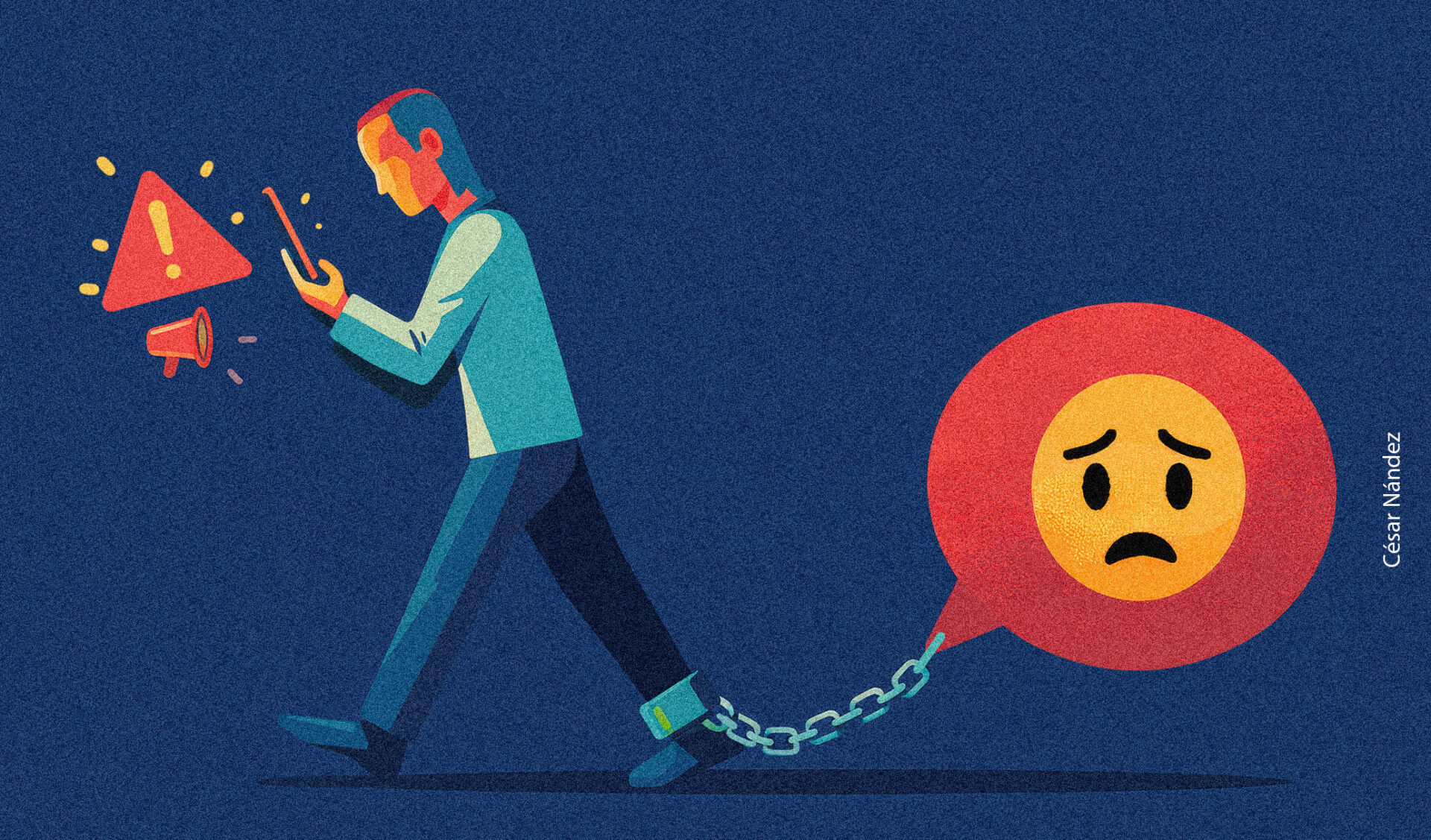
Emotions have become a fundamental part of political communication. Feelings such as anger, moral indignation, resentment, and nostalgia organize perceptions of belonging, threat, and social order, preceding and guiding ideologies. This is affirmed by researcher Paolo Demuru in his work Políticas do Encanto (Politics of Enchantment). It is within this context that Donald Trump operates, governing through noise and the relentless production of crises that are not resolved, but rather accumulate and overlap.
Amid the rise of the far right, affective grammars underpin processes of polarization that go beyond traditional divergence and turn into moral antagonisms, in which the “political other” becomes an existential threat.

Disproportion, exaggeration, and alarm in the construction of fear characterize moral panic, a concept consolidated in the 1970s by sociologist Stanley Cohen, and used to understand the relationship between the media, politics, and public opinion. Every era has its own moral panics, generated in specific historical contexts, especially during moments of shifts in power, crises of hegemony, and social insecurity.
According to authors such as Walsh and Hill, moral panics depend on digital platforms in order to exist, circulate, and gain reach. In this sense, they cease to be a mere expression of social anxieties and begin to occupy a central place in power struggles, transforming into continuous devices for the production of meaning, articulating affects, narratives, and antagonisms on a large scale. Fear becomes consolidated as a strategic political and communicational resource, permeating public debates and forms of governance.
Donald Trump’s grammar
The United States, in the face of the weakening of its global hegemony, operates less through institutional stability than through the continuous fabrication of threats. Politics ceases to be the administration of the common good and becomes the management of fear, in a movement that is not confined to U.S. borders but projected globally.
Recent episodes, such as repeated attempts to delegitimize Latin American governments, pressure on Venezuela, and fantastical narratives surrounding the “capture” of Nicolás Maduro, reveal an imperial grammar grounded in the idea of permanent conspiracy: something is always being plotted against the United States, against its sovereignty, against its “historic destiny.” From this premise, any forceful action—such as sanctions, interventions, or military or symbolic threats—appears necessary, preventive, and morally justified.
It is within this broader context that Donald Trump must be understood. Creating conspiratorial fantasies is neither a rhetorical deviation nor a personal eccentricity, but rather a central political communication strategy he adopted, focused on power struggle. Long before arriving at the White House, the U.S. president learned that narratives of threat mobilize more effectively than future-oriented projects, and that moral panic is an extremely effective resource in times of instability and in the face of the centrality of digital platforms.
Throughout his trajectory, Trump transformed strategic issues into fields of symbolic warfare. Immigration became an invasion; the press, the enemy of the people; elections, a permanent fraud; science, a conspiracy of elites. What is at stake is not the veracity of facts, but the ability to generate a diffuse sense of moral, cultural, and existential risk. In this way, governance takes place through the sensation that “something is being stolen”: the country, identity, the way of life.
This logic becomes particularly evident in the episode of Greenland. At first glance, the proposal to “buy” sovereign territory may appear to be a geopolitical delusion. However, viewed from a Trumpian perspective, the idea fulfills a far more sophisticated function. It operates as a mechanism of moral panic: the suggestion that the United States is losing space, territory, influence, and greatness to external enemies—such as Russia and China—and to internal elites incapable of protecting national interests. Territorial fantasy thus functions as a metaphor for a besieged and declining country that needs to be “recovered” at any cost.
Skilled in the communicational fabrication of panic, always supported by social networks and the algorithmic policies of platforms that privilege the far right, Trump awakens deep moral fears, reorganizes antagonisms, and generates belonging through exclusion. The “we” exists only because there is a threatening “they”: migrants, globalists, bureaucrats, journalists, and scientists. The aim is less to seek solutions and more to manage resentments, channeling diffuse frustrations toward morally charged targets.
Social effects of moral panic
In this fear-saturated environment, strategies of moral panic cease to function merely as electoral rhetoric and begin to produce broader social effects. Migration, for example, has become a permanent political problem. Immigration, especially from the Global South, is continually reinterpreted as a diffuse threat to order, culture, and economic stability—not through objective data, but through the systematic repetition of narratives of danger.
Migration ceases to be treated as a complex social experience and begins to function as a sign that condenses fear, capable of organizing diverse anxieties around a recognizable enemy. In this dynamic, fear not only guides electoral decisions, but also reorganizes internal hierarchies within diasporas themselves, generating distinctions between “legitimate” and “undesirable” migrants and turning migration into a field traversed by symbolic, affective, and political disputes.
The effect is the consolidation of a regime of permanent attention, characteristic of the digital platform ecosystem, in which politics begins to operate through successive crises, exacerbated statements, calculated retreats, and new episodes of tension. Nothing is resolved; nothing stabilizes. Panic is not a momentary deviation, but the habitual environment of political action.
It is within this context that proposals such as the “purchase” of Greenland must be interpreted: less as an isolated geopolitical delusion and more as a symbolic device of an imperial imaginary in a permanent state of alert, in which territories, borders, and sovereignties always seem on the verge of being lost or seized by external forces. Trump does not govern despite the chaos he produces. He governs through it, mobilizing affects, keeping attention in constant suspension, and managing fear as a central resource of power in a world shaped by platforms, algorithms, and conspiratorial fantasies.
Indeed, Trumpism reveals more than a personal style. It explains how, in a communicative environment dominated by digital platforms, interaction metrics, and the accelerated circulation of emotions, conspiratorial fantasy ceases to be marginal and begins to operate as political rationality. Greenland, the wall, electoral fraud, or the “communist threat” are not merely issues: they are political and communicational devices for affective mobilization. And in this game, truth matters less than the ability to keep fear in constant circulation.
Autor

Professor at Escola Superior de Publicidade e Marketing, ESPM (São Paulo). Coord. of the research group Interculturality, Citizenship, Communication and Consumption. Researcher at the Institute of Communication of the Autonomous University of Barcelona.

Doctoral Candidate in the Postgraduate Program in Communication and Consumer Practices at the Escola Superior de Propaganda e Marketing, ESPM, São Paulo. Professor of Communication Courses at the Fundação Escola de Comércio Álvares Penteado. Member of the Deslocar research group.