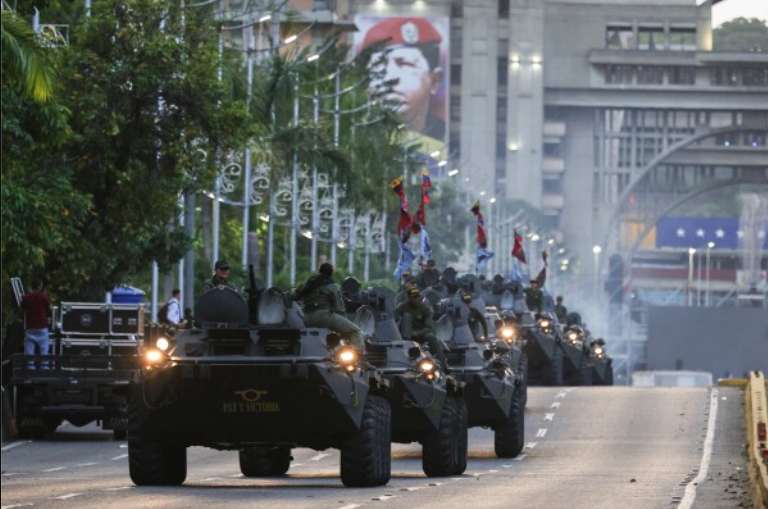
Over the past two weeks, a series of developments have significantly reinforced the likelihood of a unilateral U.S. military intervention in Venezuela aimed at overthrowing the Maduro regime. The State Department officially designated the Cartel of the Suns—allegedly led by Maduro himself—as a foreign terrorist organization; the Federal Aviation Administration issued a notice declaring all Venezuelan airspace dangerous due to possible military activity (issuing similar warnings for Puerto Rico and the Southern Caribbean); reports emerged of an imminent new phase of operations in Venezuela; and it was revealed that Trump offered Maduro peaceful exile in exchange for his resignation. In addition, U.S. armed forces seized an oil tanker off the Venezuelan coast, and the Pentagon substantially increased the presence of fighter jets and other logistics aircraft in Puerto Rico and the Dominican Republic. Military action against the regime would appear imminent.
The balkanization of Venezuela?
The most desirable outcome for Trump is that the mere show of force triggers an internal coup, removing Maduro from power. However, for such a transition to be stable, it would require a prearranged agreement with the opposition that guarantees the continuity of most Bolivarian elements within the state apparatus and provides for political amnesty. Even so, there is no guarantee that Machado would become president under this scenario. The Bolivarian regime is not personalist and could continue by replacing its leadership. But an internal coup would only occur if a sufficient number of members of the armed forces, security forces, and the United Socialist Party concluded that their respective spheres of power, networks of influence, and sources of income would not survive a possible U.S. intervention.

Without an internal coup, Trump’s options are limited. The scale of the force deployment is such that withdrawing without any tangible outcome would be a self-inflicted humiliation, as well as a wasteful expenditure of resources. Given that Trump prefers not to take risks and to avoid committing troops to yet another endless conflict—especially one that would require at least 150,000 soldiers—a multifaceted approach that includes covert operations and airstrikes aimed at ousting Maduro by fomenting popular uprisings and breaking the regime’s cohesion could be his first option. If such actions generate enough centers of protest and rebellion against the regime and do not strengthen it, Washington—assuming that widespread popular discontent legitimizes its actions—could expand its attacks with the objective of decapitating the regime.
However, one of the problems with imposed regime change is that, without a negotiated, planned, and institutionalized democratic transition, it tends to be highly unstable, violent, and inconclusive. The overthrow of regimes by a foreign power rarely promotes democratization and, in most cases, tends to trigger civil wars. Foreign interventions that replace governments tend to install elites that implement policies benefiting themselves. And although imposed governments are usually more fragile—lacking internal legitimacy and relying entirely on external support—most transitions to democracy ultimately fail.
Even if Maduro were to accept exile, significant questions remain, as outlined in a recent report by the International Crisis Group: could Machado assume power if much of the chavista apparatus remains intact? This was the problem faced by the democratic opposition in Serbia after the overthrow of Milošević in 2000. Would Machado and the United States be willing and able to establish a collaborative agreement with mid-level chavistas? This was the model in Germany, Italy, and Japan after 1945. Or would Machado plan a purge after taking power, as occurred with the de-Baathification implemented in post-Saddam Iraq by U.S. authorities, which was decisive in triggering the civil war? What would happen if the armed forces refused to recognize a government established after Maduro’s removal? This would resemble the post-Gaddafi Libya scenario.
A negotiated transition is not free of risks. Sectors of the security forces could rebel and even initiate a guerrilla war against the new authorities. Moreover, the plethora of armed groups operating across much of the country would likely exploit any power vacuum to consolidate or even expand their territorial control. Whatever government emerges after Maduro’s departure will have to contend with a dysfunctional and politicized bureaucracy, a severe economic and humanitarian crisis, and collapsed infrastructure. Long-term U.S. military presence would be the only way for a post-Maduro government to survive.
Avoiding Catastrophe
Most Venezuelans want an end to the Maduro regime. Venezuelans voted overwhelmingly for change in the 2024 presidential elections, but the government refused to accept the result. Many Venezuelans have been fighting an authoritarian government for years, and without a doubt, the end of the regime would be a positive step forward for Venezuelans, the region, and the world.
However, it is unlikely that a unilateral U.S. military action—even with the support of the majority of the population—would succeed in advancing a peaceful political transition, and it could have catastrophic consequences. A democratic transition can only be stable and lasting if it is negotiated and includes chavista elements of the former regime. Any agreement must be guaranteed by sustained commitment from the United States and regional countries willing to support the new government in a potentially prolonged, low-intensity conflict with armed groups that have rejected any negotiation.
Otherwise, a civil war is highly likely to erupt, further worsening Venezuela’s future. The democratic and peaceful future of the country and the region depends on institutional and multilateral initiatives, not on coercive and unilateral ones.
Autor

Lawyer. Postdoc at New School For Social Research (N. York). Specialized in international criminal law, constitutional law and human rights. Master in international studies and sociology.