Traditional politics suffers from an anachronistic obsession: believing that rational deliberation and the written word still drive the world. While governments and candidates wear themselves out drafting technical documents and solemn speeches, citizens have disconnected. This fatigue is not a mere generational whim; it responds to a deep cognitive basis. Research from MIT, led by cognitive scientist Mary Potter, has shown that the human brain can process and understand an image in as little as 13 milliseconds. This is almost 20 times faster than it takes us to process a single average word. Moreover, 90% of the information that reaches our minds is visual. Historically, the image has always held primacy over the word because it is cognitively “cheap”: it requires less glucose and less mental effort than logical abstraction. In the age of information overload, economic data, explanation, and argument have been defeated by the meme simply because the former demand thinking and the latter allows feeling.
This regression toward the playful returns us to our essence. As Johan Huizinga explained in his foundational work Homo Ludens, play is not a secondary activity, but the phenomenon that precedes and underpins culture. From an evolutionary perspective, play is the biological mechanism through which we rehearse reality and establish social bonds without the weight of immediate consequence. We have internalized it because playing is learning with pleasure. The current problem is that technology has shattered the limits of the game’s “magic circle”: today politics has become an endless video game in which the gratification of impact matters more than factual solutions.
This mutation has been accelerated by its technical medium. In his lucid essay Amusing Ourselves to Death, sociologist Neil Postman warned that our greatest threat was not the violent censorship depicted in Orwell’s 1984, but the pleasurable irrelevance of Huxley’s Brave New World. Postman argued that in an ecosystem dominated by image and spectacle, truth is not hidden but drowned in a sea of trivialities. When public communication becomes pure entertainment, discourse is necessarily trivialized.
The architecture of the internet is physically rewiring our neural circuits. After hours of scrolling, the brain abandons the capacity for linear, deep reading and adopts a mentality of constant jumping. The internet is not a tool for meditation; it is an “infinite toy” designed to massage our nervous system with small doses of dopamine, turning reflection into a tedious activity and visual stimulus into a physiological need.
This aesthetic mutation transcends ideological boundaries and has become the new standard of governmental communication in Latin America. We see it in Nayib Bukele in El Salvador, who has displaced diplomatic solemnity with a video game aesthetic and an aggressive use of digital sarcasm to consolidate his narrative as a “winner,” a strongman, or as he himself dubbed it: “the coolest dictator in the world.” On the opposite side, Gabriel Boric in Chile has used the codes of pop culture and internet niches to build an identity of closeness and vulnerability, humanizing the presidency through references shared with his audience, such as Pokémon cards. For his part, Javier Milei in Argentina represents the triumph of fan art over the official portrait: his figure has been reinvented through artificial intelligence and the creativity of his followers, transforming a program of economic austerity into a comic-book epic—at times he is a lion devouring his enemies, and at others a superhero with cape and mask. In all three cases, the meme is not an accessory but the main vehicle for bypassing the central route of critical thought and connecting directly with the nervous system of an electorate that no longer seeks proposals, but rather an experience of play and emotional identification.
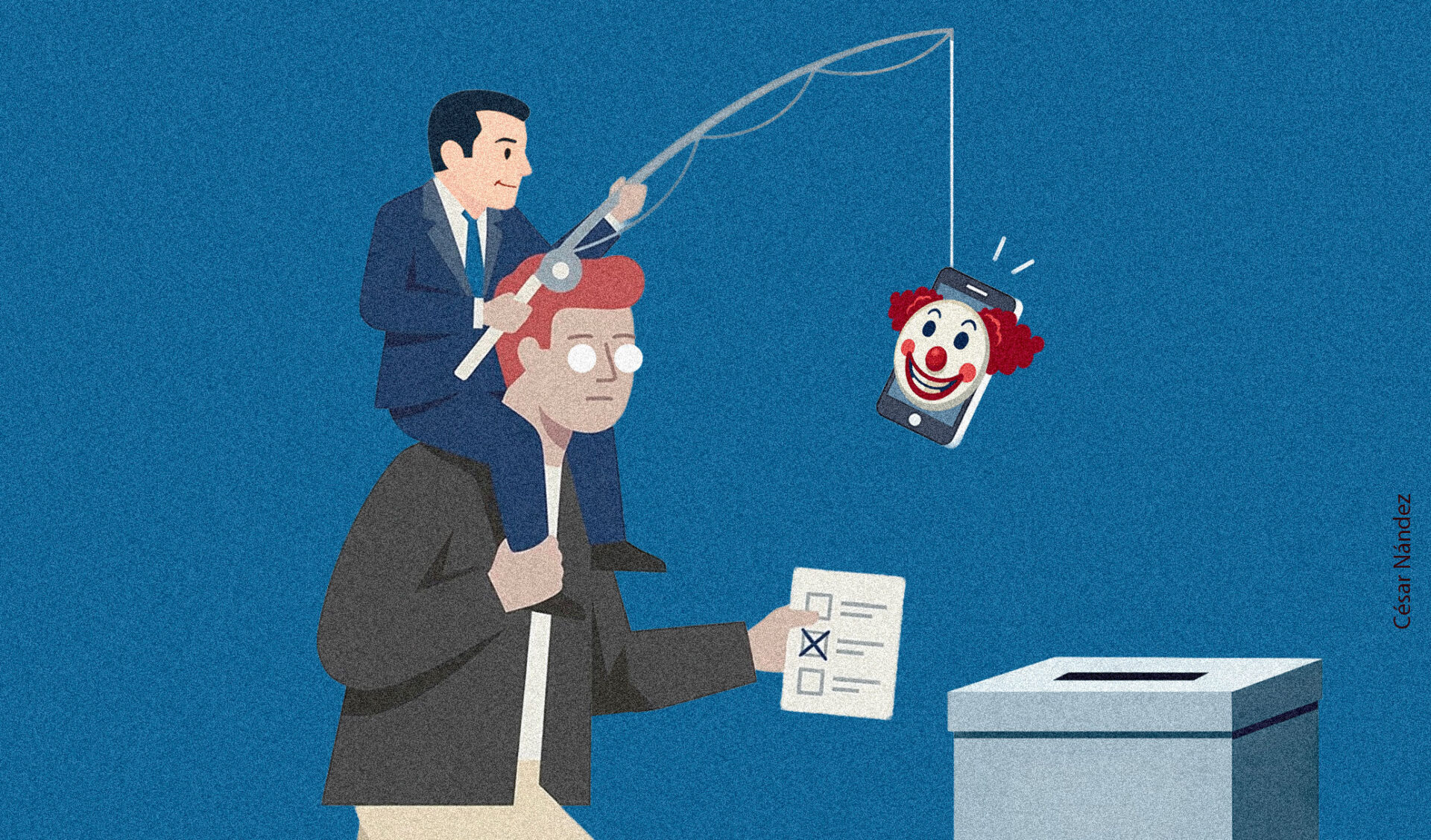
Why does a meme ridiculing a rival carry more force than a government plan? The scientific answer lies in the Elaboration Likelihood Model (ELM), developed by social psychologists Richard Petty and John Cacioppo. The ELM posits that there are two routes to persuasion: the “central” route (which requires critical analysis of arguments) and the “peripheral” route (based on superficial cues such as humor, aesthetics, or affinity). The meme is the ultimate weapon of the peripheral route. It uses humor as a Trojan horse that deactivates our critical defenses. Psychologically, sharing a meme is not only entertaining; it also generates the emotional reward of belonging. As Lee McIntyre points out in his studies on post-truth, this phenomenon is not about lying, but about the primacy of identity over facts. The brain prefers the dopamine rush of a shared joke with its “tribe” to the mental effort of validating an uncomfortable piece of information.
In this “democracy of impact,” what remains in collective memory is not the wording of a bill or a speech in parliament, but the colorful anecdote. Reality is now intentionally constructed as fiction in order to capture the attention of a Homo Ludens who no longer acts out of convictions, but out of reactions. As early as the 1960s, Guy Debord described this process in The Society of the Spectacle. For Debord, modern life is an accumulation of representations in which what appears is what counts.
Trying to put out a meme fire with a bucket of logic is a strategic mistake. So too is avoiding the incorporation of memetic communication. If candidates wish to recover their connection with audiences, they must understand that the language has changed.
Autor

Professor at the University of Buenos Aires (UBA) and the University of Belgrano, Argentina, where he also conducts research on political and electoral behavior, political communication, and political psychology. He holds a Master's degree from FLACSO and is a political scientist and sociologist from the UBA.