Despite being a distant country with a population of just seven million, Paraguay occupies a prominent place on the foreign policy agendas of Beijing, Taipei, and Washington. Why? It is one of twelve countries in the world—and the only one in South America—that maintains diplomatic relations with Taiwan. Due to Beijing’s One China Principle, which prohibits any country from simultaneously maintaining diplomatic relations with the People’s Republic of China (PRC) and with Taiwan, all countries in the world must choose between one or the other.
Most countries, including the United States in 1979, shifted their recognition to China after UN General Assembly Resolution 2758 of 1971 expelled Taiwan from the organization and awarded China’s seat to the PRC. However, many—especially small and impoverished countries—maintained their relations with Taiwan. In the 1990s and 2000s, Taipei and Beijing resorted to so-called “checkbook diplomacy”: offering stadiums, roads, and even cash in exchange for diplomatic recognition. Since then, the government of Taiwan has repudiated that practice, but Beijing and Taipei continue to compete for foreign relations.

Since 2017, several countries in Central America, Africa, and the Pacific have broken relations with Taiwan in order to establish them with China. In return, China—under Xi Jinping’s flagship Belt and Road Initiative—has granted them infrastructure projects, humanitarian donations, and trade agreements. Paraguay—along with Guatemala, Belize, Haiti, the Vatican City, Eswatini, and six island nations in the Caribbean and Pacific—is one of the few countries that still forgo relations with China and remain loyal to Taiwan amid the rise in Chinese military actions against the island.
Paraguay is a target of Chinese efforts to diplomatically isolate Taiwan. In 2021, some intermediaries reportedly offered Paraguay Chinese-made covid-19 vaccines in exchange for breaking ties with Taiwan, an offer rejected by Paraguay’s Ministry of Foreign Affairs. As a member of the South American trade bloc Mercosur, Paraguay’s loyalty to Taiwan was questioned in 2024 while the bloc was negotiating a trade agreement with China. During the controversy, a spokesperson for China’s Ministry of Foreign Affairs expressed hope that the Paraguayan government would “stand on the right side of history,” but Paraguay’s foreign minister, Rubén Darío Ramírez Lezcano, stood firm and declared: “We do not accept any condition to break our relations with Taiwan.” The trade agreement has not materialized, with Paraguay’s support for Taiwan being one of the factors. Last December, the Paraguayan government expelled a Chinese official from Paraguayan territory for encouraging opposition lawmakers to change the country’s diplomatic stance.
Beijing has not backed down. China’s foreign minister declared in August: “We hope that the Paraguayan government… makes the correct decision that truly serves Paraguay’s fundamental and long-term interests… We welcome more Paraguayan friends to visit China.”
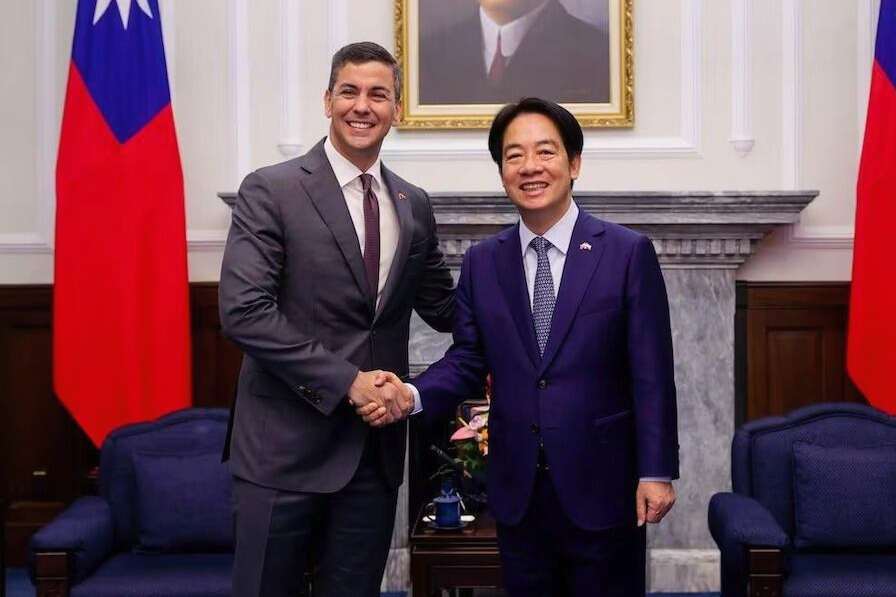
For Taiwan, however, Paraguay remains crucial in its struggle for diplomatic survival. In addition to hosting one of the few embassies Taiwan still has, Paraguay bolsters the island’s legitimacy by allowing high-level state visits. Paraguayan presidents regularly visit Taipei, including a visit in May 2024 to attend Taiwan’s most recent presidential inauguration. These exchanges also allow Taiwan to strengthen ties with its largest defense partner, the United States, through “transit” visits on U.S. territory en route to Latin America, where officials rest, refuel, and also meet with influential political figures.
While stopping in Los Angeles on the way to Paraguay in August 2018, then Taiwanese president Tsai Ing-wen had breakfast with the governor of New Mexico, lunched with three members of Congress, received a phone call from then-Senator Marco Rubio, and met with the chair of the U.S. Senate subcommittee on Indo-Pacific policy.
Beijing fiercely opposes these contacts and has repeatedly warned Taiwanese and U.S. officials to cancel transit stopovers. In April 2023, President Tsai met with the Speaker of the U.S. House of Representatives, Kevin McCarthy, in California after visiting Central American allies. As they spoke, a small airplane flew overhead with a banner reading: “One China! Taiwan is part of China!”, and Chinese warships simulated amphibious operations in the Taiwan Strait.
Paraguay has managed to take advantage of this geopolitical contest: it has signed credit and trade agreements with Taiwan while receiving generous development aid in exchange for maintaining relations. Taiwan is Paraguay’s second-largest market for beef (after nearby Chile) and consumes 80 percent of Paraguay’s pork exports. With rising protectionism worldwide, preferential access to Taiwanese markets has become especially critical for Paraguay’s export-oriented economy.
In addition, aligning with Taipei has improved Paraguay’s relations with Washington. In his 2022 memoirs, Mike Pompeo stated that he visited Paraguay as secretary of state in 2019 because “I wanted the people there to know that we applauded their brave decision to be the only South American country that maintains diplomatic relations with Taiwan.” During the visit, Pompeo reaffirmed support for bilateral cooperation in a meeting with the Paraguayan president. The following year, the U.S. Congress passed the Taiwan Allies International Protection and Enhancement Initiative (TAIPEI) Act, which commits Washington to supporting Taiwan’s remaining diplomatic partners. Marco Rubio has praised Paraguay for maintaining relations with Taiwan and met with the Taiwanese ambassador in the country during a visit in February 2024, the first visit by a U.S. senator to Paraguay in more than 40 years.
This summer, a bipartisan delegation of U.S. lawmakers traveled to Paraguay, met with its minister of economy and finance as well as with Taiwan’s ambassador to the country, and discussed, according to a press release, “how Paraguay, Taiwan, and the United States could better move forward together on their shared goals of growth and prosperity.” Deputy Secretary of State Christopher Landau has met on multiple occasions with Paraguay’s foreign minister to deepen cooperation on security and the economy, hosted a delegation of Paraguayan senators in Washington, and tweeted: “Paraguay has been a steadfast friend of the United States in the heart of South America that has not always received the attention it deserves.” Paraguay is now certainly receiving that attention, with new bilateral agreements on economic, security, and migration issues solidifying deeper cooperation.
This Monday, December 15, Rubio and his Paraguayan counterpart Lezcano signed a bilateral security agreement that will facilitate “bilateral and multinational training, humanitarian assistance, disaster response, and other shared security interests,” according to a State Department statement on the meeting. Cooperation between Washington and Asunción continues to grow.
As successive U.S. administrations have sought to counter China’s growing presence in Latin America and deter Chinese aggression against Taiwan, the alignment of Paraguay’s foreign policy has been doubly welcome in Washington. And the second Trump administration—which has shown greater interest in Latin America than any other in decades—has responded favorably.
When announcing a planned visit by Taiwan’s president to Paraguay in July 2025, Paraguayan president Santiago Peña stated: “This is to show the world that small countries have the capacity to become first-rate global actors.” Although the Trump administration reportedly canceled the trip to avoid provoking China, Paraguay’s foreign policy demonstrates that rejecting Beijing can bring benefits from Taipei and Washington.
Autor

Candidato a Doctor en Estudios Latinoamericanos por la Universidad de Oxford. Máster en Filosofía (MPhil) en Estudios Latinoamericanos por el St. Antony's College de la misma universidad.