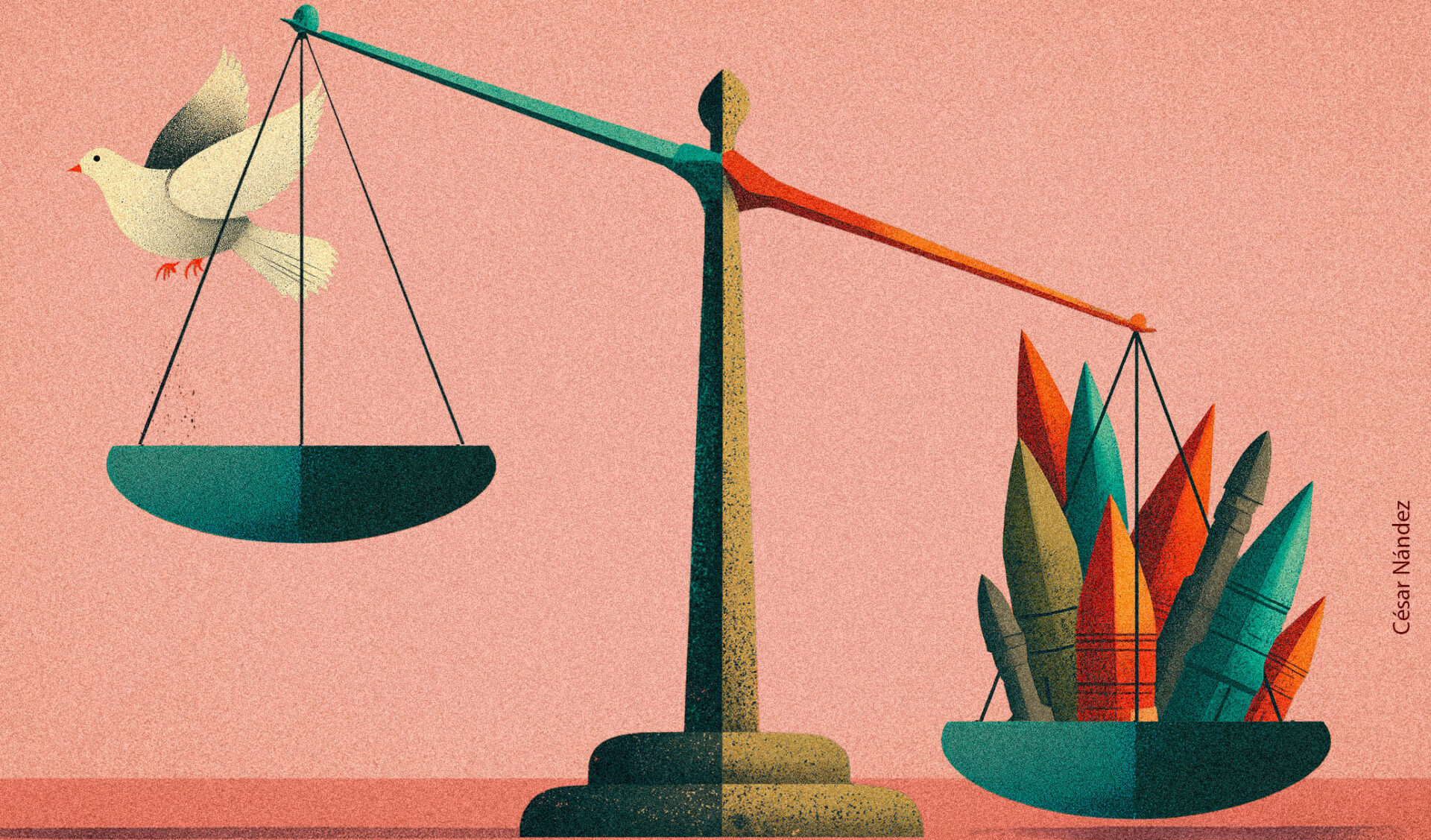
International politics functions like a theatrical play: it organizes narratives, defines characters, and establishes climaxes, generating a permanent dialogue with its audience. This imaginative dimension shapes perceptions and guides specific ways of understanding armed conflicts. Through games of simulation and dissimulation, an interpretive horizon is constructed that legitimizes practices, naturalizes interventions, and stabilizes readings. It is within this relationship between stage, backstage, and audience that a scenario marked by institutional paralysis, multilateral regression, and the deepening of imperial practices is consolidated—anchored in an international law that is corroded and selectively mobilized.
Act (1): Regional organizations, multilateralism, and international law
First, the ineffectiveness of regional organizations such as UNASUR becomes evident, as they are unable to function as autonomous instances of political coordination and conflict containment. In parallel, we witness the hollowing out of post–Second World War liberal multilateralism, replaced by a logic of exception, unilateralism, and discretionary use of force. This process is aggravated by the United States’ refusal to submit to the Rome Statute, as well as by the American Service-Members’ Protection Act, which institutionalizes legal exceptionalism by preventing U.S. citizens from being tried by the International Criminal Court. This reveals a hierarchical international legal system, deeply asymmetric and far removed from any effective universalism.

At the national level, the United States operates under a permanent state of exception. Although the Constitution provides for institutional checks, the concentration of power in the Executive Branch, combined with the neutralization of the Legislative and the Supreme Court, empties the mechanisms of checks and balances. This is a reactivation of U.S. exceptionalism, intensified by Trumpism, which rejects the normative principles of liberal democracy while selectively instrumentalizing its institutions. U.S. foreign policy is structured through the recurrent production of the figure of the enemy—from communism to terrorism, from drug trafficking to China—an indispensable grammar for legitimizing interventions and reorganizing domestic consensus, despite the growing resistance of public opinion to the costs of new military adventures.
Act (2): The United States, Venezuela, and Latin America
What we observe is not only a crisis of the international order, but the collapse of its minimal normative foundations, replaced by an open logic of force, exception, and hierarchy. The expansion of the imperial cartography of targets—with Iran, Cuba, and Colombia as spaces of containment—does not represent a deviation, but rather the very transformation of the contemporary order. The U.S. escalation should be interpreted less as a demonstration of power and more as a symptom of strategic anxiety in the face of structural economic, energy-related, geopolitical, and symbolic changes that threaten its hegemonic position.
In this context, Venezuela appears not as a cause, but as a space in which this imperial anxiety is condensed. The use of coercion, tutelage, and discursive violence reveals more insecurity than strength. At the regional level, Trumpism combines classic interventionist practices with technologies of hybrid warfare, surveillance, and intelligence, seeking political and electoral destabilization. Even so, Chavismo does not disappear. The nationalization of oil through PDVSA reconfigured regional energy geopolitics, reducing the direct influence of the United States and turning oil into the central axis of the strategic dispute. Attempts at institutional rupture in 2002, 2019, and 2026 must be understood as part of a recurrent strategy of containment and political disciplining, in which liberal democracy figures as secondary rhetoric in the face of energy interests.
Despite this, a significant portion of oil trade relations tends to be maintained with the United States, although increasingly mediated by other currencies, such as the yuan. This points to relevant changes in the international financial architecture and imposes material limits on the attempts at isolation promoted by Washington, while at the same time consolidating China as the main economic partner of several Latin American countries.
U.S. action in Venezuela, therefore, is not civilizing, but rather expresses a contemporary form of political barbarism. The pacifist rhetoric of Trumpism operates as a device of simulation: under the discourse of a “free Venezuela,” coercive practices, energy interests, and imperialist strategies are concealed, transforming violence into care, intervention into liberation, and domination into responsibility. Although the United States did not constitute a formal colonial empire, this does not imply the absence of colonial practices, rearticulated in the form of tutelage and the denial of the sovereignty of the other.
Act (3): Symbolic level – culture, media, and public opinion
These dynamics do not end at the strategic or material level. Culture and the media operate as central fields of political dispute, generating meanings, affects, and senses of belonging. In the Venezuelan case, they mobilize narratives of resistance anchored in the memory of colonialism, dependency, and anti-imperialist struggle, granting symbolic strength to the Bolivarian Revolution as a historical imaginary. This dispute is also expressed at the semantic level: the normalization of terms such as “intervention” instead of “war,” or “capture” instead of “kidnapping,” depoliticizes violence and obscures power asymmetries, while simultaneously revealing double normative standards in the characterization of political regimes.
Act (4): Diplomacy, Latin America–United States
The political fragmentation of Latin America, marked by the adherence of multiple governments to right-wing and far-right agendas, limits the construction of collective responses and increases regional vulnerability to the escalation of interventionism. In this scenario, the foreign policy of critical countries can follow three paths: automatic alignment with the United States; a frontal and isolated critique; or a critical stance combined with dialogue and multilateral negotiation, especially through CELAC and regional forums.
This tragic performance by the United States continues, revealing less the strength of a consolidated hegemony and more the anxiety of a power in crisis.
Autor

Adjunct Professor of International Relations at UERJ, working in the PPGRI-UERJ and collaborating with the PPGMC-UFRJ. PhD in International Relations (PUC-Rio) and postdoctoral fellow at UERJ. Coordinator of the LEMCRI/UFRJ.

PhD candidate in International Relations (IRI/PUC-Rio), Master's in Geography (PUC-Rio), and Bachelor's degree from UFRJ. Visiting researcher at the Complutense University of Madrid (PDSE/CAPES).