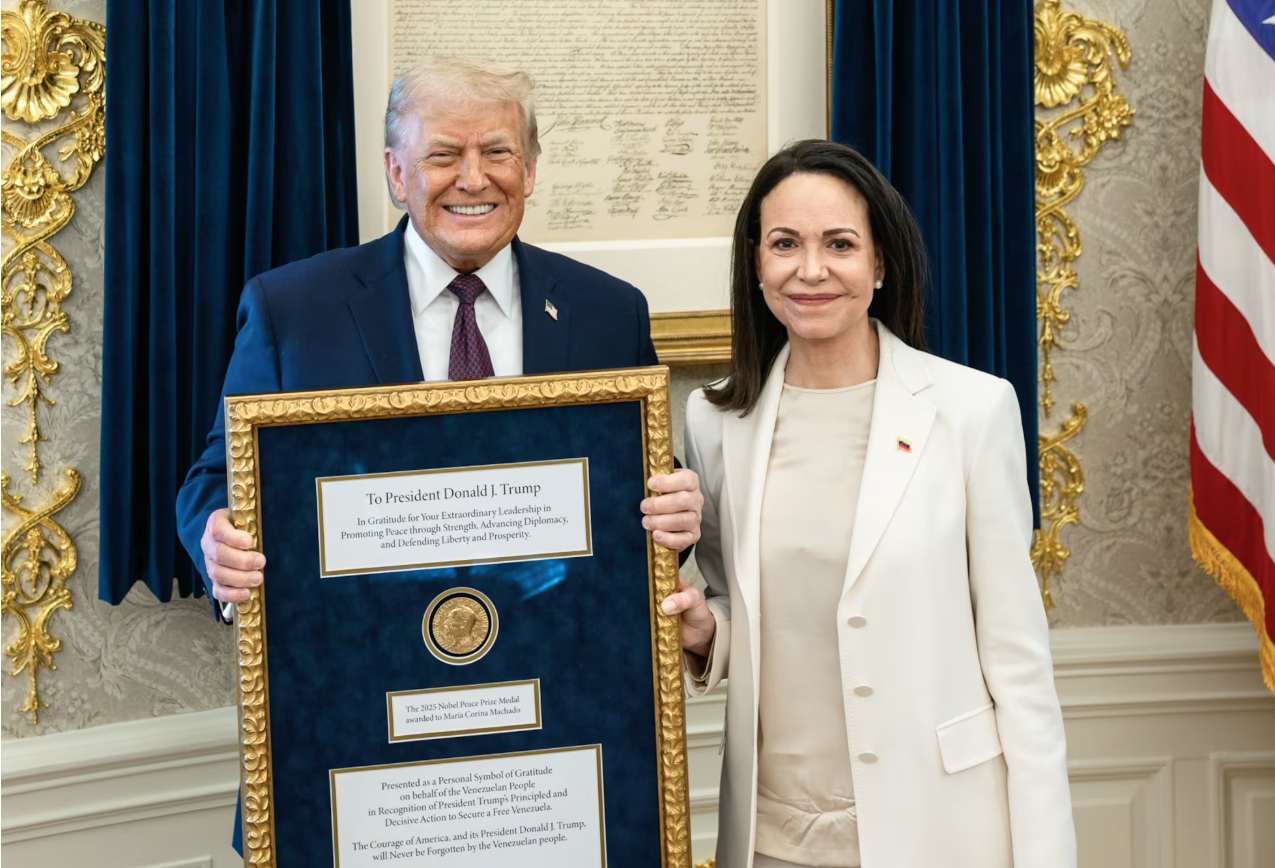
On January 15, 2026, María Corina Machado, a Venezuelan opposition leader and Nobel Peace Prize winner, handed the medal awarded by the Norwegian Nobel Committee to the President of the United States, Donald Trump. This award, the most relevant symbolic distinction at the global level, recognizes outstanding contributions to peace: disarmament, international cooperation, and the defense of human rights.
The reaction of the international community was swift. In Norway, the gesture has been met with astonishment and criticism, since the merits that underpin the prize are non-transferable. Consequently, the act at the White House—ceding the symbol of the award to Donald Trump—has been seen by Norwegians as an affront to the values that led Machado to be honored: the democratic, electoral, and peaceful struggle of Venezuelans against Maduro’s authoritarianism, as expressed in the presidential elections of July 28, 2024.

Machado’s offer comes at a moment of heightened tensions between Europe and the United States. Trump’s insistence on the annexation of Greenland, criticism over violations of international law during the capture of Nicolás Maduro, and support for Russian peace proposals in the war in Ukraine have strained the transatlantic relationship. On the domestic front, the U.S. president continues his policy of persecution and repression through Immigration and Customs Enforcement (ICE) and escalates conflict in Democratic states. Both dynamics deepen the contradiction between the symbolism of the medal and the actions of the White House.
But let us analyze the facts from the perspective of power: does Machado’s gesture contribute to her objective of attaining power in Venezuela? For the moment, the answer is no.
Her meeting on January 15, 2026 yielded no concrete promises or open support as leader of the Venezuelan transition. Her entry through the visitors’ entrance, the absence of a joint press conference, and the receipt of a White House promotional gift bag contrast with what was happening in Caracas. The Director of the Central Intelligence Agency (CIA) was meeting with interim president Delcy Rodríguez to address the issue of drug trafficking. That same day, Rodríguez presented to the Chavista National Assembly a reform of the hydrocarbons law that will facilitate the operation of foreign oil companies in Venezuelan territory. These developments reflect a structural shift in the bilateral relationship between the two nations, despite Maduro’s capture on January 3.
Meanwhile, oil companies Repsol (Spain) and Maurel & Prom (France) were requesting licenses in Washington to export oil from Venezuela, and the day before saw the first U.S. sale of seized oil worth $500 million, which will enter the Venezuelan financial system through private banking.
These three events, when compared with what Machado obtained during her visit to Washington, show that the United States government has chosen to negotiate with the power structure that sustained Maduro in order to achieve its transactional objectives—energy security, drug trafficking, and migration—rather than promote the opposition leader in the democratic transition process.
This is reinforced by statements made by Trump regarding a call he had with Rodríguez the day before, in which he said: “We had a long call, we discussed a lot of things,” “she’s a formidable person,” “she’s someone we work very well with.” Support for Rodríguez suggests that Washington currently prefers her as a transition figure. This contrasts with criticism from Democrats themselves and from Europe about supporting a transition that does not take into account the results of July 28, in which Edmundo González Urrutia was elected president.
For María Corina Machado, unconditionally supporting Trump carries the risk of alienating important allies in the pursuit of a democratic transition, in the face of the transactional vision that has prevailed at this moment. Beyond normative idealism, the reality is that an orderly transition is only possible with the cooperation of the actors who control the structures of real power within Venezuelan territory. In this context, backing Trump’s agenda reinforces the adaptive tendency of the post-Maduro regime and the prolongation of an interim government in the medium term.
Autor

PhD in Contemporany Political Processes Univ. of Salamanca. Former research coordinator at the Center for Political Studies of the Catholic Univ. Andrés Bello. Co-author of the book "Crisis y Democracia en Venezuela" (UCAB Ed., 2017).