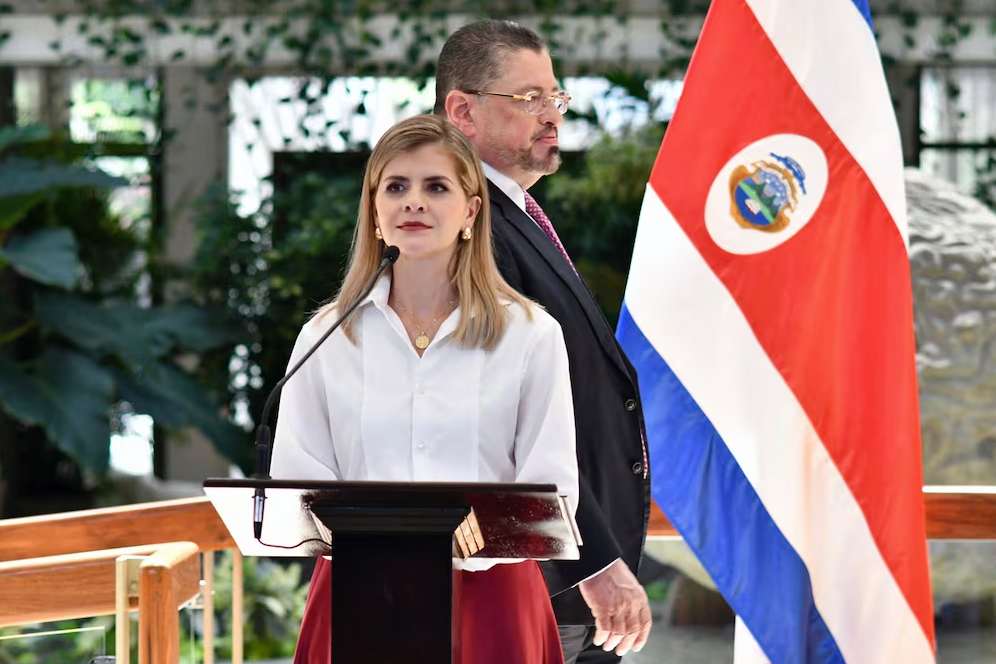
On February 1, Costa Rica voted and decided that Laura Fernández Delgado would become the country’s 50th president since it became a republic and the second woman elected to the nation’s highest office: the presidency. In addition, her party—Pueblo Soberano—founded in 2022, won 31 of the 57 seats in the country’s unicameral Congress, that is, more than half of the seats, securing an absolute majority according to preliminary data from the Supreme Electoral Tribunal (TSE). The next government will begin its term under a series of unusual circumstances: a first-round presidential victory, an increase in voter turnout of nearly 10 percentage points, and majority control of the Legislative Assembly—something that had not occurred in the country since 1990.
Since 1953, regular elections have been held, with peaceful transfers of power (there is no consecutive reelection). In this sense, Costa Rica is a consolidated democracy, where the maxim of “certainty of rules and uncertainty of results” holds true and losing political actors accept defeat when voters turn against them. This stability rests, to a large extent, on the integrity and professionalism of the TSE, which provided preliminary results on the very night of the vote through continuous online data updates. In the Central American context, this constitutes a distinctive institutional feature.

The electoral results suggest that these were atypical elections, both regionally and compared to trends observed in previous processes. Competition was reordered, and electoral support was unusually concentrated. Thus, it can be argued that a new pattern of representation and governability is emerging, while certain trends persist.
An atypical election with continuities
In regional terms, the process was atypical, as there was no punishment of the incumbent: nearly 5 out of every 10 voters chose continuity. Moreover, despite a broad slate of candidates (20 in total, five headed by women) and a highly fragmented opposition, the vote structured the competition. Pueblo Soberano (48.30%) and the once-traditional party Liberación Nacional (PLN) (33.44%) concentrated around 80% of the vote. In the legislative arena, there is likewise no scenario of greater fragmentation, but rather a Congress with fewer political forces represented and without a divided or minority government.
The results also reflect a trend observable across the region: the “emptying of the political center,” which has failed to maintain representative capacity and has left space for more radical forces, as political scientist Flavia Freidenberg has argued. In Costa Rica, this is expressed in the legislative outcome, as forces that in 2022–2026 occupied spaces on the liberal right and conservative right (Liberal Progresista and Nueva República, respectively) disappeared from Congress; their electorates were possibly absorbed by the ruling political force.
A new political era in Costa Rica?
The 2026 national elections took place after a process of transformation in the party system, characterized by the displacement of the PLN-PUSC bipartisanship toward a multiparty scenario, with eroding loyalties and a more volatile electorate. Today, only one in four people report identifying with any party (CIEP-UCR), a figure consistent with the partisan and electoral dealignment that has reshaped competition over the past two decades.
The 2014 elections deepened that trajectory when a force outside the bipartisanship reached the presidency. In the same sequence, the electoral debacle of the PAC after two governments (2014–2022), along with the personalization of competition, opened space for a personalist, confrontational, and polarizing leadership. This resulted in a president who, after nearly four years in power, has maintained approval ratings close to 60% (CIEP-UCR).
This context was reflected in the party offer. The party system displayed high fluidity; the mortality index (50/100) indicates that half of the previously represented forces were left out of Congress. In a scenario marked by the proliferation of party labels, these figures reveal a low capacity to sustain support and loyalties from one electoral cycle to the next. Political parties—for the most part—lack deep roots in society, and they do not need them in order to win elections.
On this basis, a climate of discontent and institutional distrust took shape, reinforced by rising insecurity (the homicide rate stands at 16.7 per 100,000 inhabitants, according to official figures). In this context, electoral competition was organized around a plebiscitary axis of support for or rejection of the current president, who maintained a prominent role during the campaign despite complaints of political belligerence. From the ruling camp, a narrative of promised effectiveness was presented, translated into “tough-on-crime policies,” emulating the “Bukele style” (such as the narrative of building a mega-prison).
The 2026 electoral process marks a turning point in Costa Rican politics. The incumbent’s electoral victory was decisive and territorially widespread, resulting in the concentration of political power—the presidency and a legislative majority—in a single political force: a political realignment is underway. The institutional power of the incoming government expands, and with it, its capacity for decision-making and action.
At the same time, a political movement with a social base appears to be emerging—that is, an electorate that recognizes itself in a shared set of demands and meanings around security, order, and rejection of elites and institutions perceived as obstructionist. This movement may begin to operate as a new political identity, carving out its own space. All of this is taking place at a moment when official discourse advances a promise of “refoundation,” understood as a reconfiguration of institutional balances: from the proposal of a Constituent Assembly to replace the current constitution to far-reaching reforms of the judiciary, the TSE, and other oversight bodies.
Autor

Political scientist and sociologist, she teaches at the School of Political Science and is a researcher at the Development Observatory Research Center, both at the University of Costa Rica. She is a member of the #NoSinMujeres Network of Women Political Scientists.