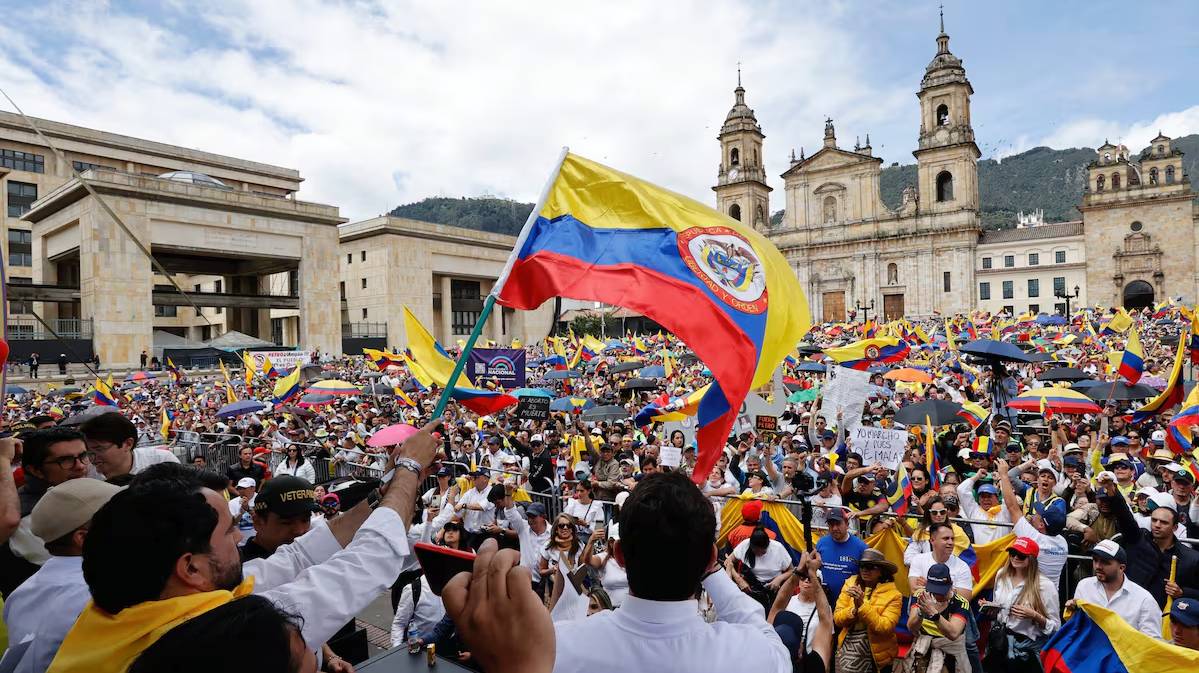
On May 31, 2026, Colombia will go to the polls for the first round of the presidential elections. The outgoing president, Gustavo Petro, and his party, the Historic Pact, are vying to maintain continuity with their left-wing project. The right seeks to consolidate a unified alternative, divided between following Uribismo—the institutional option that has been its unifying force—or backing a far-right outsider. Ahead of the first round, no candidacy can expand toward the extremes nor holds a clear majority: voters from the elusive center are the terrain to be conquered.
At this moment, the left-wing candidate is in the lead. The left enters the 2026 campaign in a new situation for Colombia, where it had been weak until a few years ago: it now has a consolidated single party—the Historic Pact—and the advantage of being in government. Its candidate, veteran senator and human rights defender Iván Cepeda, leads the polls with 37% of voting intention.

President Petro closes his term amid worsening security indicators and without having fully implemented his ambitious reform agenda, yet having completely transformed the political debate. Petro’s rise to power in 2022 was the culmination of a long process of transformation in Colombian politics that resulted in the birth of the Historic Pact, the weakening of Uribismo (the dominant political identity until then), and the emergence of concern over inequality and social reforms on the political agenda. That the first left-wing president placed social issues at the center is no small matter in a country whose debates had long been reduced to the armed conflict. Cepeda begins the presidential campaign well, but he is far from having victory secured.
At the opposite pole, the fragmentation of the right is a good representation of the identity crisis it has been immersed in for the past few years. Behind Cepeda in the polls are Paloma Valencia, candidate of the right-wing coalition, along with Abelardo de la Espriella, a far-right outsider who calls himself “the tiger.” Valencia comes from within the ranks of the Democratic Center party, with decades of experience as a congresswoman and a career patiently built in the shadow of—and in tandem with—former president Álvaro Uribe, the patriarch of the Colombian right. She had previously been a pre-candidate for her party and ultimately won the internal contest following the assassination of her colleague Miguel Uribe Turbay in 2025.
De la Espriella is a highly media-savvy lawyer, until recently based in Miami, a self-proclaimed fan of Milei and Trump, and openly aligned with the Latin American far right. If Valencia is the granddaughter of a former president, a faithful Uribista, and a product of the hierarchical structure and organizational muscle of the Democratic Center party, De la Espriella is the opposite. The ultra candidate lacks party structure and political experience, rejects traditional politics (while carefully praising Uribe), is very strong on social media, and has gained popularity by stoking a single fire: anti-Petrismo. The fuel of the “tiger’s” campaign is his fierce rejection of the current president and a discourse that emphasizes security and advocates for the elimination—even physical—of all left-wing supporters.
The most recent polls place Valencia and De la Espriella in a virtual technical tie, at around 20 percentage points each. Valencia is on the rise, while De la Espriella’s recent trend is downward—that is, Valencia’s growth has come at the tiger’s expense. The Colombian right is currently undecided between these two options, which offer very different visions of its future. Valencia represents the institutional option, though not the traditional one: she is the first female candidate of the Democratic Center and, if she wins, would become the first female president, with an openly homosexual vice president. De la Espriella is a far-right outsider, a populist, a showman with no political or public experience and few ties to the traditional political system.
In the short term, deciding which of the two right-wing candidacies advances to the second round lies in the hands of undecided and centrist voters. Decisions regarding vice-presidential tickets offer some clues about their strategies. De la Espriella opted for a running mate with academic credentials and prior experience as a minister, José Manuel Restrepo. In doing so, he attempts to send a message of reassurance and seriousness, without moderating his far-right stance.
Valencia opted for something different, in a direct appeal to center and center-right voters. She chose as her running mate economist and former Bogotá councilman Juan Daniel Oviedo, who came second in the right-wing primary with 1.2 million votes. Oviedo, who entered politics alongside key figures of the right, has built a personal brand as a technocrat and independent. His selection generated friction within the Democratic Center, where many members question the decision for not being sufficiently right-wing and for going against the party’s culturally conservative positions. Oviedo and Valencia are attempting to construct, on the fly, a coherent message that gives substance to the idea that they can build from their differences and make inroads against the left. Whether they manage to unify their message—and whether it resonates—remains to be seen.
For now, Cepeda’s strategy is to activate sectors that usually abstain from electoral politics, mobilizing more Indigenous people, marginalized populations, and poorer voters to the polls, thus continuing a strategy that worked very well for Petro in 2022. His vice-presidential running mate, Indigenous Nasa senator Aida Quilcué, reinforces this message of prioritizing his base. Meanwhile, and until the right defines who will represent it, Cepeda can afford to focus on strengthening internally. In due time, however, the left will also have to look toward voters in the center if it wants to win the election.
Autor

Professor at the University of Rosario in Bogotá, Colombia, and PhD in Political Science from the University of Notre Dame. Member of the Network of Women Political Scientists.