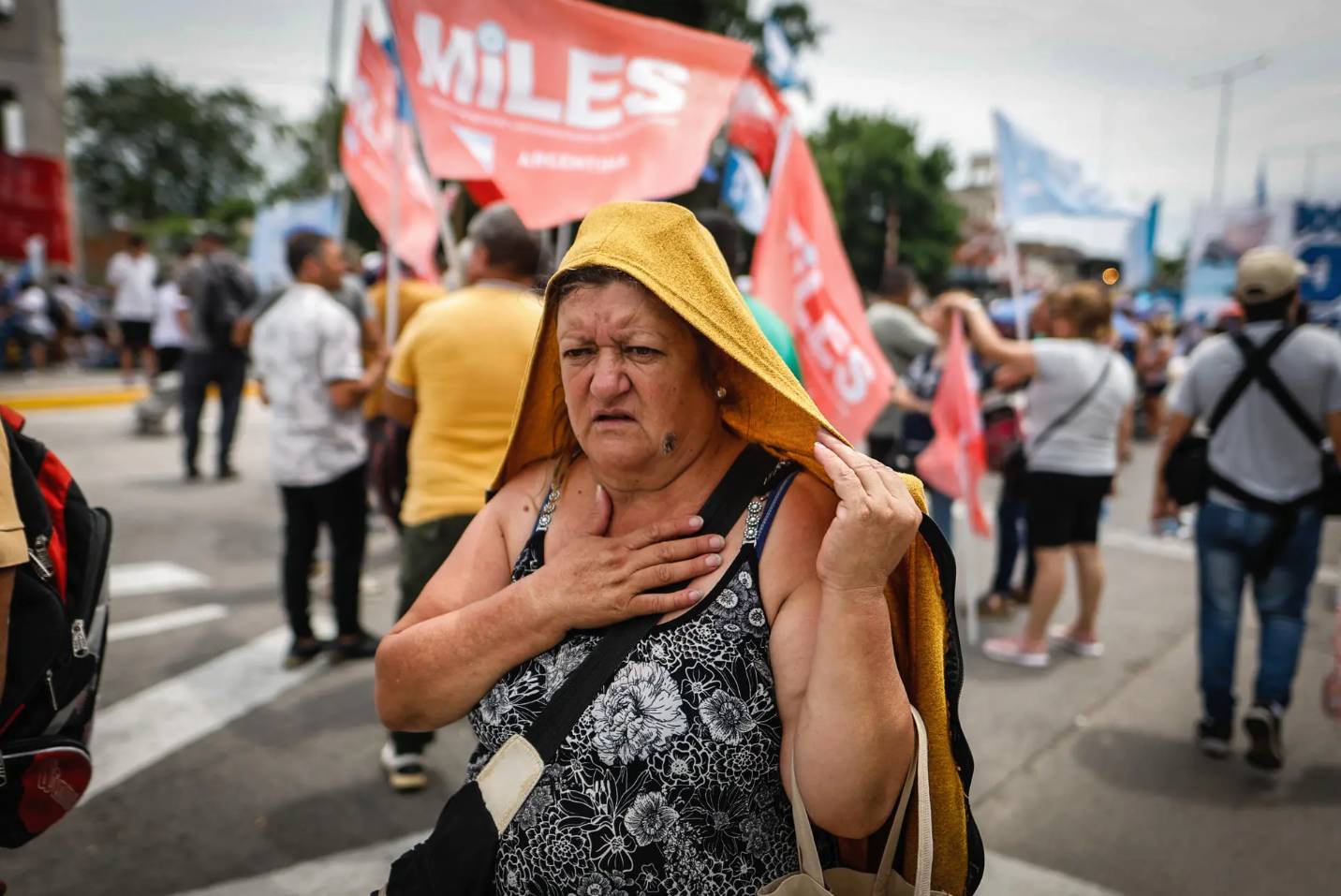
Javier Milei is going through a two-sided phase. At the ballot box, he is not short of support: on October 26, 2025, La Libertad Avanza won the midterm legislative elections with 40.84% of the vote, a result Donald Trump described as “extraordinary” and which Washington, according to his own statement, made a condition for a package of aid worth up to $40 billion. But the libertarian president’s trajectory is also marked by setbacks and defeats. His sister Karina, Secretary-General of the Presidency and the true “gatekeeper” of power, is still under investigation — both in Argentina and the United States — over the collapse of the $LIBRA cryptocurrency, in a case that remains open. On the domestic front, in August 2026 Milei suffered a major political defeat: the Senate approved his bill on the “inviolability of private property” only after stripping it of its most controversial provision, which would have raised from 15% to 25% the limit on rural land that can be acquired by foreigners. Amid protests, clashes with police and accusations of “selling out the country” — amplified by the patriotic mood surrounding the World Cup — the government was forced to back down.
On the foreign-policy front, by contrast, the strategy is delivering results. In April 2026, Milei made his third state visit to Jerusalem and reaffirmed his full alignment with Israel and Washington in the war against Iran. On September 17, 2026, he once again stirred up the longstanding dispute with London by introducing a bill that toughens sanctions against companies involved in the exploitation of the Falkland/Malvinas Islands. What holds together such a multifaceted figure is his showman’s instinct: on October 6, 2025, Milei turned the launch of his book La construcción del milagro (The Construction of the Miracle) into a rally-concert attended by 15,000 people at Buenos Aires’ Movistar Arena.

To understand the “Milei phenomenon” beyond the immediate news cycle, one must go back to its roots: an outsider who remained on the margins of Argentina’s political system until his resounding breakthrough in the media between 2016 and 2021, when he was elected to the National Chamber of Deputies representing the city of Buenos Aires. His rise emerged from the intersection of two simultaneous crises. On the one hand, the profound rejection of politics understood as an activity serving the common good. On the other, the irreversible transformation of Argentina’s “Fordist” economy, whose social fabric was eroded by deindustrialization, the growing foreign ownership of productive assets, and the shift toward a service-based economy.
That process dissolved the class identities on which the old representative system had been based. Amid this dual economic and political shift, Milei’s discourse managed to tap into three longstanding demands within Argentine society: the fight against inflation, which hits wage earners and informal workers hardest; the rejection of a corporatist society perceived as suffocating individual effort; and the frustration with a state that creates privileges for a select few close to those in power.
The economy, however, is not enough to explain Milei’s success. A decisive factor is “gorilismo”: the deep and cross-cutting anti-Peronism that has been rooted in part of the Argentine electorate for more than fifteen years. It is an outright rejection of everything associated with Peronism, a movement historically identified with defending popular sectors, but also perceived as a source of privileges for those who administer its redistributive system. Milei has managed to fuse a plebeian and irreverent style with a libertarian ideology, a combination that serves the interests of the big capital backing him: the axis formed by the United States, Israel, the financial sector, and the international right. From this perspective, right-wing populism emerges as the strategy through which concentrated capital captures popular discontent and prevents it from turning into genuine opposition.
Born out of the pre-hyperinflationary collapse inherited from the Fernández government, Milei won the election by bringing together support from both the poorest sectors and the more affluent. Today, however, that coalition has fractured: popular sectors, having seen no tangible improvements, are partly abstaining from going to the polls, while the middle and upper classes remain firmly on his side.
His fate in 2027 will depend on the evolution of the economy and on the possible emergence of a credible alternative, given the major difficulties facing Kirchnerism in becoming one. As political scientist Andrés Malamud points out, anti-Kirchnerism remains Argentina’s strongest political identity, a terrain on which Milei continues to move with ease.
*This text was originally published by the Italian outlet Pubblico of the Fondazione Feltrinelli.
Autor

He holds a PhD in Social Sciences from the University of Cassino and Southern Lazio (Italy) and is an Adjunct Professor of Political Sociology at the University of Perugia (Italy). He coordinates the Latin America Department at the International Center for Democracy and Democratization at Luiss University (Italy).