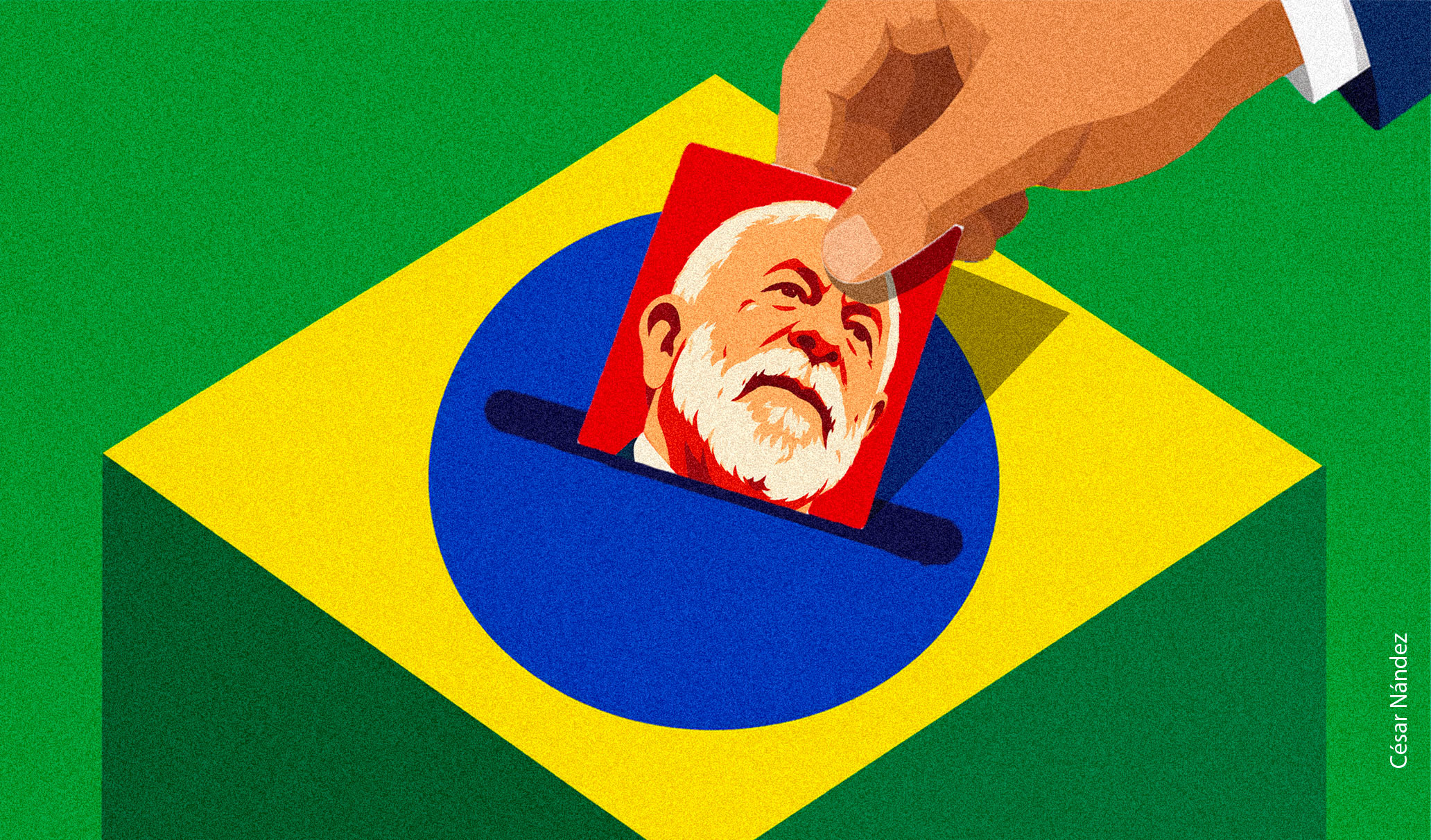
The victory of far-right candidate Flávio Bolsonaro in the first round took Lula by surprise, as he expected to win the election in the first round. It is still difficult to understand what formed the basis for these expectations. Polling companies showed that the majority of Brazilians disapproved of his administration. In fact, on the only two occasions when PT candidates won in the first round, 2006 and 2010, they did so backed by high approval ratings for the incumbent president, Lula himself. In Brazil, since the return of democracy, no ruling party presidential candidate whose party faced negative public perception managed to ultimately emerge victorious. Indeed, the best driver of a president’s reelection is their approval rating.
Overconfidence might have been merely anecdotal had it not almost certainly contributed to the victory of Flávio Bolsonaro and his party (Liberal Party) in both chambers. With the support of their right-wing allies (Progressive Party and Republicans), the Bolsonaristas could control 59% of Congress, with the option even to shift the balance of power within the Federal Supreme Court in their favor. To make matters worse, the winning coalition of the first round also secured the governorships of the most populous and wealthiest states. According to Brazilian political scientist Rivera Hoyos, Bolsonarism gained the conditions to turn a change of party into a change of regime.

Flávio Bolsonaro is not yet guaranteed executive power. However, the candidates who finished third to fifth in the first round—psychiatrist and popular self-help author Augusto Cury, and former governors Ronaldo Caiado and Romeu Zema—announced their support for the far-right candidate ahead of the runoff. Precedents also seem to favor Bolsonaro. In Brazil, no presidential candidate who lost the first round has managed to reverse that result in the second.
The presidential election is not decided
The script that events are following in Brazil does not necessarily conform to that of a chronicle of a death foretold. For the governing coalition, some signs are favorable. Comparative experience shows that when a president runs for consecutive reelection, their approval rating tends not to stagnate or decline, but rather to rise significantly. Along with this, their share of the vote also grows.
Heading into the second round of the 2014 presidential elections in Colombia and Brazil, the approval ratings of Presidents Juan Manuel Santos and Dilma Rousseff, respectively, rose by several percentage points, contributing to their electoral victories. A similar trend was observed in the 2019 presidential election in Argentina and 2022 in Brazil with former presidents Mauricio Macri and Jair Bolsonaro, although neither managed to win.
Thanks to a significant revaluation of his administration from the primaries to the first round, Macri managed to avoid the debacle predicted by the preliminary results obtained before the first round. For his part, Jair Bolsonaro’s approval went from being unequivocally negative before the campaign to virtually matching his disapproval level. This situation allowed him to sell his defeat dearly to his opponent Lula, losing by a razor-thin margin.
In the three weeks following the first round in Brazil, to varying degrees, the main polling firms have begun registering an upward movement in Lula’s approval rating. According to Datafolha, on October 15, the measurement reflected a technical tie. Lula’s administration has not yet reached a positive evaluation, but it managed to leave the disapproval zone. Interestingly, this measurement predates the approval of the constitutional reform establishing two rest days per week without salary cuts—a central banner of Lula’s campaign. A benefit that will reach 14 million Brazilians.
On the other hand, expert Rovira Kaltwasser highlighted voter punishment of governments, particularly left-wing ones, as one of the main conditions for the rise of the far right in the region. Indeed, in 2023 Kirchnerism received heavy punishment capitalized on by Javier Milei. In 2025 in Chile, the governing Broad Front and its candidate Jeannette Jara were overwhelmed by José Antonio Kast and the Republican Party. In contrast, in the Brazilian presidential first round, Lula and the PT lost by a margin of less than two percentage points. This result shows an extremely tight partial defeat in which we do not necessarily perceive voter punishment.
More than an election
The significance of next Sunday’s second round likely extends beyond that of any other election. Given the enormous institutional power accumulated by Bolsonarism after the first round, should it also gain control of the executive branch, it would have the opportunity to move toward subjugating institutional checks and balances and establishing a right-wing populist regime.
It should not be forgotten that toward the end of the term spanning 2018 to 2022, Bolsonarism showed its most authoritarian face, going so far as to threaten not to recognize election results when they were adverse. And a week after Lula’s inauguration in January 2023, Bolsonarism orchestrated an unprecedented mass attack against the main branches of state power.
On the verge of turning 81 years old, the outcome of the second round could ultimately shape the contours of Lula’s political legacy. The ending matters. The image of Lula handing over the presidential sash to Jair Bolsonaro’s son would be far from the best conclusion. Nearly eighteen years of Lulism and PT rule would conclude with the handover of the highest office to its exact antithesis, the Bolsonaro clan.
Throughout his political career, Lula was forced to reinvent himself on multiple occasions. He won the presidency for the first time in 2002 after three consecutive defeats. In his first administration, he managed to get his social policies greenlit while emerging unscathed from the “Mensalão” corruption scandal, which sent Chief of Staff José Dirceu to prison, along with Minister of Communications Luiz Gushiken, Minister of Transport Anderson Adauto, and a dozen deputies.
Lula then managed, upon completing his two terms, to leave as his successor the first woman in Brazil’s history to hold the presidency. In 2018, he was imprisoned, and after a year and a half, he achieved his release to defeat an incumbent far-right president as a presidential candidate.
Now, according to journalist and political scientist Giancarlo Summa, Luiz Inácio Lula da Silva faces his final and most difficult test of survival. Will there be room for one last reinvention?
Autor

Profesor e investigador de la Universidad de Guadalajara (México). Doctor en Ciencia Política de la misma universidad. Miembro del Sistema Nacional de Investigadores, Nivel 1.