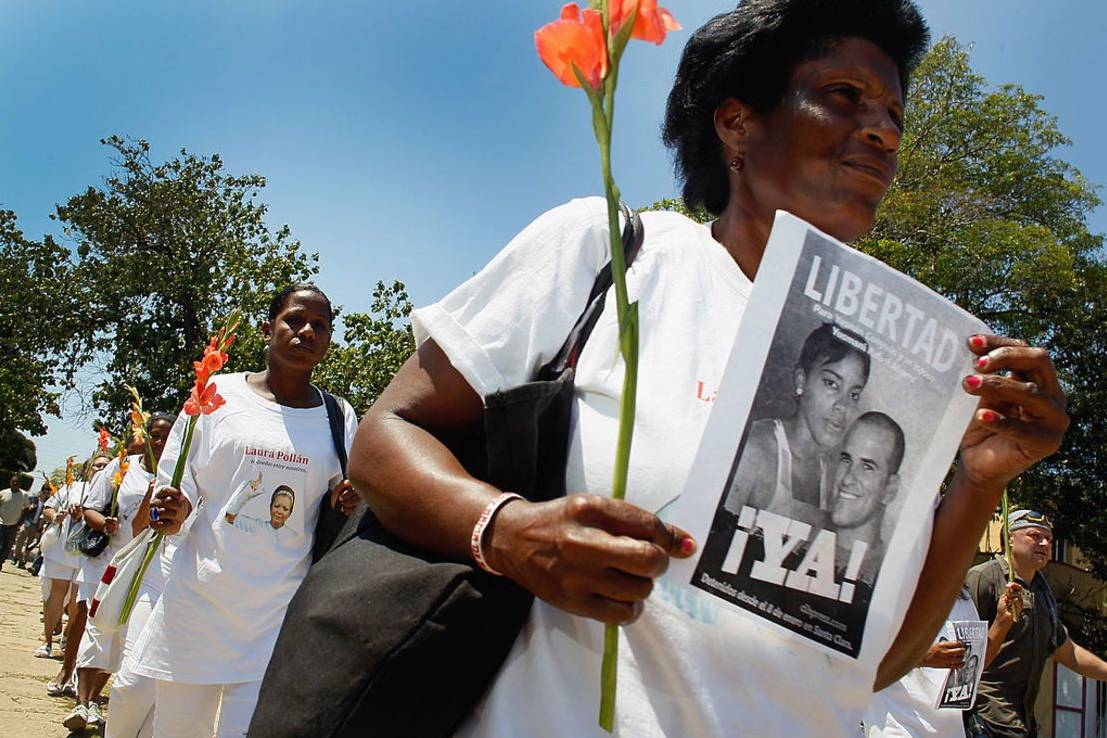
The mass arrests following the pro-democracy protests of July 11, 2021, brought political imprisonment into thousands of Cuban homes, turning what could seem like an ideological question into a deeply human one. A 2024–2025 CubaData and University of San Martín de Porres study of 1,685 Cubans found that 65 percent expressed empathy toward political prisoners, suggesting that the regime’s longstanding efforts to isolate them socially by labeling them “mercenaries” or “enemies” may be losing their effectiveness. But the July 2021 crackdown was only the latest chapter in a much longer history. Over the past 67 years, more than half a million Cubans are estimated to have been imprisoned for political reasons, while the country’s prison system has expanded from about 10 major prisons in 1958 to at least 350 prisons and detention facilities today. Across those decades, political prisoners have described beatings, killings, prolonged solitary confinement, starvation, denial of medical care, and other abuses documented by human rights organizations and United Nations human rights mechanisms.
Yet the Cuban regime has consistently denied political imprisonment. On February 1, 1977, Vice President Carlos Rafael Rodríguez told the BBC that Cuba had no political prisoners because imprisoned “counterrevolutionaries” could not be considered political prisoners. Since the massive crackdown following the pro-democracy protests of July 11, 2021, this longstanding practice has become particularly visible. Cuban officials have repeatedly insisted that the country has no political prisoners and that detainees are not subjected to torture or ill-treatment. Pro-regime groups abroad have echoed this narrative, recasting prisoners as criminals, mercenaries, or counterrevolutionaries.

Political imprisonment accompanied by denial is not unique to Cuba. Argentina’s military junta denied allegations of torture and knowledge of the whereabouts of disappeared detainees. After Venezuela’s disputed 2024 election, Attorney General Tarek William Saab denied that post-election detainees were political prisoners, portraying them instead as terrorists and criminals. Russia and Iran have similarly portrayed political prisoners as criminals, extremists, or “security prisoners.”
These examples reflect a broader authoritarian logic. In The Power of the Powerless, Czechoslovak dissident Václav Havel argued that falsehood was integral to the communist system of the Soviet bloc. Ideology created a “world of appearances” in which repression became legality and governments claimed to respect human rights while persecuting their opponents. Because the system was “captive to its own lies,” Havel wrote, it had to continually falsify reality.
The “world of appearances” Havel analyzed found a revealing Cuban expression in Raúl Castro’s own words in 1989. Speaking to a military audience amid the unfolding case against General Arnaldo Ochoa, Castro said that regardless of what he had told them, what ultimately mattered was what appeared in Granma, the Communist Party’s official newspaper: “What appears in the newspaper is the official concept.”
This divide between reality and official truth is particularly evident in Cuba’s treatment of political prisoners. By criminalizing the peaceful exercise of fundamental rights, the regime can portray political prisoners as common criminals and cite their convictions as proof. Denial thus serves concrete political purposes: protecting legitimacy, concealing resistance, limiting international costs, and whitewashing repression.
Protecting legitimacy
The revolutionary government built part of its legitimacy by condemning the torture, killings, and political repression of the Fulgencio Batista dictatorship. Acknowledging political imprisonment and abuse would expose the contradiction between the repression the revolution once condemned and the practices of the state it created. It would also damage the humanitarian image Cuba has cultivated internationally.
Concealing resistance
A political prisoner reveals two things an authoritarian government would rather conceal: its willingness to repress and citizens’ willingness to resist. Cuba’s plantados (“those who stood firm”), political prisoners who refused political rehabilitation and ideological submission, embodied that resistance despite harsher punishment. Decades later, prisoners of conscience such as Félix and Saylí Navarro have resisted pressure to accept exile as the price of freedom. Repression has never completely extinguished resistance.
Limiting international costs
Recognition of political prisoners can bring condemnation, investigations, diplomatic pressure, and sanctions. Since July 2021, amid sustained mobilization by the families of political prisoners and human rights activists, the European Parliament has adopted at least six resolutions addressing political prisoners and repression in Cuba. In June 2026, it condemned torture and other abuses and called for sanctions against officials involved in repression. The U.S. Senate and the Inter-American Commission on Human Rights (IACHR), have also scrutinized individual cases, demonstrating the limits of denial in the face of mounting international scrutiny.
Whitewashing
When repression becomes too extensively documented to deny, controlling how it is perceived can become just as important. Whitewashing does not always require fabrication; a carefully managed truth can have a similar effect.
Chinese human rights lawyer Xie Yanyi spent about 18 months in detention, where he reported beatings, starvation, isolation, and other abuses. After his release in 2017, authorities kept him under surveillance in a hotel, where he was well fed and regained considerable weight before returning home. The improved conditions were real, but they could also soften the visible signs of what he had endured by the time he reappeared publicly.
Cuban artist and prisoner of conscience Luis Manuel Otero Alcántara presents a striking parallel. After spending much of his early imprisonment in solitary confinement, he was later allowed to create art and receive family visits. Near the end of his four-year arbitrary imprisonment, authorities moved him to a beach house for eleven days before his departure into exile.
In both cases, exceptional conditions near the end could shape perceptions while drawing attention away from earlier abuses. The responsibility lies not with prisoners whose accounts may be entirely truthful, but with systems that control the conditions of imprisonment and what the outside world sees.
Conclusion
For nearly seven decades, Cuba’s denial of political imprisonment has helped protect the regime’s carefully cultivated image as a revolution standing with the poor and oppressed. But denial does more than protect an image. It renders the victims of political repression invisible by stripping their imprisonment of its political meaning. By portraying political prisoners as common criminals, the regime obscures their suffering, their resistance, and the repression that put them behind bars. A government unwilling to acknowledge the political nature of their imprisonment can hardly confront, much less end, the repressive practices that sustain it. Historical memory, however, is shaped not only by the principles governments proclaim, but by how they treat their citizens, especially those who dissent. Cuba’s political prisons therefore leave a question that official denial cannot erase: How should history judge a system responsible for nearly seven decades of political repression?
Autor

Researcher and director of Espacios Democráticos, an NGO dedicated to promoting solidarity in Canada with human rights defenders and civil society in Cuba. Master in Latin American History from the University of Toronto