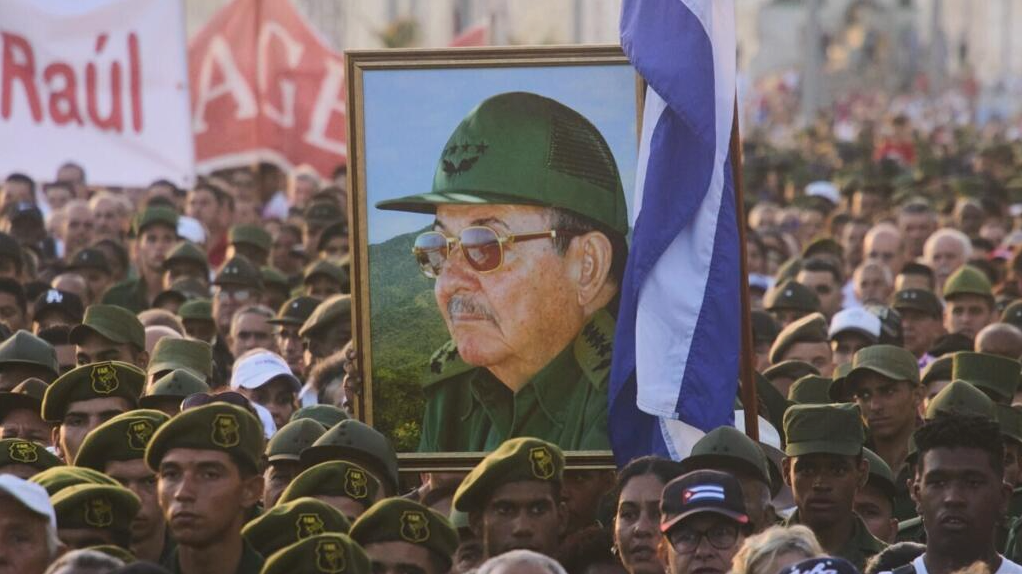
The eventual death of Raúl Castro would constitute a pivotal symbolic event in the history of Cuban politics since 1959. It would not create an institutional vacancy—the presidency passed to Miguel Díaz-Canel in 2018 and leadership of the Communist Party of Cuba (PCC) in 2021—but it would mark the disappearance of the last major figure of the founding generation capable of arbitrating conflicts within the ruling coalition.
The central question is not who will succeed Raúl Castro, but what will happen when the system loses an informal authority that is difficult to reproduce institutionally. In 2026, this question takes on particular importance amid the economic, energy and social crisis: power outages, shortages, deteriorating services and recurring protests have increased the costs of governance. At the same time, the government is pursuing 176 economic measures aimed at expanding the model’s room for adaptation.

Raúl’s death should therefore be understood as an intervening variable. On its own, it would be unlikely to produce a transition, but it could alter internal balances at a time of mounting pressure. Based on this premise, five scenarios can be identified: authoritarian continuity, elite fragmentation, economic liberalization without democratization, crisis accompanied by social mobilization, and a negotiated transition.
Raúl Castro’s death as a problem of authority
Authoritarian regimes are not sustained solely through formal institutions; they also depend on personal networks, historical loyalties and informal mechanisms of negotiation. In Cuba, this dimension is particularly important given the prolonged dominance of the revolutionary generation and the weight of the Revolutionary Armed Forces (FAR) and security agencies.
Although Raúl stepped down from the presidency and the leadership of the PCC, he retains political capital through his revolutionary legitimacy, military career and knowledge of the networks of power. Díaz-Canel possesses institutional legitimacy; Raúl retains a historical authority that no successor can fully inherit. His disappearance would therefore constitute a test of institutionalization: if the regime preserves cohesion and discipline, it will demonstrate post-personalist capacity; if suppressed conflicts emerge, the continuing weight of the historic generation will become evident.
Scenario I: authoritarian continuity and “raulism without Raúl”
This is the most likely scenario in the short term. Raúl’s death would be managed through state ceremonies, an emphasis on unity and a reaffirmation of revolutionary continuity. Díaz-Canel’s leadership would seek to demonstrate that the system can survive its founders. The PCC, the FAR and the Ministry of the Interior would seek to close ranks and could preemptively intensify political surveillance.
Continuity would not necessarily mean immobility. Economic adjustments could be introduced, younger leaders promoted and institutions reorganized without altering the PCC’s political monopoly. It would be “Raúlism without Raúl”: institutionalization, coercive discipline and selective adaptation. As long as the security apparatus remains cohesive, this scenario will remain highly likely.
Scenario II: quiet elite fragmentation
Raúl’s disappearance could remove an arbiter capable of reconciling divergent interests. Differences would probably not emerge as open confrontations, but rather through dismissals, military rotations, disputes over state-owned enterprises or contradictions in economic policy.
Three broad sensibilities can be distinguished: a conservative one, committed to preserving the political monopoly; a technocratic one, favoring greater economic liberalization; and another linked to military and business interests, concerned with stability and strategic assets.
The decisive variable would be whether any sector concludes that preserving the status quo is more costly than reforming it. Experiences of authoritarian transitions show that divisions within the elite can become more important than the opposition’s initial strength. Raúl’s death would not automatically produce such fractures, but it could remove one of the mechanisms that helped contain them.
Scenario III: economic liberalization without democratization
The government could accelerate economic reforms precisely to prevent political opening. The 176 measures adopted in 2026 take on strategic importance here by expanding space for investment and private activity while reducing certain bureaucratic obstacles. Cuba could seek to develop a model of authoritarian adaptability: greater economic flexibility while maintaining the political monopoly.
The expansion of the private sector, diaspora investment and the inflow of capital could ease social pressures, but it could also create actors with interests of their own and demands for legal certainty and predictable rules. There is no automatic relationship between capitalism and democracy, but a society less dependent on the state can gradually alter political incentives. Reforms designed to preserve the regime could end up transforming its social foundations.
Scenario IV: economic crisis and social mobilization
Raúl’s death would be unlikely to trigger nationwide mobilization on its own, but it could serve as a focal event if it coincided with prolonged blackouts, inflation, worsening food conditions or a perception of government weakness. The protests of July 11, 2021 demonstrated that territorially widespread mobilization can occur without a pre-existing national organization. In 2026, protests linked to basic services show that the social repertoire of discontent remains active.
The sequence could be: the disappearance of the historic leader, a perception of vulnerability, local protest, digital dissemination and territorial contagion. The decisive factor would be the behavior of the coercive forces. Protests confronted by a cohesive security apparatus would favor authoritarian survival; partial neutrality by the security forces would produce a crisis; and, combined with elite fragmentation and a split within the coercive apparatus, it would open a real possibility of transition.
Scenario V: negotiated rupture and a pact-based transition
This is the least likely scenario in the immediate term, but the one with the greatest transformative potential. It would require a significant faction of the elite to conclude that its interests could be better safeguarded through negotiation than through indefinite repression. Negotiated transitions tend to accelerate when differences emerge between hardliners and reformists and the latter find a moderate opposition capable of offering credible commitments.
A negotiation would have to address guarantees for the military and government officials, economic assets, political prisoners, independent organizations, electoral reforms, the diaspora and relations with the United States. The diaspora could provide investment and expertise, but a viable transition would have to avoid a logic of winners and losers.
The United States would be a critical variable. An exclusively punitive policy could strengthen hardline sectors, while a strategy combining pressure, incentives, guarantees and conditional relief could broaden the space for negotiation. At the same time, support from China and Russia could increase the government’s capacity for resistance and reduce its incentives to negotiate.
The scenarios as a sequence
These scenarios are not necessarily mutually exclusive. The trajectory could begin with apparently successful continuity. Then, the absence of the historic arbiter could make internal divergences more visible. If the crisis persists, one part of the elite could push for reforms while another seeks to block them. If social mobilization also increases, the regime would have to choose between intensifying coercion, deepening adaptation or exploring a negotiated way out.
Attention should be paid to the cohesion of the PCC, the behavior of the FAR and MININT, the economy, protests, opposition coordination, the diaspora and external actors. The most important indicator would be coercive cohesion: crises and protests do not necessarily lead to a transition as long as the state apparatus maintains unity and repressive capacity.
Conclusions
Raúl Castro represents an informal mechanism of cohesion whose importance can only be fully measured once he is gone. His death will test the system’s capacity to reproduce authority, resolve internal conflicts and manage the crisis without relying on the legitimacy of the founding generation.
Continuity is the most likely scenario in the short term. However, the loss of the historic arbiter, economic reforms, material deterioration, social mobilization and internal divergences could gradually transform the balance of power. Raúl’s death is not a sufficient condition for transition, but it could act as an accelerant if it coincides with a fracture in the ruling coalition and a shift in the expectations of the coercive forces.
Post-Raúlism will be less a struggle to replace one man than a test of the institutionalization of Cuban authoritarianism. The decisive question will be whether the system can preserve, without the historic generation, the political and military cohesion that the Castros forged over more than six decades.
Autor

Professor and researcher at the Iberoamericana University (Mexico City). PhD. in Political Science from FLACSO-Mexico. Specialized in republican institutional history in Cuba, political transition and democratization.