Cuba’s deepest crisis under the current regime coincides with a Washington-driven strategy of maximum pressure. The objective is to force a political transition, but the use of force no longer appears to be a dismissed possibility.
Cuba’s situation deteriorated decisively following the U.S. intervention in Venezuela earlier this year. Since then, Venezuelan oil supplies—vital to Cuba’s energy system—have been cut off. These accounted for more than 60% of the island’s oil imports. At the same time, Washington expanded sanctions against companies and countries that continue to support the Cuban regime. The goal is to narrow Havana’s economic and political room for maneuver so that its leaders become willing to undertake a political and economic transition.
For Washington, that transition should lead to the opening of the economy, the release of political prisoners, investment opportunities for U.S. companies, and, in the long term, the emergence of a government that adopts a cooperative stance toward the United States. Within the Trump administration, however, it still appears unresolved whether this transition should take place with the participation of elements of the current regime or through its complete replacement.

Against the last adversary
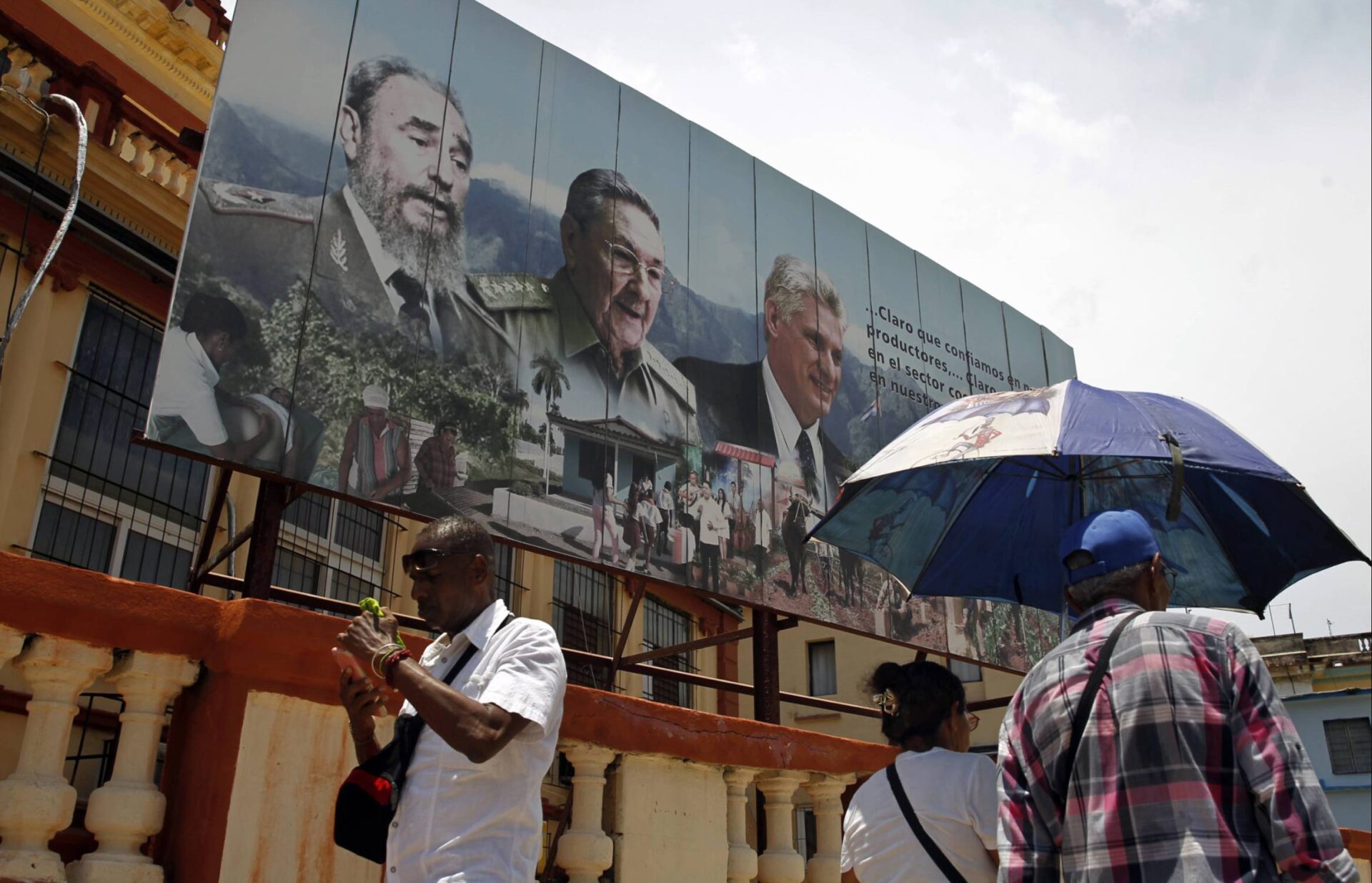
U.S. policy toward Cuba is part of a broader foreign policy strategy. For the Trump administration, it represents a return to a modernized version of the Monroe Doctrine. Cuba is regarded as one of the last authoritarian adversaries of the United States in Latin America. Unlike Venezuela, the island has a cohesive power structure. Political power does not rest solely with President Díaz-Canel but rather with a tightly interconnected network comprising the Communist Party, the Armed Forces, the security apparatus, and key economic actors.
Within this structure, the military-linked conglomerate GAESA plays a central role, serving as the regime’s principal economic power base. Former President Raúl Castro, despite his advanced age, continues to wield considerable influence over the leadership’s strategic decisions. Washington still considers him a key power broker in Havana, as evidenced by his conviction by a U.S. court in May 2026.
Current U.S. policy suggests that Washington will initially maintain its strategy of maximum economic and political pressure. The objective is to raise the costs of remaining in power for Cuba’s leaders to such an extent that part of the ruling elite becomes willing to pursue an orderly political transition. From the U.S. perspective, this approach offers significant advantages. It would preserve the country’s core state institutions, introduce economic and political reforms gradually, and at the same time avoid the risks associated with a sudden state collapse or military intervention.
The Cuban regime’s initial reactions suggest that Washington’s strategy is having an impact. Recently, Cuba’s leaders approved economic reforms that once seemed unimaginable. For the first time in decades, the communist leadership opened key sectors of the economy to private enterprise and foreign capital. Washington, however, has not interpreted these measures as a fundamental change of course but merely as limited concessions intended to buy time and ease U.S. pressure.
Cuba’s history shows that economic pressure alone has not been sufficient to overthrow the regime. Yet today the island faces a far deeper economic and humanitarian crisis, while pressure from Washington is greater than ever.
If the U.S. strategy fails to produce tangible results in the coming months, calls within the Trump administration for more forceful measures are likely to intensify. President Trump has repeatedly raised the possibility of military intervention. Moreover, as attention shifts away from Iran, Washington’s foreign policy priorities are likely to refocus on the Western Hemisphere. Cuba could once again become a strategic priority for the United States. In this context, the military option appears more realistic today.
Support for an intervention
Various surveys indicate that around 77% of Cubans want a transition to a market economy and liberal democracy. At the same time, more than 60% of the population would welcome U.S. intervention and the overthrow of the regime. The humanitarian crisis has significantly increased public support for U.S. military intervention. For many Cubans, their living conditions can scarcely deteriorate further. They associate political change with the hope of improving their quality of life.
Yet this discontent has not yet given rise to nationwide mass protests, although localized demonstrations are becoming more frequent. A few months ago, a local Communist Party headquarters was set on fire, and spontaneous street protests erupted. The absence of a nationwide protest movement can largely be explained by two factors. On the one hand, many Cubans are entirely consumed by the daily struggle for survival. The search for food, medicine, or electricity leaves little time or energy for political resistance. On the other hand, the regime’s repressive apparatus continues to function with great efficiency. Even the smallest demonstrations are systematically suppressed, while the many political prisoners held under inhumane conditions in Cuban prisons deter countless people from openly opposing the regime.
The most visible form of protest, however, has long been emigration. Since 2019, roughly three million of Cuba’s approximately eleven million inhabitants have left the country, most of them young people. What remains is an aging population, further worsening the island’s economic challenges.
Cuba’s future?
It is impossible to predict with certainty whether political change will occur in Cuba or when it might happen. Even if a regime change were to take place in the coming months, it would not automatically lead to a transition toward liberal democracy. The fall of the authoritarian regime would merely mark the beginning of a long process of transformation whose outcome is far from predetermined.
Many of the institutional and social conditions needed to sustain a democratic transition are absent. Independent political parties, free media, a strong civil society, and autonomous labor unions either scarcely exist or have been systematically weakened over decades. Moreover, there is no nationally organized democratic opposition capable of assuming political responsibility in the short term. As a result, a sudden transfer of power would initially leave behind a political and institutional vacuum.
The Cuban diaspora is likely to play a key role in the transformation process. Millions of Cubans, particularly in the United States, possess capital, business experience, and international networks. Many exiled Cubans hope to invest in their homeland over the long term and contribute to the country’s economic reconstruction. At the same time, the diaspora is fragmented and holds differing visions for Cuba’s future. Developing a shared vision for the country’s political and economic reconstruction will therefore be a significant challenge.
In the long run, the success of a political transition will depend decisively on whether robust democratic institutions can be established. Free elections alone will not be enough. An independent judiciary, institutions committed to the rule of law, free media, political parties, and an active civil society will all be essential. Social reconciliation will also play an important role.
Whether Cuba achieves a new democratic beginning will not depend solely on the decisions of political leaders in Havana and Washington. Germany and the European Union should clearly denounce the systematic violations of human rights and align their Cuba policy consistently with democratic principles. The EU should continue to make use of the Political Dialogue and Cooperation Agreement with Cuba, consistently insist on compliance with its human rights provisions, and involve Cuba’s independent civil society more actively in its implementation. Germany and the EU could make an important contribution to building institutions founded on the rule of law, fostering a democratic political culture, and strengthening an active civil society.
This article was originally published in Diálogo Político.
Autor

Representative of the Konrad Adenauer Foundation for Ecuador.

Political scientist and international relations specialist in Bielefeld, Eichstätt, and Bogotá. Intern at the KAS Mexico office and worked at the Munich Security Conference.