The decision by Argentina’s president, Javier Milei, to ban all accredited journalists from entering the Casa Rosada is unprecedented, even during non-democratic periods. The move comes amid escalating confrontation with the press and is based on two official arguments: an investigation into alleged foreign infiltration in media outlets and a criminal complaint over alleged illegal espionage against two journalists from the television channel Todo Noticias. As part of the measure, existing accreditations were suspended and fingerprint access records were removed, leaving the Executive Branch without on-site media coverage while the judicial investigation proceeds and the accreditation system is redefined.
At the other end of the region, the United States announced the revocation of visas for members of the Board of Directors of the Costa Rican newspaper La Nación, without explanation or clear procedures. An independent newspaper with 79 years of history, which has investigated cases of government corruption, is being targeted by a foreign government without, so far, receiving condemnation from its own government.

Both decisions are among the most recent aggressions against journalism and the press. They represent an attack on the very quality of democratic systems, on freedom of the press, and on the right to free expression. Press freedom has declined worldwide to its lowest level since 1975, according to the latest report by International IDEA (International Institute for Democracy and Electoral Assistance), The Global State of Democracy.
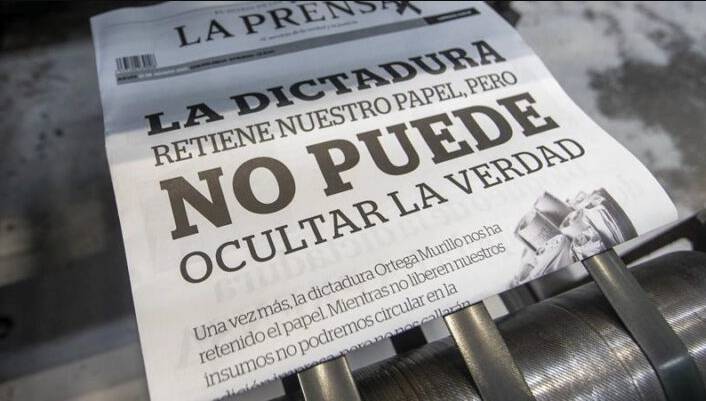
The most dramatic setbacks in the region—and in the world—have occurred in contexts of extreme violence or consolidated authoritarian regimes such as Haiti, Cuba, Venezuela, and Nicaragua. There, persecution and attacks against journalists undoubtedly constitute grave human rights violations.
Situations such as those faced by Guatemalan journalist José Rubén Zamora, known for exposing corruption cases and the relationship between politics and organized crime in his country, are becoming increasingly common. Zamora, who faces up to 40 years in prison and spent more than three years incarcerated, has finally been released after a judge granted him house arrest so he may continue a criminal process that, according to civil society organizations and the Inter-American justice system, has been marked by irregularities and violations of his right to due defense.
Zamora’s case illustrates how journalists in Latin America have become one of the groups most exposed to judicial persecution, public harassment by authorities, and violence from criminal organizations.
Between 2018 and 2024, more than 900 journalists were forced into exile in Latin America, according to UNESCO data, while at least 142 journalists were murdered and another 51 disappeared while carrying out their work between 2017 and 2025, according to the attacks barometer of Reporters Without Borders. The countries with the highest numbers of murdered journalists in Latin America are Mexico (79), Colombia (15), Honduras (13), Brazil, and Haiti (10 each). Women journalists are also victims of sexual harassment and constant intimidation on social media and in the digital sphere.
These figures reflect that attacks on the press also occur within democratic regimes. Latin America and the Caribbean have fallen back in International IDEA’s Press Freedom Index to levels similar to those of 1990. This is due to a clear reduction in civic space and democratic deterioration driven by high political polarization, the rise of authoritarian governments with illiberal traits that do not tolerate dissent, and the expansion of criminal organizations whose tentacles permeate the economy and politics. Therefore, attacks on the press come not only from governments, but also from autonomous security and justice bodies, as well as organized crime and actors involved in corruption networks.
Thus, media outlets—which around the world are already struggling for survival in the face of artificial intelligence, social media, and new forms of communication—must also confront unprecedentedly adverse political and security contexts in Latin America.
Yet beyond these setbacks, there are efforts underway to strengthen the integrity of the media ecosystem, and the region has three countries at the very top of the rankings: Costa Rica (4th), Chile (5th), and Uruguay (20th). Fortunately, moving against the broader trend, Costa Rica’s Law for the Freedom of Journalistic Practice came into force in March, eliminating prison sentences for journalists accused of defamation and slander. According to International IDEA, this strengthens press freedom and reduces self-censorship.
Governments and organizations seeking to strengthen democracy must reinforce these measures. Protecting freedom of the press and access to information requires coordinated efforts from justice institutions, parliaments, civil society, international cooperation, as well as the communications world and the private sector. In addition to confronting violence and criminal persecution, effective mechanisms are needed to finance independent and traditional media so they can resist and survive. It is also necessary to counter hate speech, disinformation, and attacks against media outlets originating from political actors themselves.
Freedom of the press is an indispensable condition for maintaining the strength of democracy’s political freedoms. Defending democracy in Latin America means raising our voices—but to do so, we must ensure spaces where all voices can be heard.
This text was written within the framework of the campaign “Reclaiming the Profession of Journalism in Central America,” launched by International IDEA together with partner organizations on the occasion of World Press Freedom Day.
Autor

Regional Director for Latin America and the Caribbean at the International Institute for Democracy and Electoral Assistance (International IDEA). PhD in Political Science from the University of Wisconsin-Madison, United States. Former Minister of Justice and Human Rights of Chile.