When people arrive at a Vipassana meditation center, the first thing they are asked to surrender is not their silence or their discipline, but their phone. Participants hand it over and do not see it again until the retreat is over. During that time, they go without screens, reading, writing, or speaking.

The same thing happened in a study I led with people who took part in ten-day meditation retreats, during which they voluntarily gave up access to their phones and other technological stimuli. While conducting the study, a question occurred to me that has stayed with me ever since: what remains of us and our thinking when we are plugged in, and what remains when the machine is taken out of our hands?
The goal was to understand human cognitive sovereignty and explore the conditions that make it possible to preserve it. The study grew out of an interest in understanding how we make decisions, not out of any desire to demonize artificial intelligence. We sought to identify lessons that could help us retain authorship over what we think and choose.
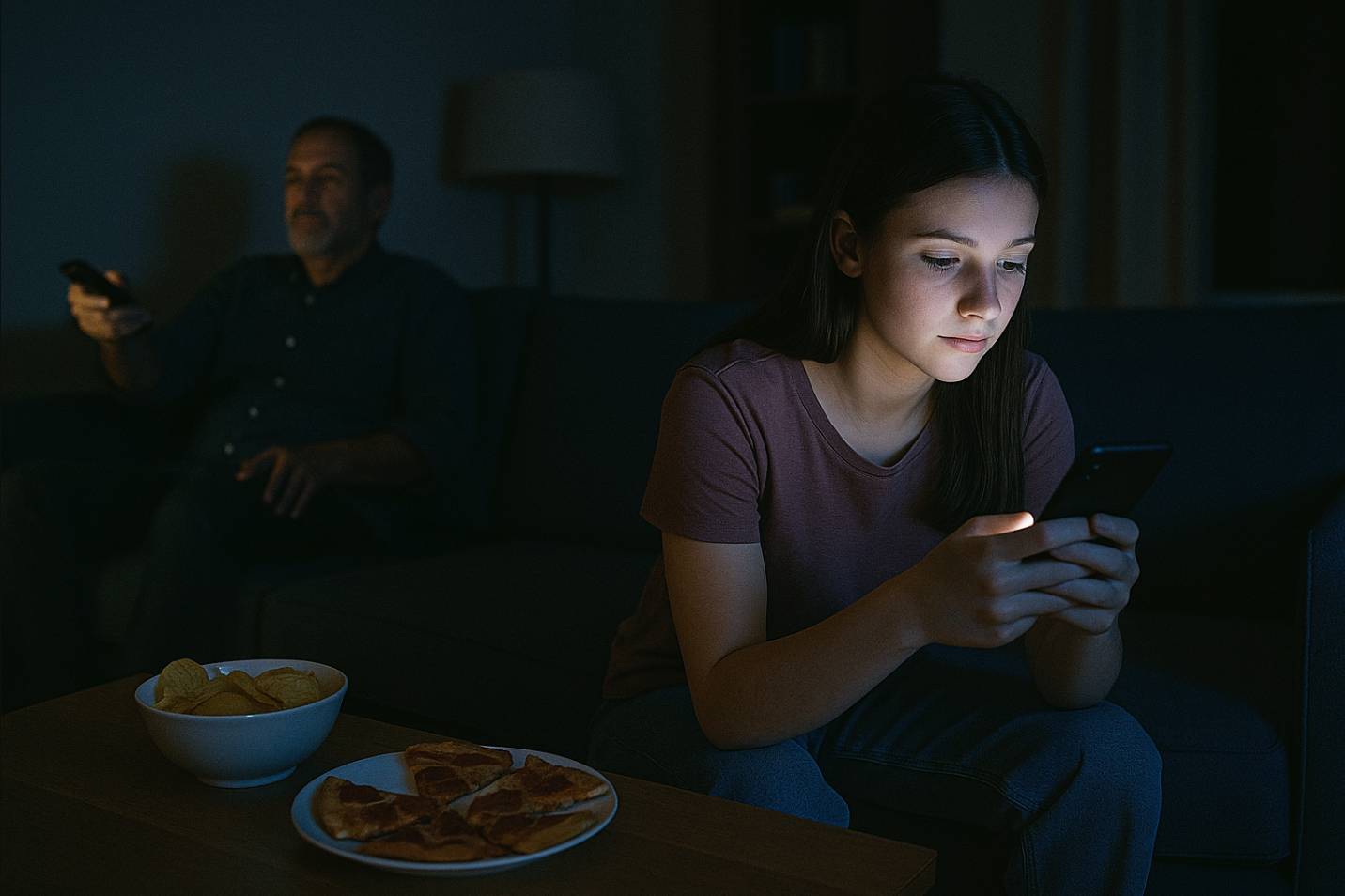
What matters is not simply how much time we spend in front of a screen or how many decisions we delegate to artificial intelligence. It is what happens in the moment before we act: can we still pause, think about what we need, and make our own decision, or has the impulse already decided for us? There is a pause between one action and the next, and that pause may be one of the least visible forms of our sovereignty.
To study this, we conducted the research through Inquiara Lab, in collaboration with India’s Vipassana Research Institute. We surveyed 251 people before they entered the retreat and measured 48 of them again one week later. This is not a representative sample of the general population, and its findings cannot be directly extrapolated to everyone. Its value lies in examining a particular group in depth, whose relationship with thought and cognition offers a unique field of observation. If even people who actively seek to regain control of their attention struggle to do so, it is worth asking what happens when no one is aware of this influence or tries to resist it.
When knowing is not enough
The first finding forced me to reconsider an assumption I had taken for granted. Two out of every three participants knew that apps are designed to keep them hooked, even when they want to stop. I expected that awareness to protect them. It did not. Even more troubling, six out of ten participants who understood these mechanisms felt that they—not the interface design—were the ones making the decisions. Knowledge does not work as a shield; it is more like an excuse. Knowing how apps shape our attention can give us a false sense of control, and that feeling is itself part of the problem.
So, if you have also read about the addictive design of social media, discussed it over dinner, and then opened the apps again before going to bed last night, you are not alone. Almost everything we do today to protect our minds has to do with information: awareness campaigns, apps that track screen time, labels that issue warnings… These measures are necessary, but the data suggest we need to go further.
This is a problem that cuts across professions and gender. We are not dealing with an individual vice, but with a condition of our times. Age, however, does appear to play a role. Those who grew up with the feed as part of their everyday landscape are the most exposed—and they are also the people who will govern, educate, and vote in the decades to come.
What sets people with greater autonomy apart?
The central finding emerged when we cross-referenced cognitive sovereignty with how much each person delegates to artificial intelligence. We identified four profiles, which we named after figures from classical mythology. The Ulysses, who retain control of their attention and delegate little, account for 36%. The Centaurs, who delegate extensively without losing control, make up 15%. The Narcissuses, who delegate little but remain glued to their screens, represent 14%. And the Prometheuses, who delegate extensively but lack control over their attention, account for 35%.
Two of these profiles are particularly interesting to me: the Centaurs and the Prometheuses. The former delegate based on their own judgment and integrate technology into their lives without sacrificing their autonomy. The latter, by contrast, delegate so they do not have to think. They are aware of the potential cost of this behavior, but struggle to interrupt it. They are conscious captives, and they report higher levels of mental exhaustion. In these two groups, the tool is the same and the amount of time spent using it is similar. What differs is the starting point and the way the technology is used.
What do the Centaurs have that the Prometheuses do not? It is not that they know more, since most people in both groups understand how platforms and artificial intelligence work. Nor are they more satisfied with their habits: in both profiles, more than three out of four participants want to change their relationship with technology. They do not even use it for different purposes. What seems to set them apart is how they delegate, and when they turn to technology. Only 27% of Centaurs reach for their phone or artificial intelligence before considering what they can solve on their own, compared with 72% of Prometheuses. This pause may be part of the difference: a space in which to develop their own judgment before incorporating a machine’s response.
What changed after the retreat?
Among the 48 people measured both before the retreat and one week after leaving, the proportion who felt that their thoughts belonged to them rose from 31% to 65%. In addition, the proportion who used their phones to escape everyday distress fell from 69% to 23%, while the feeling of losing control over their attention dropped from 52% to 19%. These findings raise an important question: what conditions can help people regain the sense that they are directing their own thinking?
Of the 20 participants who entered the retreat as Prometheuses, seven had shifted to the Centaur profile in the subsequent measurement. They continued to delegate some mental functions to artificial intelligence, but appeared to have regained their own judgment. This is encouraging because what happens in our minds has consequences beyond the individual. One week after the retreat, 70% of the 48 people we measured again said they would support rules or authorities that protected their minds from manipulation, even at the cost of restricting some of their personal freedom.
This is a troubling finding that should give us pause. An exhausted society may accept having others make decisions on its behalf in the name of protecting it. In the Latin American context, this tension deserves discussion in both political and institutional spheres.
The existence of profiles such as the Centaur points to a way of exploring responses that could strengthen cognitive sovereignty. If knowing more is not enough, public policy should explore other ways to strengthen users’ cognitive autonomy. Families, schools, science communicators, and institutions could help people develop their ability to govern their own attention and habits, form independent judgments, and tolerate silence and boredom, rather than reinforcing anxiety or the need for constant stimulation.
Let us return to the first gesture of the retreat I described at the beginning: handing over the phone. Ten days later, participants return to their devices. The point is not to give them up forever or prove that we can live without them. It is to reclaim something less visible, but equally important: those moments when we are still able to choose.
The Centaurs do not reject technology. On the contrary, they use it every day. What we learned is that they have a moment of their own before using it, a precious space between impulse and action. That space can be lost and, as the findings suggest, it may also be recovered through sustained work on our habits and our relationship with our own minds.
The challenge, then, is not to switch off the machines. It is to prevent them from gradually switching off our ability to make decisions.
Autor

Political scientist (University of Buenos Aires) and social researcher in public opinion and political culture in Argentina, Mexico, and the United States. Director of Inquiara, co-leader of the AI and Innovation Commission of SAIMO, member of the Center for Prospective Studies of Cuyo. PhD candidate at the University of San Andrés.