The signing of the agreement between Mercosur and the European Union should not make us forget that Mercosur has survived 40 years of crises, frustrations, and resilience. The 67th Mercosur Presidential Summit, held in December last year in Foz do Iguaçu, was not significantly different from previous ones: attendance was low due to the failure to sign the agreement with the European Union, and disagreements arose, especially between Lula and Javier Milei. The press paid little attention to the meeting. Once again, a sense of frustration can be felt after the past 10 years. Many academics highlight the bloc’s shortcomings. There is widespread criticism of Mercosur and academic complaints about its failures and noncompliance with established guidelines. Mercosur would thus be a destroyer of expectations that generates frustration. But perhaps there is room for optimism.
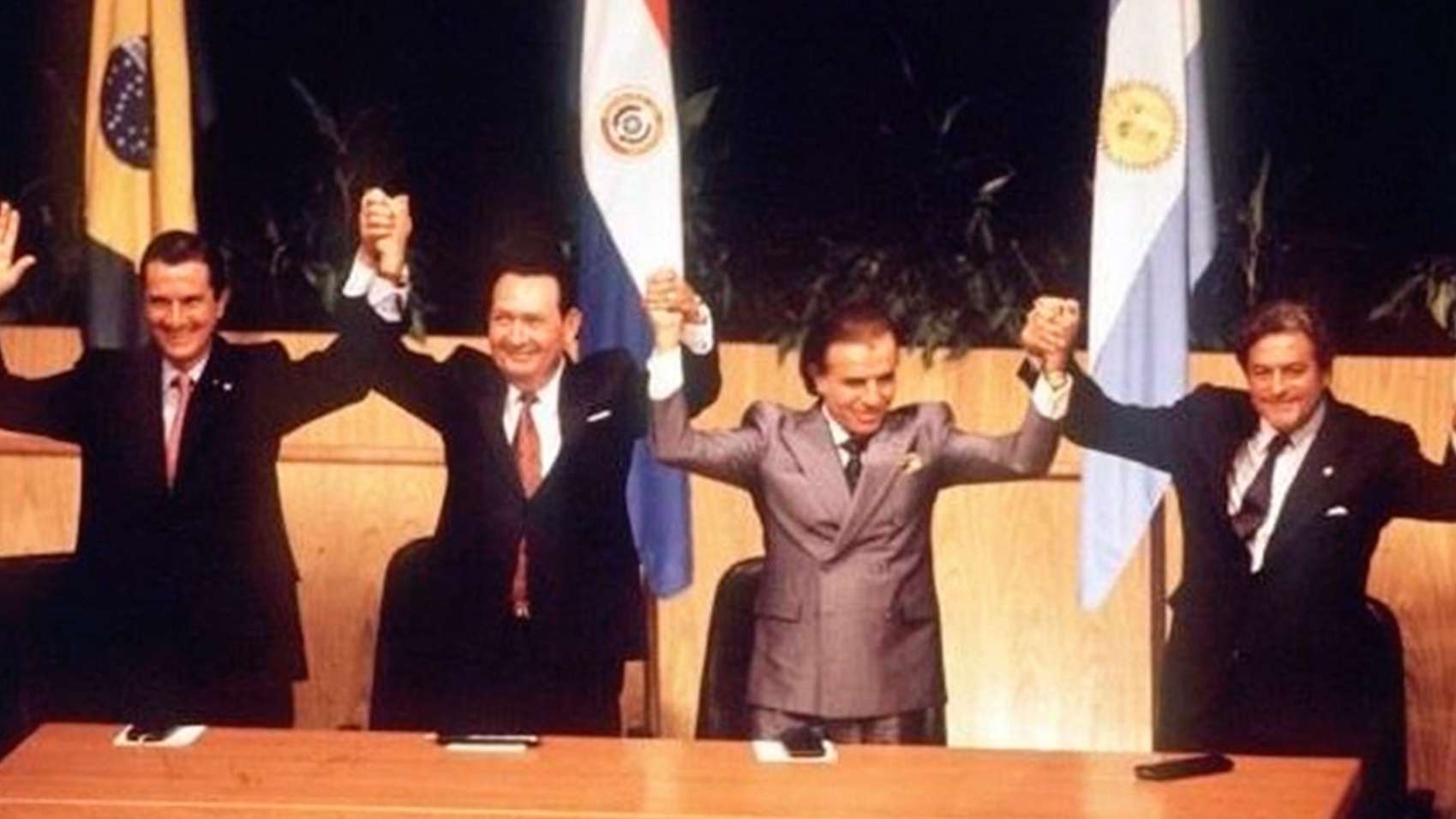
Mercosur has been operating for 34 years, in a region that has already witnessed the disappearance of organizations such as UNASUR and PROSUR. And if we count from the Declaration of Iguazú, that adds six more years. The integration initiative began 40 years ago between Argentina and Brazil, but when it culminated in the signing of a treaty, Uruguay—considering both countries to be important trading partners—requested to join and, along with that, suggested the incorporation of Paraguay.

This later incorporation of smaller partners has always been a distinctive feature of the bloc. Mercosur and relations between Brazil and Argentina are intertwined, as the bloc displays two internal dynamics: the bipolarity between those two countries and the quadrangular structure of the four member states. Bipolar relations within the bloc shape the dynamics of its functioning.
If we examine Mercosur’s history, we observe frustrations, but always accompanied by resilience and the overcoming of challenges. The 1985 Declaration of Iguazú heralded productive integration between Argentina and Brazil that never materialized. The Treaty of Asunción focused more on trade, and by the end of the Las Leñas negotiations, the commercial dimension was consolidated as the bloc’s main hallmark. During negotiations over the Ouro Preto Protocol, sectors of Brazilian diplomacy put forward the idea of expanding the bloc to form a South American Free Trade Area, which would have dissolved the four-state Mercosur. Nevertheless, Mercosur prevailed.
The 1999 crisis, resulting from the devaluation of the Brazilian currency without prior consultation, affected intra-bloc trade and Argentina’s Convertibility Plan. Argentina reacted by obstructing the Common External Tariff and even the free trade area, but President De la Rúa, once elected, calmed the situation. Argentina’s economic, political, and institutional crisis in 2001 received support from Brazil, albeit modest.
During the period known as post-hegemonic regionalism, under the PT governments in Brazil, Néstor and Cristina Kirchner in Argentina, and the Frente Amplio in Uruguay, advances were made in Mercosur’s political and social dimensions: the creation of the Mercosur Parliament, the Mercosur Social Institute, the Human Rights Institute, and the Specialized Meetings. UNASUR was created, but it did not replace Mercosur; rather, the two complemented each other. However, the construction of the Parliament stalled, and the Brazilian development expected by Argentine partners did not materialize.
Under the governments of Mauricio Macri and Michel Temer, the achievements of the post-hegemonic period suffered a setback. The bloc’s institutional framework was reduced, and it returned to a commercial profile. The reprimarization of the member states’ economies contributed to obstructing future advances of the bloc.
After this period came the coexistence of Alberto Fernández and Jair Bolsonaro, exacerbated by the COVID-19 pandemic. The only face-to-face meeting between the two presidents took place at a G20 meeting in Italy. Bolsonaro and Economy Minister Paulo Guedes repeatedly threatened the common external tariff, and Uruguayan President Lacalle Pou also pressed to end its restrictions, but in both cases without success. Then came presidential alternation, with Javier Milei in Argentina and Lula da Silva in Brazil. They do not get along either and, in their first year of coexistence, exchanged insults. Yet Mercosur continued.
Why does Mercosur, despite all the frictions and limitations it has experienced and presidents with such different political leanings, continue to function? Here come the reflections on the bloc’s success.
The first reason refers to the motivation that led to its creation and continues to drive it: it is an instrument created and maintained to manage relations (historically complex) between Brazil and Argentina, with Uruguay and Paraguay being important but complementary. In this framework, it has stabilized and significantly improved relations between the two.
The second reason is related to its operational dynamics. Mercosur is like a framework that limits the space for state maneuvering, but one that each government can occupy as it sees fit. It is resilient and therefore does not have rigid rules that prevent adaptation to the political preferences of governments in power. Rigid rules can act as self-imposed traps. Mercosur has a strong capacity for change and adaptation.
Finally, and no less significant, Mercosur enjoys the participation and support of important economic actors from the four member states, who oppose it whenever they see the bloc threatened. Brazil’s National Confederation of Industry has expressed concern every time the common external tariff has been threatened by the Bolsonaro government.
This, then, is the bloc’s strength that has guaranteed its existence throughout all these years. Disagreements and the lack of commitment at recent Mercosur summits raise fears that motivation, flexibility, and support from economic actors may have a limited lifespan. However, the signing of the agreement between Mercosur and the European Union, after 26 years of negotiations, renews hope for the bloc.
Autor

Professor and researcher of the Post Graduate Program in International Relations at the Univ. of the State of Rio de Janeiro. PhD in Political Science from the Complutense Univ. of Madrid. Post-Doctorate at the European University Institute (Florence, Italy).