Any serious political analysis begins with assumptions—not certainties or wishes, but with environmental conditions that open or close courses of action for actors. In this framework, external pressure from the Trump administration and the possibility of a government led by Edmundo González Urrutia and María Corina Machado reinforced an autocratic adaptation of chavismo. Under threat, regimes do not liberalize: they retrench, cohere and redefine their priorities. In that context, the principal risk for chavismo was not electoral or economic, but existential and identity-based.
The military operation led by the United States to extract Nicolás Maduro and Cilia Flores introduces a critical juncture in that adaptation process. Contrary to what many Venezuelan actors expected—those betting on a “clean sweep” that would leave the board cleared—the outcome has been functional both for Washington and for the remaining chavismo in terms of their short- and medium-term objectives.

For chavismo, Maduro’s forced exit does not represent the collapse of the regime. On the contrary, it feeds its founding narrative. Maduro becomes a martyr of the Bolivarian revolution and a symbol of anti-imperialism, reinforcing epic storytelling, chavista identity and internal cohesion. The figure of a leader defeated by an external power serves a clear political function: closing ranks.
Beyond the narrative, however, Maduro’s removal and the credible threat of the use of force open space for new equilibria. The chavismo that remains in power gains room to reduce external pressure and to reposition itself strategically for the year ahead.
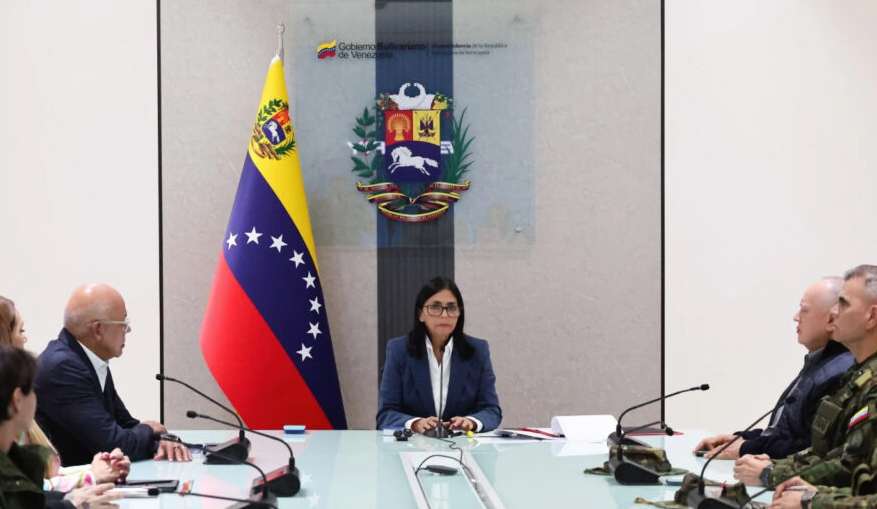
In this scenario, Delcy Rodríguez is recognized by the Trump administration as a valid interlocutor for a negotiation process over Venezuela’s role within the new U.S. national security strategy. This is no minor detail: it signals that the Venezuelan problem has shifted from the normative arena to the transactional one.
Maduro’s exit thus offers chavismo a path of adaptation and survival through realignment with U.S. national and geopolitical priorities. Put differently, without Maduro in the equation, chavismo can reposition itself to survive.
First, without Maduro in power and acknowledging the existence of an existential threat to the territory, chavismo would be more willing to cooperate in the return of U.S. investment to the oil industry and the extraction of strategic minerals. Control of the military, police and paramilitary apparatus would allow it to guarantee a minimum level of governability in key zones for those investments.
Second, recognition of Delcy Rodríguez could translate into partial relief from international sanctions, not only on the oil industry but also on the Venezuelan state. This would open the door to the unfreezing and eventual return of assets by the United States, pragmatically resolving the institutional dilemma of CITGO and PDVSA Ad-Hoc.
Third, foreign-investment-driven inflows of hard currency would help mitigate part of the economic shock experienced in 2025. Chavismo would regain access to oil revenues, this time reducing the risk of destroying the industry through incompetence or overt corruption, due to greater external oversight of operations.
Fourth, on the migration front, relative economic stabilization would serve as an argument in favor of policies promoting the return of Venezuelans, reinforcing the rationale behind suspending Temporary Protected Status (TPS) for this population.
Fifth, regarding drug trafficking and organized crime, the capture of the alleged leader of the “Cartel of the Suns” would push the armed forces to demonstrate cooperation with the United States. Even if largely symbolic—as evidenced by recent actions against small aircraft in the country’s south—this cooperation fulfills a political and symbolic function.
The Trump administration’s military action places a potential Delcy Rodríguez government in a relatively advantageous position to ensure chavismo’s adaptive survival. The new U.S. national security strategy—made explicit in the January 3, 2026 speech—does not prioritize the promotion of democracy. It prioritizes strategic resources, migration control, the fight against drug trafficking and minimum economic stability.
Within that framework, chavismo can operate with relative comfort as long as it guarantees those objectives.
From U.S. domestic politics, Maduro functions as a trophy: a quick victory that demonstrates military capability and sends a deterrent message to other countries in the region, particularly Colombia and Mexico, the main sources of drug production and trafficking toward the United States.
It is in this context that the fraud of July 28, 2024 loses centrality. The victory of Edmundo González Urrutia, the moral authority of María Corina Machado and the massive human rights violations documented by the UN and the ICC fall to second or third place. Meanwhile, the opposition lacks the political and organizational resources needed to reorganize for a potential presidential election in the short term. This is the cost of externalizing domestic politics or reducing it to marketing and social media. None of this denies that a majority of Venezuelans want a change of government. But wanting is not the same as being able.
The scenario remains fluid. It remains to be seen whether these realignments will be accepted by all actors with power within chavismo and whether Delcy Rodríguez will manage to establish—beyond ideological rhetoric—a pragmatic and stable relationship with the United States.
Several unknowns also persist: if actors linked to the Cartel of the Suns retain power, will there be guarantees of impunity in a potential negotiation? Will pressure from the most ideologized sectors sabotage sustainable oil agreements? What role will the ELN and other irregular groups controlling parts of the territory play? After the attack, will the armed forces accept this kind of realignment? How will China, Iran and Russia position themselves in this new scenario? What will happen to political prisoners?
The central question, however, is no longer whether chavismo will fall. The question is how—and with whom—it will manage to adapt in order to survive within the region’s new geopolitical configuration.
*Machine translation, proofread by Ricardo Aceves.
Autor
PhD in Contemporany Political Processes Univ. of Salamanca. Former research coordinator at the Center for Political Studies of the Catholic Univ. Andrés Bello. Co-author of the book "Crisis y Democracia en Venezuela" (UCAB Ed., 2017).