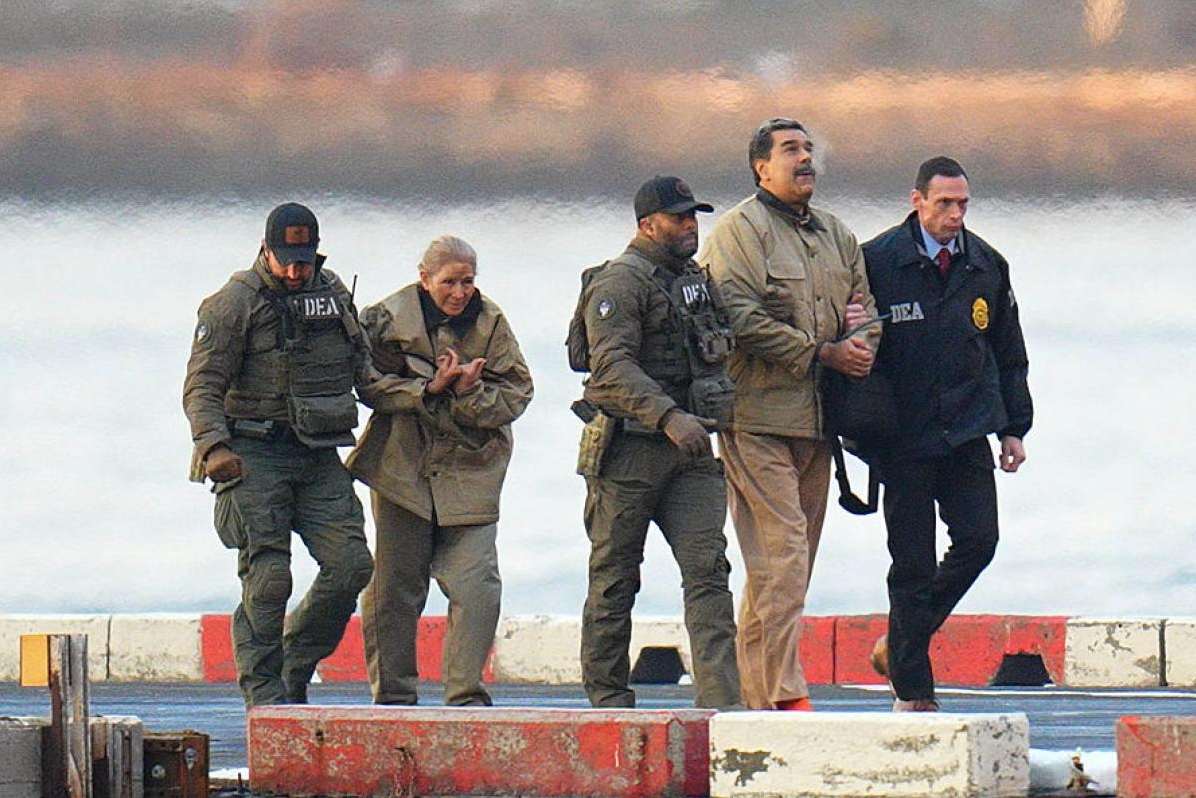
News about the United States’ intervention on Venezuelan territory focused on Nicolás Maduro, whose indictment and arrest already appeared as a foreseeable outcome. However, the arrest of his wife, Cilia Flores—indicted individually, as a direct actor with agency of her own—introduced a distinctive element into the operation. The role of the first lady is often presented as a merely symbolic function. Nonetheless, Latin American political history shows that this space has, in many cases, been a key terrain for the accumulation of power. From the emblematic precedent of Eva Perón, whose influence gave rise to an unprecedented dynamic of dual leadership alongside the Argentine president, the figure—and often the personality—of the first lady has repeatedly reinvented itself and adapted to different contexts, both democratic and dictatorial.
Today, first ladies continue to play diverse roles in government. Some limit themselves to protocol duties; others assume a social profile; and quite a few actively participate in promoting public policies aligned with the official agenda, building their own influence and political capital. Several have later chosen to run for elected office, even reaching the presidency, as occurred in Argentina and Honduras.

Cilia Flores fits squarely within this group of influential first ladies characterized by dual leadership. She had solid prior political experience; that is, her prominence did not begin with her husband’s rise to power. A lawyer and a historic leader of Chavismo, Flores held central positions in the Venezuelan state: she was a member of the National Assembly from 2006 to 2011, attorney general of the Republic from 2012 to 2013, and a member of the National Constituent Assembly in 2017. She was also responsible for administering the oath of office to Hugo Chávez as president. Various analysts argue that, from those positions and as first lady, she exercised significant influence over public administration and the judicial system, particularly in the processes for appointing judges and prosecutors, which helped consolidate internal loyalties within Chavismo and weaken the independence of the judiciary.
With Nicolás Maduro’s arrival to the presidency, Cilia adopted the title of “first combatant.” The designation was no minor detail. On the one hand, it reinforced the language and epic narrative of the Bolivarian revolution; on the other, it avoided the use of the term “first lady,” since at that time the couple was not formally married. At the same time, the concept resonates with a regional tradition of first ladies who sought to redefine their political role, such as Eva Perón—known by various denominations, including “the first worker,” “eternal sentinel of the Revolution,” or “Perón’s shield”—or Cristina Fernández de Kirchner, who asked to be called “first citizen.”
The case of Cilia Flores is also not an exception within a broader regional phenomenon. In Latin America, several first ladies have been investigated or prosecuted for corruption and financial crimes under democratic regimes. The most recent precedent is that of Nadine Heredia, first lady of Peru between 2011 and 2016, sentenced to 15 years in prison and currently granted asylum in Brazil. Added to this are cases in Honduras, Guatemala, and El Salvador, where presidents’ wives were accused of illegal campaign financing, money laundering, or misuse of public funds.
In 2015, the United States Drug Enforcement Administration (DEA) arrested two of Flores’s nephews for drug trafficking–related offenses in a case that marked a turning point in her public exposure. Since then, she adopted a lower public profile, with an emphasis on traditional and family themes, visible in her television program Con Cilia en familia, broadcast on state television. Flores has been subject to sanctions by several countries, including the United States, Canada, Panama, and Colombia, which linked her to the erosion of democracy and corruption networks in Venezuela—measures that resulted in entry restrictions and asset freezes for her and members of her family circle.
Despite that international isolation, Flores continued to play a strong institutional and influential role within the regime until early 2026, when on January 3 she was arrested in Caracas, along with Maduro, during an operation by U.S. forces. Both were transferred to New York, where they face federal charges for narco-terrorism, conspiracy to import cocaine, and other drug trafficking–related offenses before a court in the Southern District of New York. This placed under scrutiny not only her personal trajectory but also the power structures she represented within the Venezuelan dictatorship. She was part of a circle closely linked to the core of the regime, where her voice and proximity to Nicolás Maduro shaped internal dynamics and public policies for years.
The arrest of Cilia Flores once again brings to the forefront an institutionally opaque position in presidential systems: the figure of the first lady, whose margin for action—and for corruption—is amplified in authoritarian contexts, as also occurred with Lucía Hiriart de Pinochet in Chile. But it also affects democracies, since it is a role without a precise legal definition, without clear administrative controls, and without effective accountability mechanisms. This institutional ambiguity has allowed, in different countries and regimes, presidents’ wives to accumulate influence and capacity for intervention outside the formal structures of the state, enabling some first ladies to exercise real power with high visibility and political weight, yet without institutional responsibility. As long as that vacuum persists, the first lady will remain a figure as influential as she is structurally controversial within public administration.
Autor

PhD in Political Science. Associate Researcher at the GIGA Institute for Latin American Studies in Germany and a member of the Network of Political Scientists.

PhD in Political Science. Principal Researcher of Conicet. Professor at the National University of Tres de Febrero and member of the Network of Political Scientists. Her research focuses on classical Peronism, the leadership of Eva Perón, women's organizations, and Peronist first ladies.