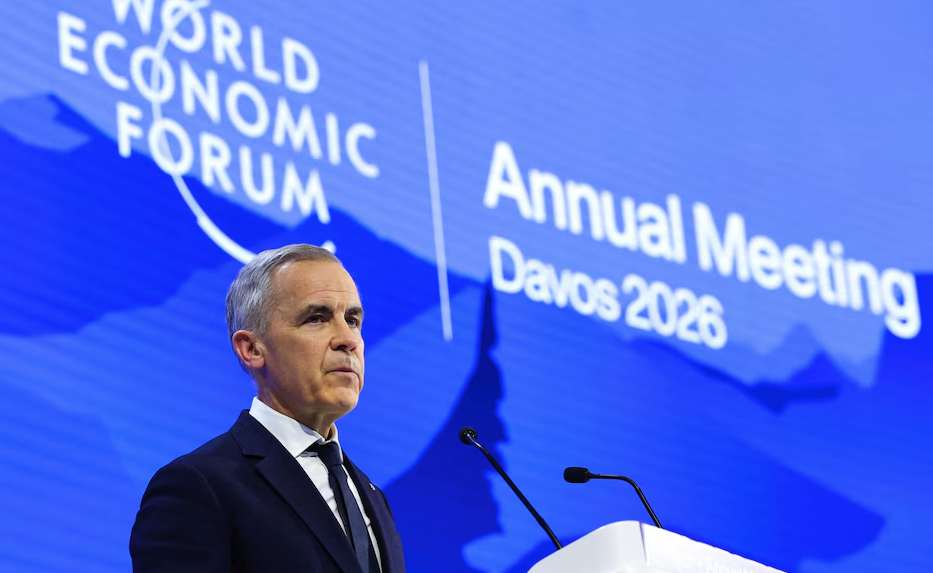
In international politics what one believes can have serious consequences. Mark Carney knows this, arguing at the World Economic Forum, that the power of collective belief can challenge US hegemony. Great powers, Carney argued, are using economic dependence as weapons. If nations can collectively stop believing in economic institutions such as the International Monetary Fund, (IMF), Carney implied, then they lose their power. Yet is the solution so simple?
No region knows the hard power of the USA but also the collective power of belief in shared norms better, than Latin America. The region was the first in the world to become a nuclear weapon free zone following the treaty of Treaty of Tlatelolco in 1967, exemplifying Alexander Wendt’s famous 1992 constructivist claim, that ‘anarchy is what states make of it’. Latin American nations believed and believe by upholding conditions of the treaty, that their neighbours will not seek military nuclear capabilities.

On the other hand, it is often because of what nations in the region have believed that the US has responded, often with hard power. The Monroe Doctrine (1823), the Roosevelt Corollary (1904) the Platt Amendment (1901), coups in Guatemala (1954) and Chile (1973), the failed Bay of Pigs invasion in Cuba (1961) and the invasion of Grenada (1983) and Panama (1989), are testament to US responses to nation’s left leaning politics or desires to diversify trading partners. In other words, thanks to beliefs that challenge the US, the US has responded with interventions.
For that reason, applying Carney’s logic to the economy of Latin America might be easier said than done. Hard power in the region is also maintained by Washington through the power of the dollar. Indeed, in Argentina the shared belief in the power and value of the US Dollar, perhaps encouraged by the 1991 ley de convertabilidad has led Argentines to save 260,443 million in physical dollars (INDEC, 2025). A change in belief for example, towards saving in peso’s or any other currency would be very costly for those with savings in dollars. Adding to this, three Latin American nations have recognised de jure the dollar as official currency Panama (1904), Ecuador (2000) and El Salvador (2001).
This is something that the Trump supporting President of Argentina, Javier Milei has understood all too well. Also, at Davos 2026, Milei argued that free enterprise capitalism is not only more productive, but also that it’s the only just system. Yet the free enterprise capitalism Mieli is subscribing too is not free, thus it is not just. It is governed and maintained by the US and the US dollar. The Special Drawing Rights in the IMF of which the dollar is pegged at a value of 43.38 and the US majority 17.42% voting share (a near veto) are a key example of the weaponisation of institutions Carney is warning against. (IMF, 2026)
Furthermore, by maintaining a belief in the power of the dollar Milei is not only working towards his 2023 election promise of dollarizing Argentina, but he is also following the Austrian school of economics, whose member Murray Rothbard, defined government as a group of bandits using coercion to gain revenue. Thus, belief in the power of the dollar goes hand in hand with the hard power of the US military.
Milei’s claimed that “the fundamental right to liberty gives rise to the acquired right to private property, which is manifested in our ability to freely acquire property with the fruits of our labour” Yet, the fruit of labour in Argentina while often paid in pesos is saved in US dollars. Property in Argentina is frequently boughtcash in hand, in US dollars. Furthermore, in the province of La Rioja as recent as 2024 cuasimonedas which hark back to the crisis of 2001, were being used to pay salaried workers. Further damaging citizen belief in the peso.
In this context, how can Argentina and other Latin American nations respond to Carney’s calls and escape the belief that dollars offer a secure future?
Carney’s answer was to stop believing in the power of the International Monetary Fund, and the US dollar. Does the power of the US dollar weaken? Maybe, yet only slightly. If a region stops believing in the power of the dollar, then we might see the change Carney is hoping for. However, this relies on having a currency to diversify and rely on. Leaders of Latin American nations who in have dollarized will have to convince their populations. Not to mention Chile’s Antonio Kast and Rodrigo Paz in Bolivia who are ideologically close to the USA.
One way to diversify and reduce dependence on the US dollar could be to continue strengthening regional autonomy through organizations such as the Inter-American Development Bank or Mercosur. And on a global level, the New Development Bank of the BRICS+, with equal voting power in the bank, is attractive.
If Latin American nuclear liberation has been maintained since 1967, perhaps, Latin America can liberate itself from the US dollar. However, for the citizens of Latin America the operative word for changing reliance on the US currency is not belief it should be courage.
Autor

Politics Subject Lead, International Foundation Programme, University of Bristol. Master of Politics, Civilisation, Terrorism and Dissent, University of Hull