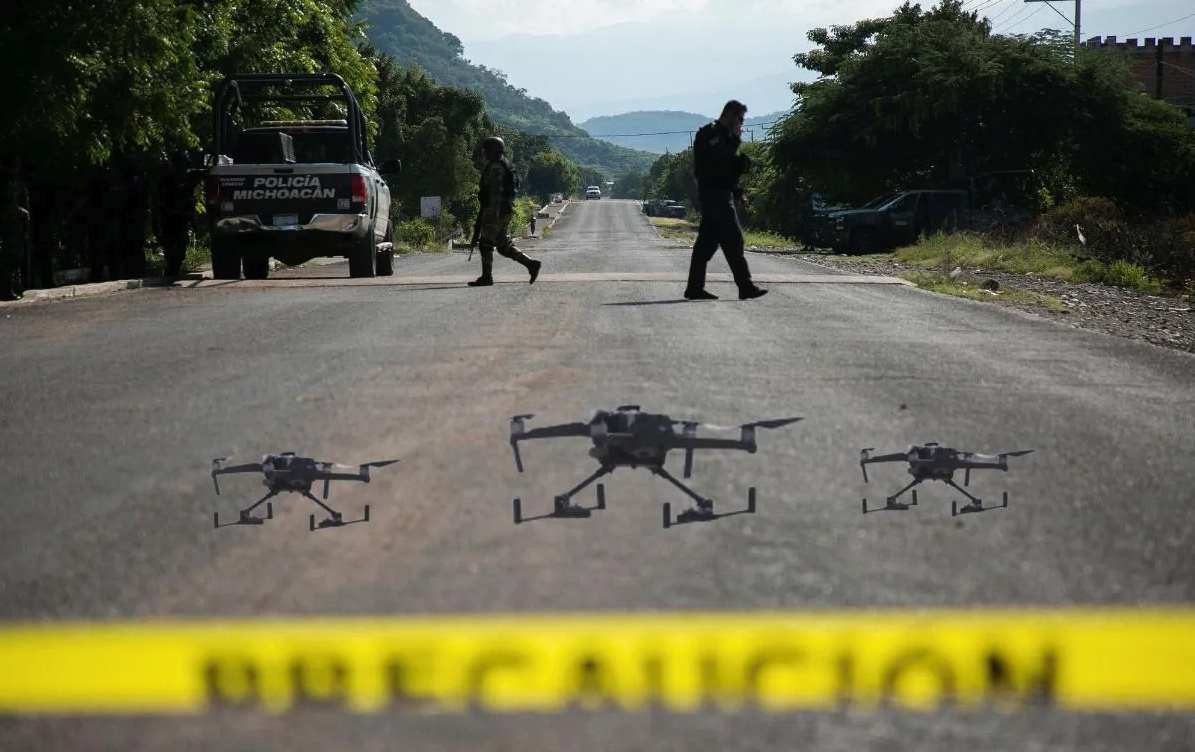
In Latin America, the security architecture is undergoing a radical transformation, driven by the emergence of unmanned aerial systems (UAS) in the operations of transnational criminal organizations and local micro-trafficking networks. This phenomenon, which has surged between 2024 and 2026, represents a paradigm shift in criminal logistics, territorial control, and confrontation with state institutions, as warned by an El Tiempo (2025) analysis on the expansion of aerial drug trafficking.
In this context, the technological democratization of commercial drones, combined with the tactical adaptability of cartels and criminal gangs, has generated an operational asymmetry in which the cost of criminal innovation is marginal compared to the high expenses governments face for detection and neutralization. Consequently, the use of unmanned aircraft has ceased to be an exclusive resource of armed forces and has become an accessible tool that now redefines irregular conflicts and crime governance in Latin America’s urban and penitentiary environments.

Under this premise, security in the current three-year period cannot be limited to traditional ground surveillance; it requires a deep understanding of how technology has enabled illicit economies to conquer the low-altitude aerial dimension.
Innovation dynamics and the capture of the tactical environment
The use of drones in the region has moved from a phase of rudimentary surveillance to an offensive and logistical stage of high precision, in which criminal organizations capitalize on the massive availability of consumer devices to transform them into transport and attack vectors. As noted by El Estratégico (2025), this transition is supported by a low-cost, high-impact logic: while an institutional defense system may exceed $100,000, a modified commercial drone represents a minimal investment with a disproportionate damage capacity.
However, it is imperative to demystify the idea of absolute superiority, since the effectiveness of these devices is conditioned by technical limitations. According to technical data from Revista Marina, 46% of commercial drones have an autonomy of less than one hour, confining them to “last-mile” micro-trafficking or rapid attacks, while only 5% of specialized equipment possesses persistent surveillance capabilities exceeding 24 hours. Likewise, 38% of these systems are limited by winds above 16 knots, which tempers their impact in coastal or mountainous areas that are difficult to access.
Despite these physical restrictions, sophistication in detectability reduction has advanced through the creation of clandestine workshops. According to reports by Prosegur Research (2024), the use of 3D printers to manufacture remote-release systems and firmware modifications to evade geofencing—air exclusion zones imposed by manufacturers—has enabled criminal networks to circumvent traditional control mechanisms.
Ultimately, this capacity for technical adaptation reflects a criminal resilience that exploits regulatory gaps to consolidate technologically assisted territorial control, especially in hard-to-reach areas where, as reported by Ecuador’s National Police, drones are even used to monitor the arrival of small aircraft at clandestine airstrips in Manabí and Guayas.
The penitentiary front and the “last-mile” of micro-trafficking
In the Southern Cone and the Andean region, the breach of penitentiary systems through UAS constitutes one of the most critical challenges for legitimate civil control. The experience in Chile, documented by the Investigations Police (PDI) in Operation Predator (2021), revealed a network that coordinated nighttime flights to smuggle narcotics into Santiago Sur prison and carried out at least 21 successful incursions valued at 100 million Chilean pesos.
This pattern of aerial delivery is repeated in Argentina, where in 2025 the Córdoba judiciary dismantled a gang that operated seven drones to supply the Bouwer complex with cocaine and mobile phones, using aerodynamic packaging designed not to compromise flight stability. Therefore, the capture of detention centers is amplified by a tool that allows criminal leaders to project power and coordinate illegal economies without the need for physical contact.
However, the phenomenon is not purely logistical; in countries such as Colombia and Mexico, the technology has escalated toward open confrontation. Reports from the Colombian National Army indicate that since April 2024, nearly 400 drone-related incidents have been recorded, including swarm attacks against military bases such as Aguachica in Cesar. Simultaneously, the Jalisco New Generation Cartel (CJNG) in Mexico has formalized Drone Operator units, according to C-UAS Hub, integrating tactical knowledge that, in some investigated cases, includes technological transfer from combatants with experience in international conflicts.
This militarization of micro-trafficking and territorial control raises a sovereignty conflict in low-altitude airspace that current security forces—whose electronic interference resources are still in the deployment phase, according to Major General Juan Carlos Correa—are only beginning to fully grasp.
Toward comprehensive aerial governance
In light of this diagnosis, it is crucial for Latin American states to move forward with a multidimensional strategy that goes beyond reactive responses. The first pillar of this proposal consists of the harmonization of hemispheric legal frameworks—following models such as RBAC-E Regulation No. 94 of Brazil’s National Civil Aviation Agency—that regulate the importation and traceability of UAS, eliminating the gaps that allow the anonymous acquisition of high-capacity technology.
Reforms such as these must be accompanied by a second pillar focused on investment in advanced criminal intelligence and detection systems based on radiofrequency and high-resolution radars capable of distinguishing between birds and threats in complex urban environments.
Finally, the third pillar must address comprehensive harm reduction and the recovery of public space, integrating aerial surveillance into a “security urbanism” model that protects vulnerable populations from technology-assisted criminal contagion. Ultimately, the success of these measures will depend not only on technical superiority, but on the capacity of institutions to reform their governance structures and act with the same agility as the criminal algorithm.
Autor

PhD in Public Policy from IEXE University (Mexico). Master's degree in Public Security. Academic researcher. Organizational advisor to Mexican police forces and consultant in public and private security.