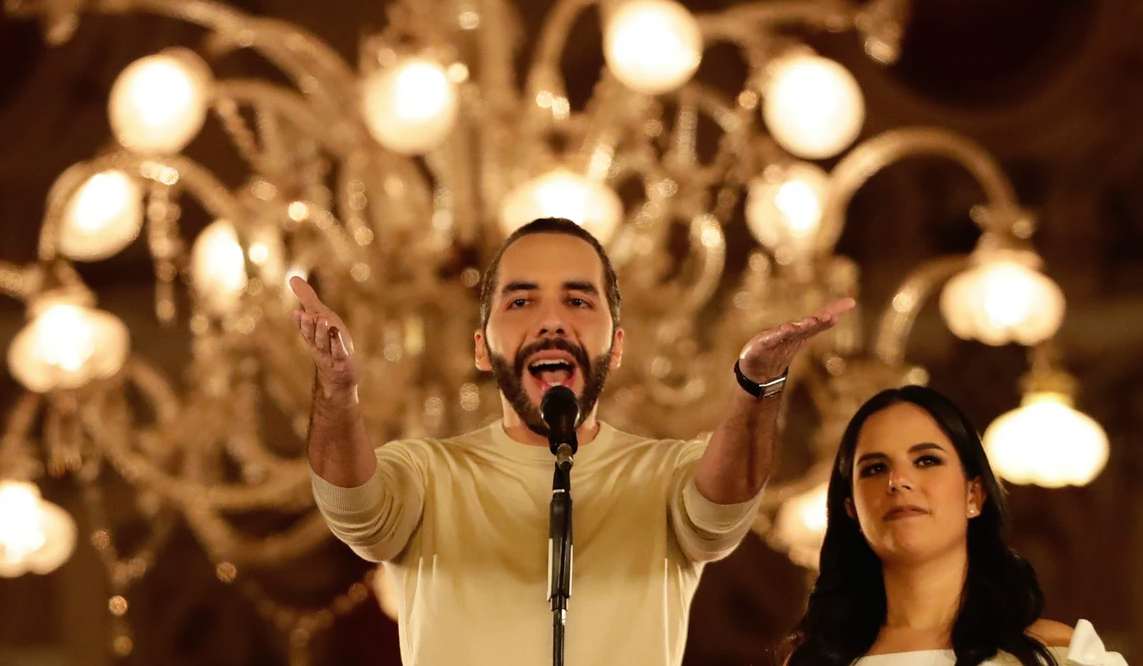
How did El Salvador come to plunge into the depths of today’s authoritarianism and erosion of the rule of law? Does the stronghold of violence and political disorder justify such an outcome? In truth, the country has never been a haven of peace. Since its independence from Spain (mid-19th century), endemic violence has been part of its DNA: coups d’état, military repression, peasant uprisings, and massacres carried out by the State.
The ingredients, then, were already floating in the primordial soup that leads us into the turbulent 20th and 21st centuries: social inequality and the weakness of State institutions contributed to assembling the foundations that synthesized the gene of ubiquitous violence, with the civil conflagration that began in 1980 being one of its consequences.

After the 1992 Peace Accords, El Salvador entered a post-war period that was meant to bring them to life. The country was governed by ARENA (1989–2009) and the FMLN (2009–2019). The goals—demilitarization, free elections, and freedom of expression—failed: impunity, inequality, and weak governance persisted. It is not surprising, therefore, that gang violence, insecurity, and distrust in institutions eroded faith in democracy. In this sinkhole of credibility and justice emerged the now-president Nayib Bukele, a symbol of the exhaustion of the post-war system.
Bukele: ‘Outsider, ma non troppo’
Although Bukele presents himself as a newcomer alien to the political caste—a modern, people’s man, hyperactive on social media, at times a human troll—the truth is that he navigated traditional politics comfortably: he was mayor under the FMLN (of the capital, no less), thanks to the connections and resources of his well-to-do family. His expulsion from the party was a headlong escape to reinvent himself as anti-system, but in reality he is a man of the system. Bukele has masterfully used the façade of independence to consolidate his power, with his own networks of privilege, corruption, and clientelism that have enriched his family since he took the reins of the country. Today, he exerts that control through the subjugation of the judiciary and the opacity surrounding public funds and/or bitcoin—reasons for which he has been sanctioned by the United States. Then came Donald Trump.
Bukelismo, in Search of Labels
His model contains components of what I call orbanismo (in its tropical variant), referring to Viktor Orbán, Hungary’s prime minister, who uses his electoral victory as a kind of people-endorsed revolution granting him carte blanche to concentrate power and dismantle democratic institutions—without altering the system itself—through control of the judiciary and the legislature. Added to this is punitivism, based on repression and a hardline stance against gangs to gain popularity, projecting an appearance of security effectiveness while maintaining networks of privilege and eroding civil liberties. The success of bukelismo lies in imposing the dichotomy of human rights versus security, presenting it as a settled fact, beyond debate.
The formula also contains an authoritarianism rooted in permanent states of exception that justify massive and/or arbitrary detentions and systematic human rights violations. Bukelismo has also been labeled “popular authoritarianism,” echoing a tradition of caudillismo that took root and flourished in the region: voting for him is nothing new.
“Achievements” with a Catch
Bukele boasts of having reduced violence with his “iron fist.” Yet he is hardly original: the Mano Dura and Súper Mano Dura plans already existed in the early 2000s. But in reality, it is an under-the-table, left-handed, soft hand: straightforward negotiation with the MS-13 and Barrio 18 gangs (the most important, though not the only ones). Two of their leaders stated that, since 2014, Bukele struck deals with them, offering prison benefits and money in exchange for electoral support, which materialized through territorial control exerted by the gangs to coerce votes and temporarily reduce homicides, thus improving the image of the then-candidate.
Of Agents and Constitutions: Bukele’s Deepening Authoritarianism
Two milestones have marked 2025—a fruitful year in the chapter of the gradual dismantling of democratic institutions: the constitutional reform and the Foreign Agents Law.
As for constitutional reform, it has already been a common recourse in Peru, Colombia, Nicaragua, Venezuela, or Hungary, revealing a trend of confusing a constitution with an electoral platform.
On July 31, 2025, El Salvador’s Legislative Assembly approved an express constitutional reform with unmistakably Orban-esque colors; namely: it used the overwhelming majority of Nuevas Ideas—Bukele’s party—in Parliament as a steamroller, stripping the opposition of any debate (with exceptional time limits), and, finally, intentionally confusing a constitutional charter with a campaign manifesto.
“Bukele’s Constitution” lays out the following milestones: first, it allows indefinite presidential re-election; second, it extends the presidential term from five to six years; third, it eliminates the second electoral round, which in a presidential system reduces the guarantees of representativeness and legitimacy of the elected president; and fourth, it brings forward by two years the start of the next mandate to synchronize general elections with the legislative and municipal ones of 2027—everything in service of Bukele.
The reform amounts to the virtual founding of a new political system, a quiet coup that calls into question the principles of alternation and limitation of power established in the 1983 Constitution, reinforcing power concentration and diminishing alternation and the checks-and-balances mechanisms of any democratic standard.
The other decisive legal event of 2025 is the Foreign Agents Law, approved via decree no. 308. The mark of Vladimir Putin is tenacious, with his laws from 2012 (modified in 2022 and 2025). Georgia’s 2023 law practically copies the Russian one and surely inspired Trump through a barrage of executive orders.
El Salvador’s law bears the same name as Russia’s, and conspicuous conspiracists must be delighted, since the Salvadoran law was approved on May 30, 2025, and the Russian modification in June. In any case, it is obvious that both share the same goals: controlling and stigmatizing organizations that receive foreign funding—with one difference: the Salvadoran law is even more aggressive than the Russian one in terms of economic sanctions.
El Salvador’s 2025 Foreign Agents Law establishes several measures that raze any democratic standard. It obliges individuals and organizations receiving funding from abroad to register as “foreign agents”. It imposes a 30% tax on said funds. It stipulates heavy economic penalties for non-compliance. It employs ambiguous wording that could lead to even greater restrictions on freedom of association and expression. It stigmatizes human-rights organizations and civil society (resulting in persecution and detention of activists), forcing them to halt their activities.
The immediate consequence is that major NGOs such as Cristosal no longer operate from El Salvador and now work from Honduras and Guatemala. Other major casualties are news media. The venerable APES (Association of Journalists of El Salvador), founded in 1936, and outlets like El Faro have adopted similar measures.
The Foreign Agents Law has sparked deep international concern, with the UN urging the guarantee of a safe environment for civil society and respect for human rights. Likewise, the Inter-American Commission on Human Rights (IACHR) and the European Union (EU) criticized the Salvadoran law, which provoked Bukele’s ire. True to form, in vintage tweet-style, the Salvadoran leader reproached the EU for being an aging, bureaucratic bloc, energy-dependent and technologically lagging, yet still daring to lecture the world. It is a fitting end to this article: it perfectly summarizes Bukele’s discursive modus operandi, listing the EU’s shortcomings as echoed by his far-right counterparts in Europe.
Autor

Historian and PhD in Legal and Social Sciences specializing in the Balkans from the University of Malaga. Master's degree in History from the University of Granada.