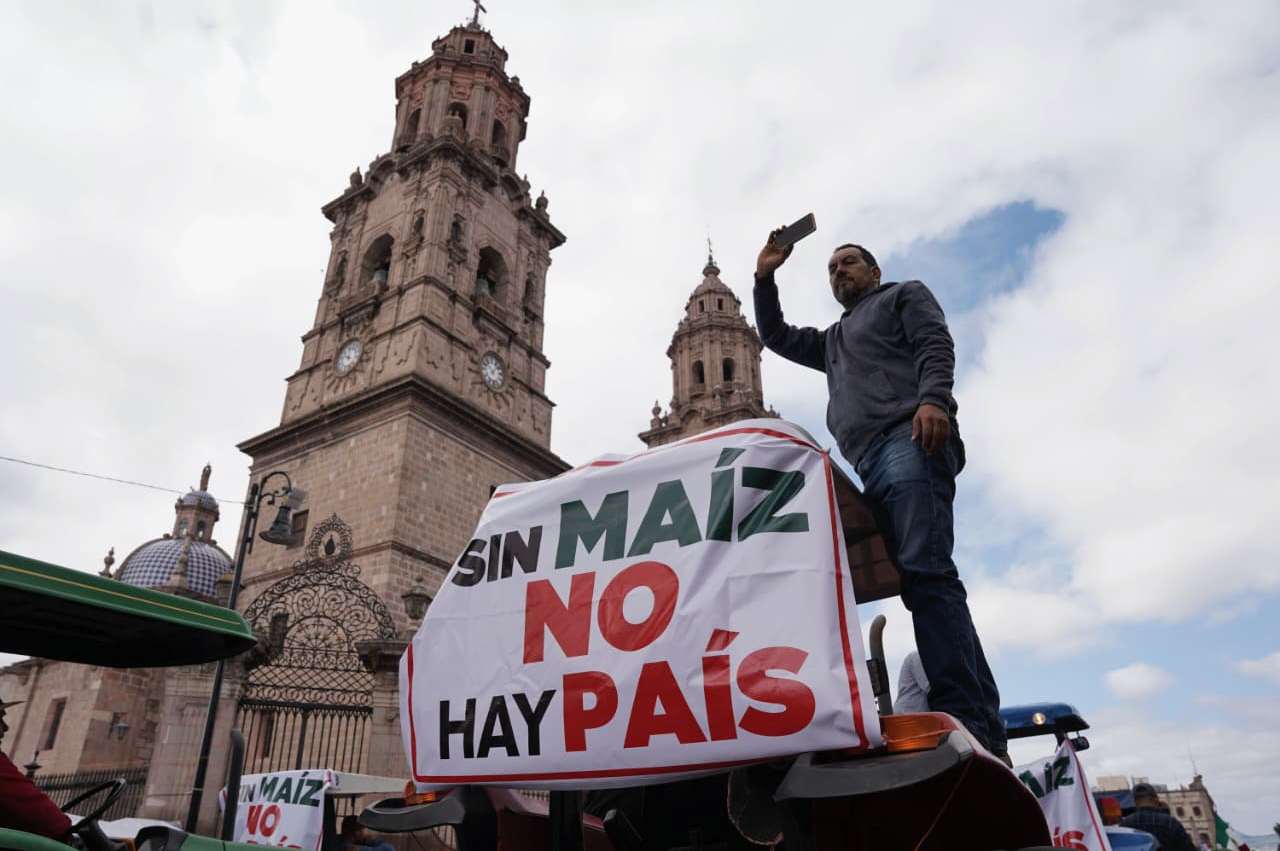
In the last week of November, thousands of transport operators and agricultural producers abandoned their communities, plots, crops, offices, and warehouses to demand greater security on highways, competitive guaranteed prices for grains—especially corn—and water from the reservoir system to achieve their goals. They set up with their vehicles and heavy machinery on major highways, toll booths, and customs offices, paralyzing mobility from Chiapas to Baja California, while their leaders held talks with political and agricultural authorities.
After a call to sit down at negotiation tables to seek a way out of the security and agricultural problems, the government of Claudia Sheinbaum has committed to improving security on the roads and has told farmers that there is not enough public money to improve the guaranteed price per ton of corn to make it competitive with U.S. producers, who receive subsidies and supply part of the Mexican market.

But what lies behind the demands of agricultural producers? Why does the agricultural problem erupt from time to time without a visible solution, affecting not only producers but, through inflation, the tables of Mexican households? Is it true, as a propaganda slogan loaded with millennia-old symbols claims, that “without corn, there is no country”?
First: more than 70% of production units have fewer than five hectares, which are fragmented and prevent economies of scale, access to credit, and competitive marketing.
Second: the country imports between 40% and 45% of its grains, especially yellow corn, which is used to produce tortillas and is indispensable on the Mexican table.
Third: production costs and low competitiveness due to the prices of inputs, which are set in international grain markets.
Fourth: climate change and the constant degradation of natural resources, the result of prolonged droughts, desertification, floods, frosts, and pests, as well as the loss of fertile soil due to overexploitation, erosion, and poor water distribution.
Fifth: lack of public financing due to the disappearance, during the López Obrador administration, of the so-called Rural Finance agency, which provided soft loans, many of them non-repayable.
Sixth: insecurity, due to the presence of organized crime in agricultural regions where, through extortion, dispossession, and so-called protection rackets, it is causing forced migration to urban centers that are unable to provide jobs, housing, and public services, generating real bottlenecks and problems of marginalization and crime.
Seventh: given the profile of production units, there is a disarticulation of value chains, with producers frequently selling their products directly to criminal groups or powerful intermediaries, who end up capturing most of the benefits. An example was given by a farmer referring to corn: “They buy corn from us at 4 pesos per kilo, and a kilo of tortillas costs 26.”
And lastly: inconsistent public policies for the countryside due to six-year political changes, clientelist programs, and lack of continuity. In addition, with the arrival of the 4T government, direct support was given to producers instead of long-term public investments, which means an absence of incentives for innovation and the promotion of technologically advanced agriculture, as occurs in countries with greater vision.
Faced with this crisis scenario, real options would mean reversing structural problems and eliminating the bottlenecks present among large, medium, and small agricultural producers, which implies a change in public policy.
First: guarantee that rural activities are carried out without the presence of organized crime, which, as noted, bleeds farmers during the stages of production, distribution, and marketing, and also subjects them to extortion, kidnappings, and protection payments.
Second: the crisis demands a long-term National Agri-Food System, insulated from six-year political swings—something that under the 4T government appears difficult due to a lack of will and liquidity.
Third: defining strategic crops, agroecological zones, and food self-sufficiency targets.
Fourth: promote productive reconversion and precision agriculture by redirecting unproductive areas toward higher value-added crops through drones, sensors, smart irrigation, or improved seeds, along with tax incentives for the adoption of cutting-edge technologies.
Fifth: reestablish and finance a rural banking system that provides soft loans, guarantees for small and medium producers, and accessible agro-climatic insurance.
Sixth: stimulate the organization of agricultural producers through cooperatives, rural production societies, and even agroindustrial clusters, as well as collection and cooling centers and administrative logistics for producers.
Seventh: public–private investment to improve strategic infrastructure by rehabilitating irrigation districts, expanding drip irrigation technologies, and building quality rural roads.
Finally, intermediary practices must be curbed to guarantee fair prices for producers and final consumers alike, which calls for strengthening the rule of law and eliminating weaknesses in the country’s current agri-food system.
In short, the crisis of the Mexican countryside demands an agricultural revolution. Only with political will and a comprehensive strategy for rural areas will it be possible to achieve food self-sufficiency, combat political deadweight, and, above all, ensure that road blockades and toll booth takeovers are no longer necessary to make agriculture sustainable and serve the national economy.
Autor

Professor at the Universidad Autónoma de Sinaloa. D. in Political Science and Sociology from Universidad Complutense de Madrid. Member of the National System of Researchers of Mexico.