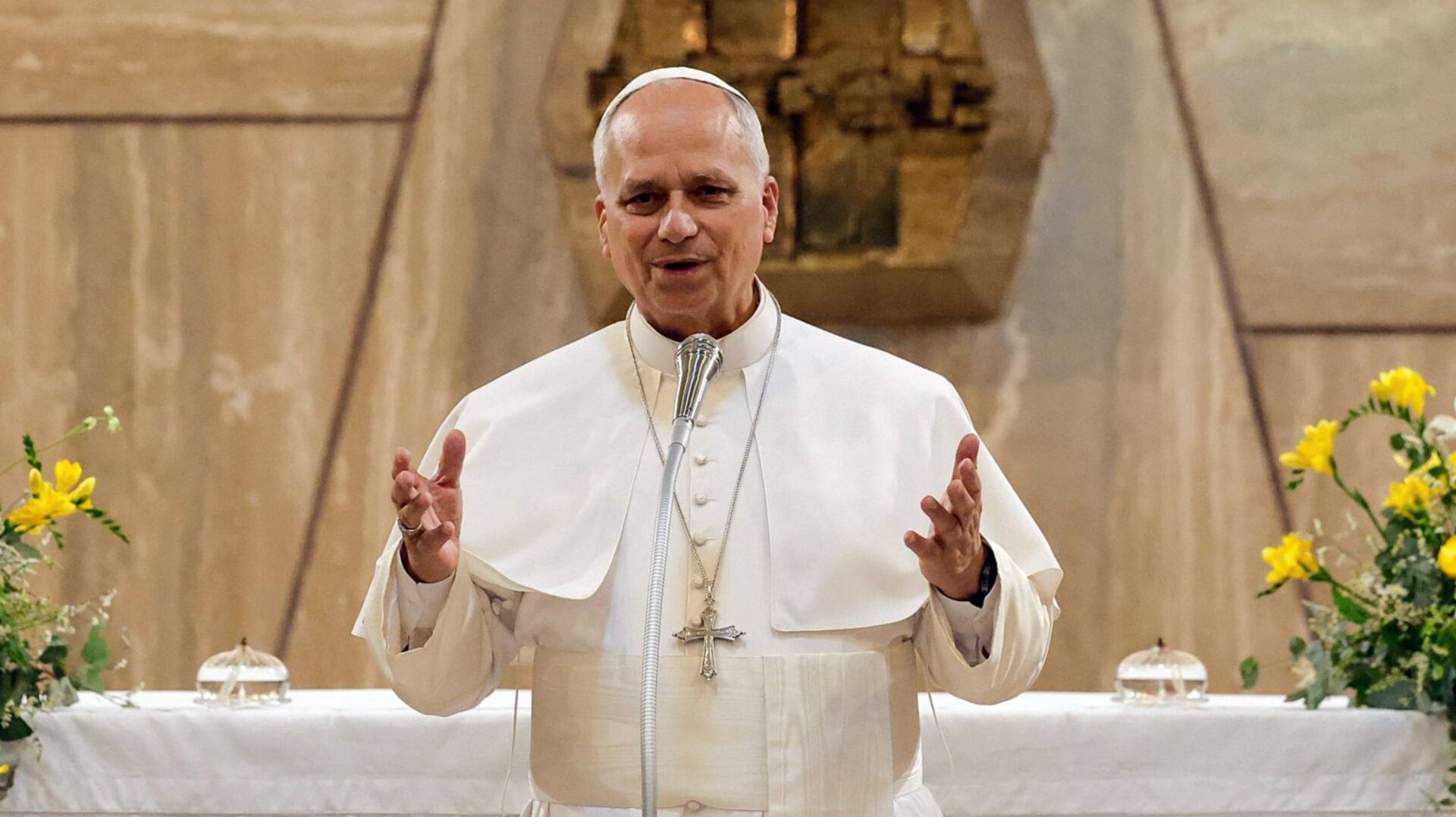
In May 2026, Pope Leo XIV published Magnifica Humanitas, his first encyclical, devoted entirely to artificial intelligence and the safeguarding of the human person in the digital age. The decision carries both symbolic and historical weight: it places AI at the center of the moral and social concerns of our time, reviving a tradition inaugurated by Leo XIII with Rerum Novarum in 1891, when the Church chose to address the transformations brought about by the Industrial Revolution.
Its timing coincides with the latest findings from the WIN World AI Index 2026—a study conducted by WIN and Voices! involving nearly 40,000 people across 44 countries—and invites a particularly revealing conversation. Reading them together is illuminating, as the data empirically captures what the encyclical articulates through philosophical and ethical categories.

What the data reveals is no longer a stage of technological experimentation but rather the transition to a world that has begun to depend on AI as part of everyday life. In just one year, global AI adoption rose from 62% to 74%, while frequent or daily use increased by 24 percentage points. The world has moved beyond merely trying AI: it has begun incorporating it into daily routines for searching information, planning, working, analyzing, and creating.
Leo XIV interprets this phenomenon through the powerful biblical image of the Tower of Babel. In Magnifica Humanitas, Babel represents a construction driven by a single logic, a single direction, and a claim to self-sufficiency that ultimately erodes genuine human communication. This is not a condemnation of technology—the encyclical explicitly acknowledges that technology is part of human history—but rather a warning against speed without discernment. “Most people remain waiting, observing from afar, and simply hoping that everything turns out well,” writes Leo XIV. The data appears to confirm that diagnosis: adoption is advancing much faster than public debate about its consequences.
And if there is one thing the data measures with precision, it is precisely the fears the encyclical seeks to name. Magnifica Humanitas identifies three major concerns: disinformation, the impact on work, and the concentration of technological power in private hands.
Disinformation tops global fears: 73% of AI users worldwide worry that these technologies could create and spread false information. In Latin America, countries such as Mexico, Venezuela, and Paraguay rank among the most concerned. This is not the fear of people unfamiliar with technology; it is the fear of those who use it every day and understand its capacity to generate texts, images, and content that are increasingly difficult to distinguish from reality.
But the encyclical goes even further. Leo XIV insists that AI cannot be understood as a neutral tool. Every technical system embodies priorities, criteria, and ways of classifying reality: what it measures, what it ignores, what it considers relevant, and what it seeks to optimize. The debate, therefore, is also cultural and political: who defines the criteria by which these tools organize the world and shape what societies come to regard as true.
The second major concern is work. Sixty-five percent of global users fear that AI could replace human jobs. In Mexico and Chile, that concern is even greater. Here, Leo XIV returns to a central idea of the Church’s social tradition: work is not merely a means of subsistence but a fundamental dimension of human dignity.
The third concern is perhaps the most structural: the concentration of technological power. “In the past, it was primarily states that drove and directed innovation,” writes Leo XIV. “Today, by contrast, the main engines of development are private actors, often transnational.” The encyclical thus warns of a profoundly asymmetrical system of governance in which technology companies acquire influence exceeding that of many governments.
In Latin America, moreover, the expansion of AI does not produce a homogeneous map but rather a region divided between leaders and laggards. Paraguay, Mexico, and Ecuador are classified among the global leaders in AI adoption and integration, alongside India and China. Colombia, Venezuela, and Chile are described as “rising challengers”: they recognize AI’s functional value but have yet to embrace it emotionally. Meanwhile, Argentina, Brazil, and Peru are defined as “cautious adopters”: countries with strong infrastructure and knowledge but also a more critical and pragmatic attitude toward the technology.
This regional heterogeneity also carries ethical implications. Leo XIV revisits a concern already present in the Vatican document Antiqua et Nova: unequal access as a central issue. The question is not only who uses AI and who does not. It is also who participates in defining its rules, values, and limits.
Yet perhaps the deepest dimension is not technological but human. Beyond instrumental fears—disinformation, employment, or security—a quieter transformation is emerging: that of human relationships.
A recent study by Voices! in Argentina shows that the importance people assign to human relationships declined from 89% to 81% between 2019 and 2025. In that context, 31% of Argentinians report having spoken with AI systems about personal or emotional matters. The phenomenon is especially pronounced among young people and among those less satisfied with their human relationships.
The encyclical provides a particularly powerful framework for interpreting these findings. Leo XIV warns that “the artificial imitation of positive human communication” can create “the false impression of being in a relationship with an authentic personal subject.” He adds an even deeper warning: the risk is not merely that someone believes they are speaking with a real person, but that they gradually lose the very desire to seek out another human being.
The data suggests that AI has entered an already fragile relational landscape and is beginning to assume functions traditionally performed by humans: listening, accompanying, and conversing. This is precisely what the encyclical urges us not to normalize without critical reflection.
Here lies one of the great paradoxes of our historical moment. As AI adoption grows, high levels of concern and distrust persist. People use these technologies more, recognize their usefulness, and even enjoy experimenting with them, yet at the same time they harbor profound doubts about their social and cultural consequences.
To reflect on this tension, Leo XIV ultimately turns to two biblical images: Babel and Nehemiah’s reconstruction of Jerusalem. The first represents technology understood as a project of self-sufficiency. The second proposes collective reconstruction grounded in cooperation and the care of human relationships.
The data shows that the world has decided to embrace artificial intelligence on a massive scale. The question left open by the encyclical—and one that the numbers alone cannot answer—is whether that adoption resembles Babel more closely or Nehemiah.
It is, perhaps, one of the most important questions of our time.
Autor

Director of the Argentinean consulting firm Voices. She is currently a member of the Board of Directors of WAPOR Latin America, the regional chapter of the World Association of Public Opinion Research.