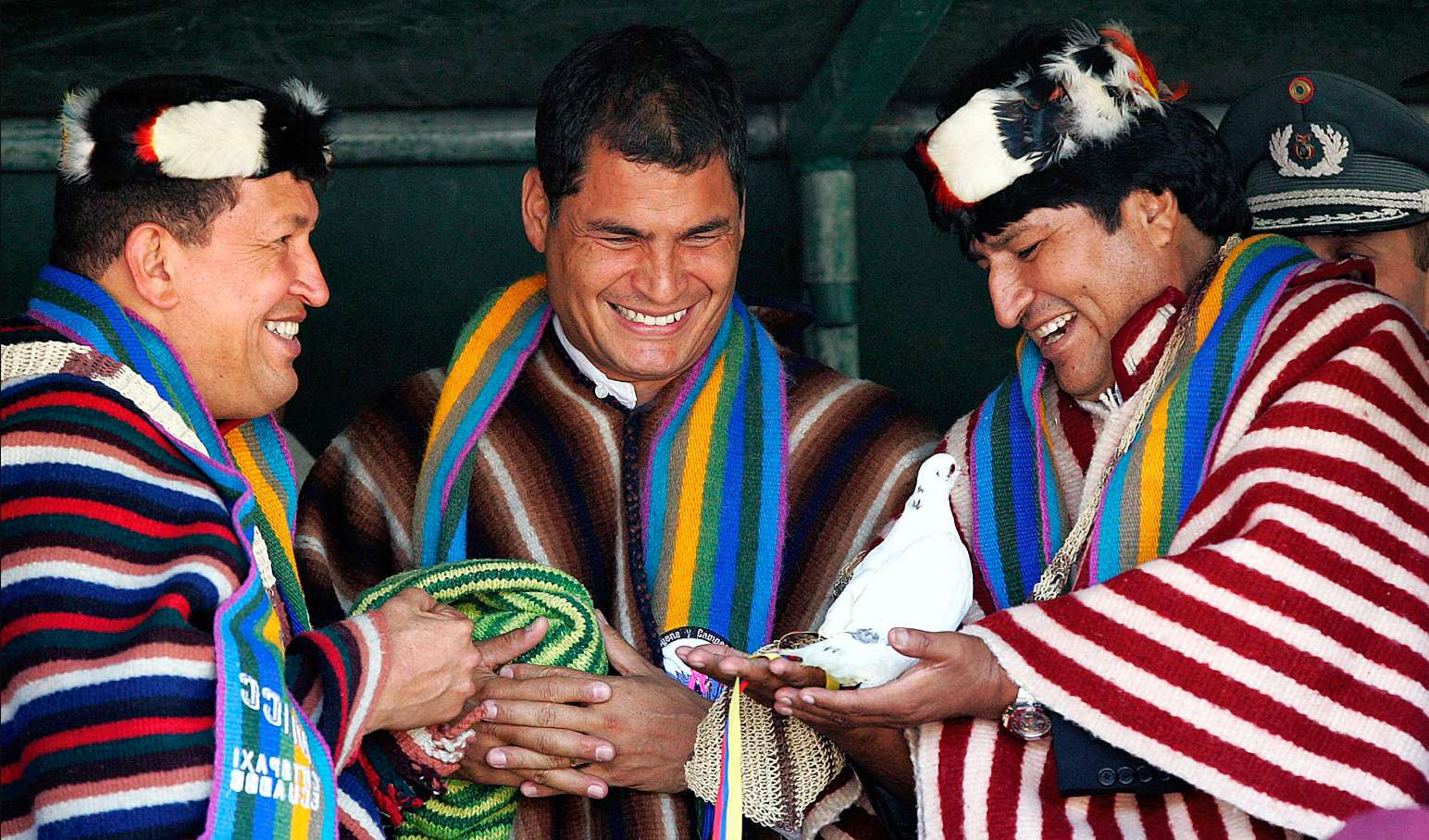
With the capture of Nicolás Maduro, it is pertinent to ask whether this marks the end of the wild years of left-wing populism that began at the start of this century. The question is unavoidable, among other reasons, because this wave began with an anti-American, anti-globalization, and anti-neoliberal discourse: that of Hugo Chávez.
From these guidelines emerged what came to be called twenty-first-century socialism—a wave of left-wing populisms that, in general terms, was marked by a set of discourses and social policies presented as progressive alternatives to the inequalities produced by neoliberal practices implemented in the region toward the end of the twentieth century.

To fulfill its promise of social equality and the radicalization of democracy, this form of populism relied on personalistic leaderships that believed they embodied the popular will through a discourse of moral polarization that divided society between “the people” and “the elite”—something also present in the rhetoric of far-right populist leaders. Added to this were social programs aimed at redistributing wealth and expanding mechanisms of citizen participation.
Although this populist current—also referred to at the time as the “pink tide”—experienced advances and setbacks in the region, its effects, both theoretical and practical, during this first quarter of the century have been intense in Latin America and globally. It would therefore not be an exaggeration to say that we have witnessed the wild years of left-wing populism.
In practice, electoral victories turned these movements into a social force that generated a whirlwind of disputes, attacks, controversies, and political, academic, and everyday debates. In its theoretical dimension, the analysis of this populism has left us with grandiloquent defenses, a diversity of definitions, heterogeneous theoretical approaches, hard data used to defend or criticize it, and the occasional conciliatory perspective.
At the center of this populist whirlwind lies the debate over its relationship with democracy: some are convinced that left-wing populism is a clear threat to democracy, while for others it expresses both the promise of inclusion of popular sectors and the fragility of democratic institutions.
Although there may be a broad spectrum between these two poles, this left-wing wave teaches us that populism—whether from one side or the other—cannot be conceived as an anomaly, as something that would not exist if democracy “worked well.” On the contrary, the intensity of the debate and its social penetration reveal that populism—in its different faces—is one of the recurring grammars of Latin America’s political history. Thus, given its sweeping passage and polarizing character, both in university classrooms and in street conversations, it seems necessary to undertake a critical assessment of the mistakes that have led this left-wing populism into dead ends.
In the case of Bolivia, a populist movement developed—the MAS, initially led by Evo Morales—which vindicated the necessary symbolic and political inclusion of historically marginalized sectors, one of populism’s positive traits. However, this example also revealed one of the main weaknesses of left-wing populism: excessive dependence on the figure of the leader and the difficulty of distinguishing between personalistic and democratic projects.
In Mexico, although we can speak of a left-wing populism that is decidedly redistributive and respectful of certain democratic rules of the game, the moral construction of a “good people” and its “enemies” showed that, while it does not destroy democracy, it wears it down by polarizing society and generating tensions between the government and autonomous bodies, the press, and civil society—something also observable in contemporary far-right populisms.
Venezuela may be, for having shown the path to other Latin American countries, the archetypal model. Although it began with a narrative of “participatory democracy” that shook its political and social gears—at least suggesting that the promise of transforming democracy could be real—that same discourse ultimately justified the progressive concentration of power.
Left-wing populism has the quality of challenging democracy, as it forces it to reconsider who is recognized as part of “the people” and who is left outside its promise of equality. However, these populist movements ended up creating their own paradoxical conditions: either they left structures intact while covering them with a moralizing discourse, or they revealed their incapacity to give political space to those they claim to represent.
This paradoxical condition of left-wing populism in power compels us to ask whether it has exhausted its capacity to offer equality and a future, or whether it will be able to remake itself without devouring itself.
If these wild years of left-wing populism—like those of the right—have left us with anything, it is that they are a reflection of the profound political crisis in which we live. Therefore, if they cannot sustain their promise of improving democracy, what should we do?
Autor

PhD in Political Philosophy. Research Professor at Anáhuac University Mexico. Adjunct Professor at the Faculty of Philosophy and Letters, UNAM. Academic Coordinator of the “Democratic Narratives” Project at UNAM.