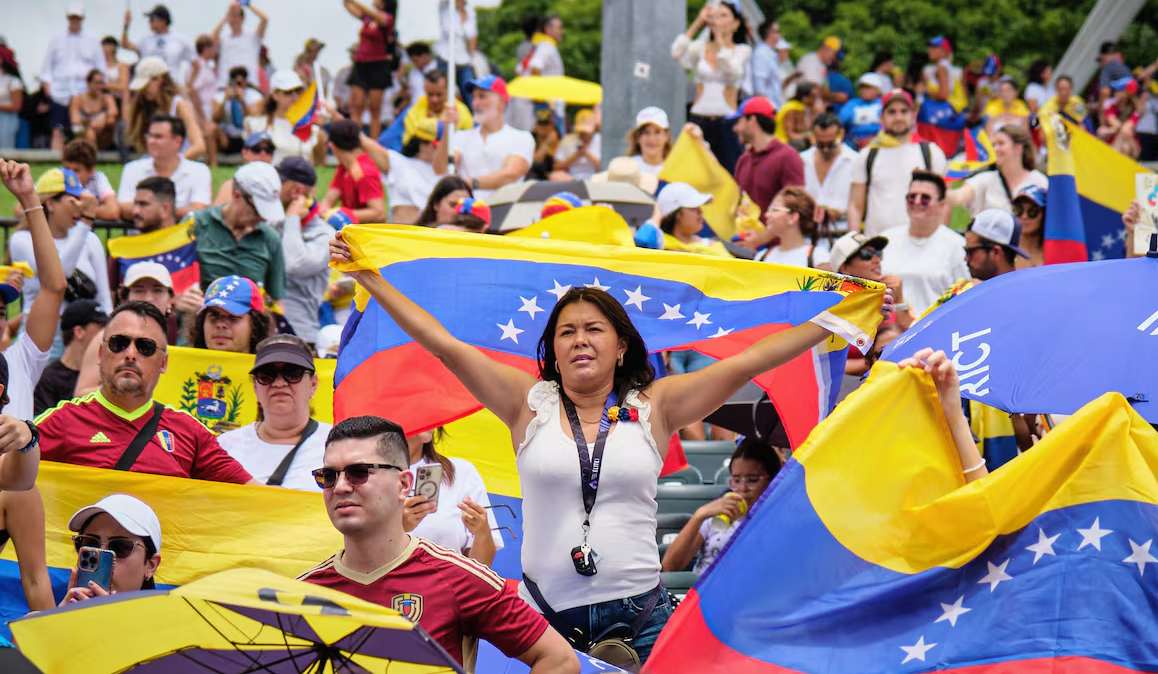
January 2026 opened an exceptional phase for Venezuela: a reconfiguration of power, international pressure, and a horizon of transition once again framed in terms of “stabilization, recovery, and elections.” But there is a blind spot that could undermine the legitimacy and viability of any roadmap: the Venezuelan diaspora.
We are not talking about a “social detail” or a secondary agenda. We are talking about around eight million citizens who did not cease to be Venezuelan when they crossed a border, and whose rights to identity, participation, and representation have been restricted. If the transition seeks to restore democracy, it must begin by recognizing the full demos.

The major omission
The diaspora did not emerge by choice. For years, Venezuela expelled its population amid the collapse of material living conditions and social coexistence: the closing of plural space, persecution of dissent, and the destruction of productive capacity and basic services. All of this was compounded by a perverse state policy toward its emigrant nationals: denial of the phenomenon, precarious consular services, costly procedures, and barriers to identity and political participation.
The result is a fractured citizenry: people with family, social, and economic ties to the country, who closely follow what is happening and who, in many cases, want to return, but who are treated as if their citizenship were “second-class” for having left. In a transition, this fracture becomes a public policy problem, not just a matter of justice: it weakens legitimacy and opens space for new forms of exclusion and institutional capture.
We propose a hypothesis: incorporating the diaspora into the design of the transition—through inclusion and return as public policy—has a triple, immediate, and measurable utility. First, it expands democratic boundaries: it extends the effective political community and strengthens popular sovereignty beyond territorial control. Second, it revitalizes institutions: it brings state capacity based on merit and integrity at a stage when the state must function, not merely promise. Third, it accelerates technical and productive capacities: it mobilizes human capital, networks, and privately sourced financing to reactivate the economy and services.
“Measurable” implies accountability: documentation and electoral participation abroad, restoration of capacities through merit-based and integrity-driven processes, and investment channeled with traceability. Put plainly, the diaspora is not only a “victim” or a “remittance,” but an asset for democratic governance.
External voting: The democratic wall
In contexts of institutional capture or coercion, voting within the territory can be distorted by fear, dependency, or de facto control. Voting abroad, by contrast, can operate as a reserve of citizen sovereignty less vulnerable to intimidation. Guaranteeing it is not a symbolic gesture: it is an anchor of legitimacy.
Meritocracy: Security is also state capacity
Every transition is played out on two boards: the political (agreements, rules, elections) and the administrative (a functioning state). Without minimal state capacity—operational critical services, manageable public finances, enforceable integrity rules—stabilization becomes fragile and easily captured.
Here, the diaspora can “revitalize” institutional life: professionals with experience in a wide range of fields, from public administration to infrastructure, energy, health, or education, contributing to the rebuilding of capacities under verifiable criteria of merit, transparency, and traceability.
This approach helps move beyond the false dilemma between “working through forgetting” and “witch hunts.” Institutional reconstruction requires cleansing, but above all meritocratic rebuilding: competitive selection processes, protection of technical functions, integrity standards, and results-oriented management. In practice, this is democratic security: it reduces dependence on clientelist networks and strengthens the nation’s resilience.
Diaspora capital: Early investment, gradual trust
Recovery will not be financed solely through major announcements. It requires early investment, networks, applied knowledge, and mechanisms to rebuild trust. The diaspora can provide “patriotic risk capital”: direct investment, commercial networks, technology transfer, financing for SMEs, and technical assistance for local reconstruction.
This contribution does not replace macroeconomic reforms or state policies, but it can reduce debt pressures, accelerate productive linkages, and improve the quality of reconstruction in a context of fiscal constraints and social urgency.
From discourse to design: enabling conditions
Translating this thesis into public policy requires three minimum conditions. First, an institutional architecture that coordinates identity, electoral registration, reintegration, and investment, with clear leadership and intersectoral coordination. Second, integrity and transparency standards that block capture and corruption, ensuring traceability in procedures, beneficiaries, procurement, and funds. Third, verifiable, phased targets so that diaspora inclusion does not remain well-intentioned rhetoric or become a new space for unlimited discretion. This makes it possible to anticipate risks—backlash, capture, and bottlenecks—and incorporate safeguards from the outset. These risks do not argue against inclusion; they require designing it well.
If the transition is structured in phases of stabilization, recovery, and elections, the diaspora agenda must be translated into concrete, verifiable measures with clearly defined responsibilities for each stage.
The first phase, stabilization, requires guaranteeing identity and documentation through accessible and efficient consular services, reducing cost and time barriers. It also requires opening and updating the external electoral registry, with clear access and auditable timelines, and providing priority protection to highly vulnerable populations in host countries, especially in South America.
The second phase, recovery, should focus on voluntary, safe, and dignified return, accompanied by processes of social and labor reintegration; recognition of credentials through the homologation of degrees and experience to leverage human capital; and the creation of a diaspora investment window with simple rules, minimal guarantees, and transparency to channel productive investment and support local reconstruction.
Finally, the third phase, elections, involves ensuring full external voting with guarantees and promoting effective political participation that opens a discussion on diaspora representation so that citizenship and democracy do not end at the border.
A transition without the diaspora is born incomplete
Popular sovereignty does not end when crossing a border. Without rights there is no citizenship; without citizenship there is no democracy; and without the diaspora there is no fully legitimate transition.
Venezuela will not be able to rebuild itself as a democracy if it begins by repeating the logic of exclusion that deepened its crisis. Recognizing the diaspora is not only a matter of justice: it is about governability, state capacity, and recovery. A Law of Return and National Reconciliation is needed to complement the Amnesty Law and transform political change into the country’s real reintegration with itself.
None of this is an institutional utopia: there are comparative experiences of return, external voting, and representation in countries such as Ecuador, Spain, or Italy. The central point is to embrace the principle: the transition will be inclusive—or it will be fragile.
Autor

PhD in Public Policy, Strategies, and Development from the Federal University of Rio de Janeiro (UFRJ). He is the founder and president of the NGO Venezuela Global, based in Rio de Janeiro, Brazil.

Researcher at the University of the Pacific, Peru. Master's degree in Government and Public Management in Latin America from Pompeu Fabra University, Spain. Specialist in International Finance with a Diploma in International Politics.